Making notes and summaries
Introduit| English | Sens |
|---|---|
| summary/ˈsʌməri/ | a short version of a text that keeps only the main points |
| main point | one of the most important ideas in a text |
| notes | short words and phrases recording the main points, not full sentences |
The Great Fire of London, 1666
- On 2 September 1666 a fire started in a bakery on Pudding Lane. A strong wind spread it through the wooden houses. It burned for about four days and destroyed more than 13,000 houses and old St Paul's Cathedral.
- That is a long story in three sentences. A summary 摘要 keeps only the main points 要点, in your own words.
Where did the Great Fire of London start?
Difficulté 1/5 · 100 pièces + un petit bonus lors de la première réussite aujourd'hui
On 2 September 1666.
Taking the main points
- Read the task first: what must the summary be about? Only collect points on that topic.
- Underline each separate point. Ignore examples, repeated ideas and small details.
You should read the summary task before you collect points.
Difficulté 1/5 · 100 pièces + un petit bonus lors de la première réussite aujourd'hui
Only collect points on that topic.
What should you leave out of a summary?
Difficulté 2/5 · 140 pièces + un petit bonus lors de la première réussite aujourd'hui
Keep only the main points.
Make short notes
- Notes 笔记 are short: a few words for each point, not full sentences.
- One point per line. Use your own words where you can.
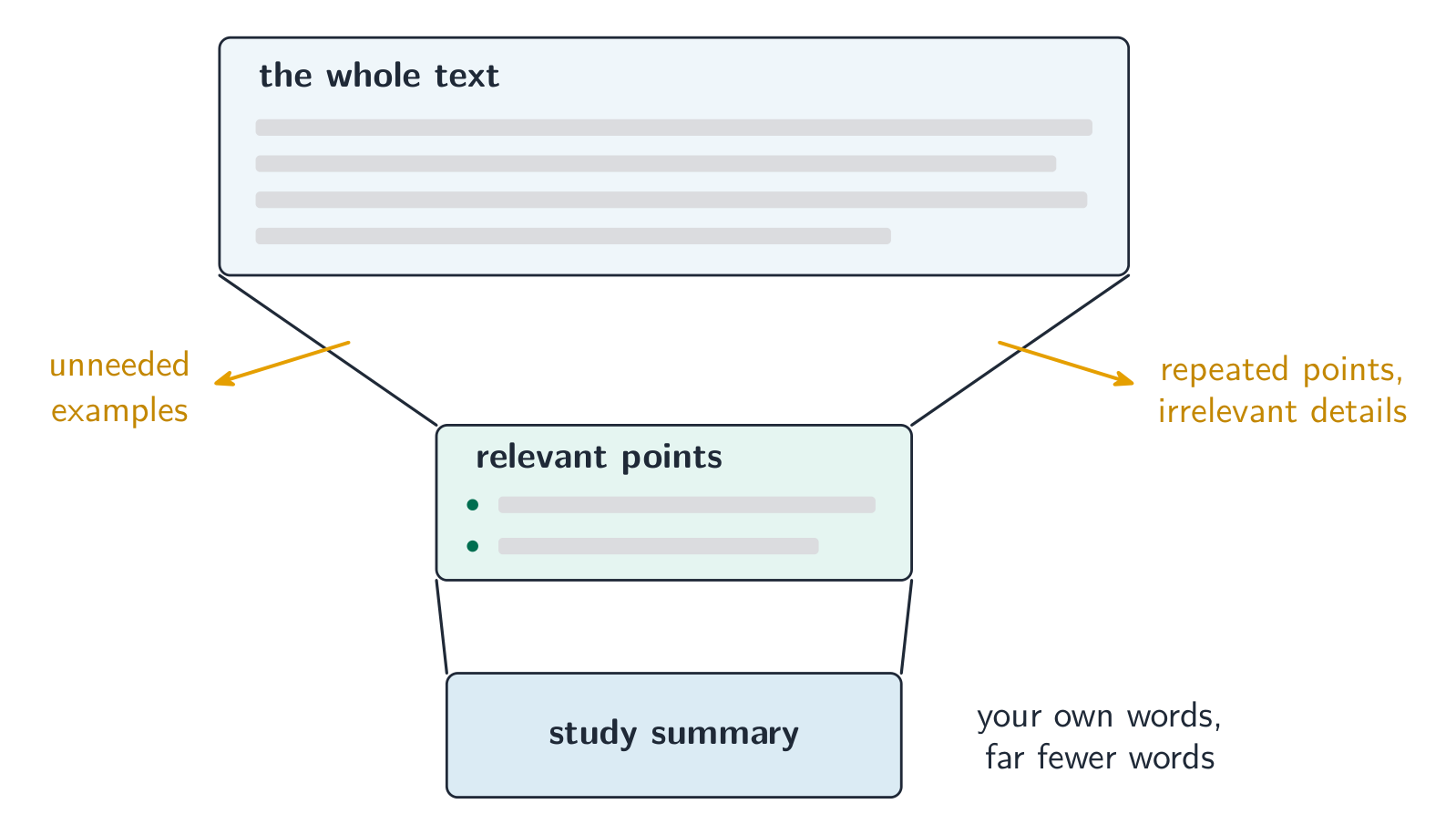
From text to summary, step by step
Find the points, drop the examples, then rewrite the points in your own words.
Which is the best note?
Difficulté 1/5 · 100 pièces + un petit bonus lors de la première réussite aujourd'hui
Short, one point, no opinion.
From notes to summary
- Join the notes into sentences with linking words: also, because, as a result.
- Keep to the word limit and do not add your own opinions.
You may add your own opinion to a summary.
Difficulté 1/5 · 100 pièces + un petit bonus lors de la première réussite aujourd'hui
Report the text only.
Worked example: why the fire spread
"The summer of 1666 had been very dry. Most houses were made of wood and stood close together. A strong east wind blew for days. People often ran to save their belongings instead of fighting the flames."
- Task: summarise why the fire spread.
- Notes: dry summer; wooden houses close together; strong wind; people saved goods, not fought fire.
- Summary: "The fire spread because a dry summer left the city's crowded wooden houses ready to burn. A strong wind also pushed the flames, and many people saved their belongings instead of fighting the fire."
Which are reasons the fire spread?
Difficulté 2/5 · 140 pièces + un petit bonus lors de la première réussite aujourd'hui
The name is a detail.
Cut and combine
- Join two similar points into one sentence. Cut words like very and really.
- Count your words at the end.
Do not copy whole sentences. Copying wastes words and does not show understanding. Change the wording, but keep the meaning.
Copying whole sentences is a good way to summarise.
Difficulté 1/5 · 100 pièces + un petit bonus lors de la première réussite aujourd'hui
Use your own words.
Read the task, collect only the relevant main points, write short notes, then join them into sentences in your own words with linking words. Keep to the word limit and add no opinions.
Summarise in one sentence why people like cycling to work: "Cycling is cheaper than driving. It also keeps people fit. Many riders say it is faster than the bus in city traffic. Some enjoy the fresh air."
Points, words, link.