Properties of metals
Introduit| English | Sens |
|---|---|
| malleable/ˈmæləbl/ | Able to be hammered or bent into shape without breaking. |
| conductors/kənˈdʌktəz/ | conducteurs |
| ductile/ˈdʌktaɪl/ | malléable |
A statue's skin of hammered copper, 1886
- The Statue of Liberty, finished in New York in 1886, is covered in copper sheets only about 2.4 mm thick — roughly two coins. Workers in Paris hammered the sheets into shape over wooden moulds, a technique called repoussé. The metal bent and stretched without cracking.
- Copper could be shaped like this because metals are malleable 有延展性的. Their properties come from how their atoms are bonded.
Metal property lab
Link metal properties to the particle model.
Which property let workers hammer the Statue of Liberty's copper into shape?
Difficulté 1/5 · 100 pièces + un petit bonus lors de la première réussite aujourd'hui
It bends without cracking.
Physical properties of metals
- Metals are good conductors 导体 of heat and electricity, malleable (hammered into shape), ductile 可拉成丝的 (drawn into wires), and usually shiny with high melting points.
- Non-metals are usually poor conductors, brittle when solid, and have lower melting points (graphite is an exception: it conducts).
Liaison métallique
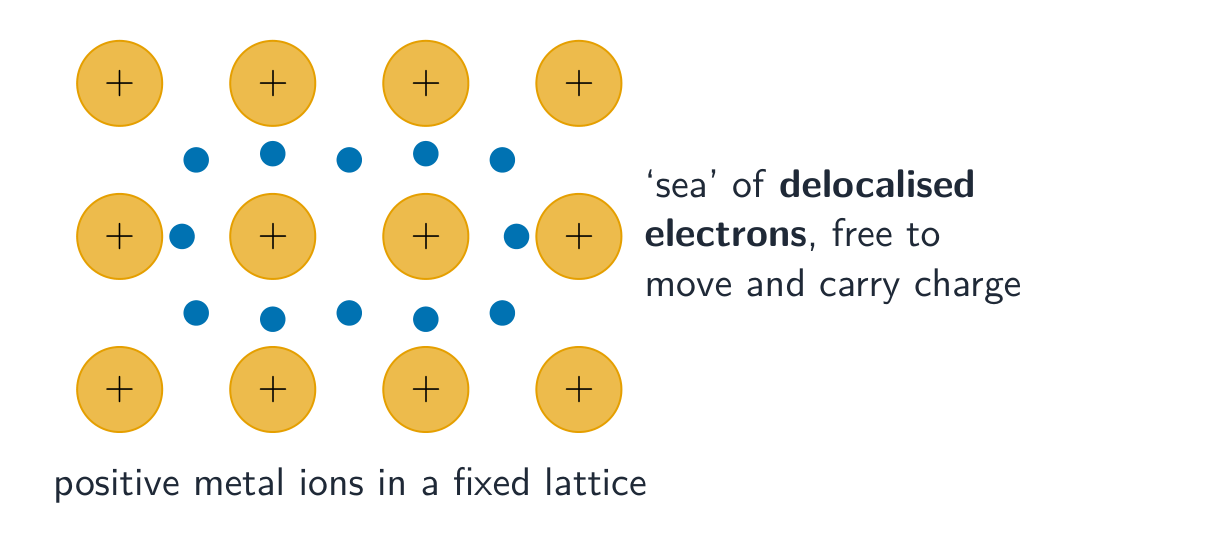
Positive ions sit in a sea of delocalised electrons — that is why metals conduct and bend. Push the layers and the bond holds.
Match each property to its meaning.
Difficulté 2/5 · 140 pièces + un petit bonus lors de la première réussite aujourd'hui
Three metal properties.
Graphite is a non-metal that conducts electricity.
Difficulté 1/5 · 100 pièces + un petit bonus lors de la première réussite aujourd'hui
An exception.
Metallic bonding
- A metal is a lattice of positive ions in a "sea" of delocalised electrons. The bond is the attraction between the positive ions and the moving electrons.
- Electrons can move through the structure, so metals conduct electricity; layers of ions can slide over one another without breaking the bonds, so metals are malleable.
What is metallic bonding?
Difficulté 1/5 · 100 pièces + un petit bonus lors de la première réussite aujourd'hui
Ions in a sea of electrons.
Chemical properties
- Many metals react with dilute acids to give a salt and hydrogen: Mg + 2HCl → MgCl₂ + H₂.
- Reactive metals react with water or steam; metals react with oxygen to form basic oxides.
What gas forms when magnesium reacts with dilute hydrochloric acid?
Difficulté 1/5 · 100 pièces + un petit bonus lors de la première réussite aujourd'hui
Mg + 2HCl → MgCl₂ + H₂.
Worked example: explain two properties
Explain why copper is used for electrical wires.
- Property 1 (conducts): delocalised electrons move through the lattice when a voltage is applied.
- Property 2 (ductile): layers of ions slide over each other, so copper can be drawn into thin wires without breaking.
- Link: both come from metallic bonding — the electrons are not fixed to one atom.
Why is copper used for wires?
Difficulté 2/5 · 140 pièces + un petit bonus lors de la première réussite aujourd'hui
Both from metallic bonding.
Metal or non-metal?
- Test an unknown solid: does it conduct as a solid? Does it bend or shatter when hit? Is its oxide basic or acidic?
- No single test decides — graphite conducts but is a non-metal.
Metals do not conduct because of "free ions". In a solid metal the ions stay in place; it is the delocalised electrons that move and carry the current.
In a solid metal, moving ions carry the electric current.
Difficulté 1/5 · 100 pièces + un petit bonus lors de la première réussite aujourd'hui
Delocalised electrons carry it.
Metals conduct, are malleable and ductile, and have high melting points because of metallic bonding: positive ions in a sea of delocalised electrons. Many react with acids to give hydrogen and with oxygen to give basic oxides.
Use metallic bonding to explain why metals are malleable but ionic solids like sodium chloride are brittle.
Structure explains properties.