Ions and ionic bonds
Introduit| English | Sens |
|---|---|
| ion/ˈaɪɒn/ | ion |
| cation/ˈkætaɪən/ | cation |
| anion/ˈænaɪən/ | anion |
| ionic bond/aɪˈɒnɪk bɒnd/ | liaison ionique |
Atoms that gain or lose electrons
- Atoms are happiest with a full outer shell. Many achieve this by giving away or taking electrons.
- An atom that has gained or lost electrons becomes a charged ion 离子.
When a metal atom forms an ion, it:
Difficulté 1/5 · 100 pièces + un petit bonus lors de la première réussite aujourd'hui
Metals lose electrons, becoming positive.
A non-metal atom gains electrons to form a ______ ion.
Difficulté 1/5 · 100 pièces + un petit bonus lors de la première réussite aujourd'hui
Extra electrons give a negative charge.
Forming ions
- A metal atom loses outer electrons to form a positive ion (cation 阳离子).
- A non-metal atom gains electrons to form a negative ion (anion 阴离子).
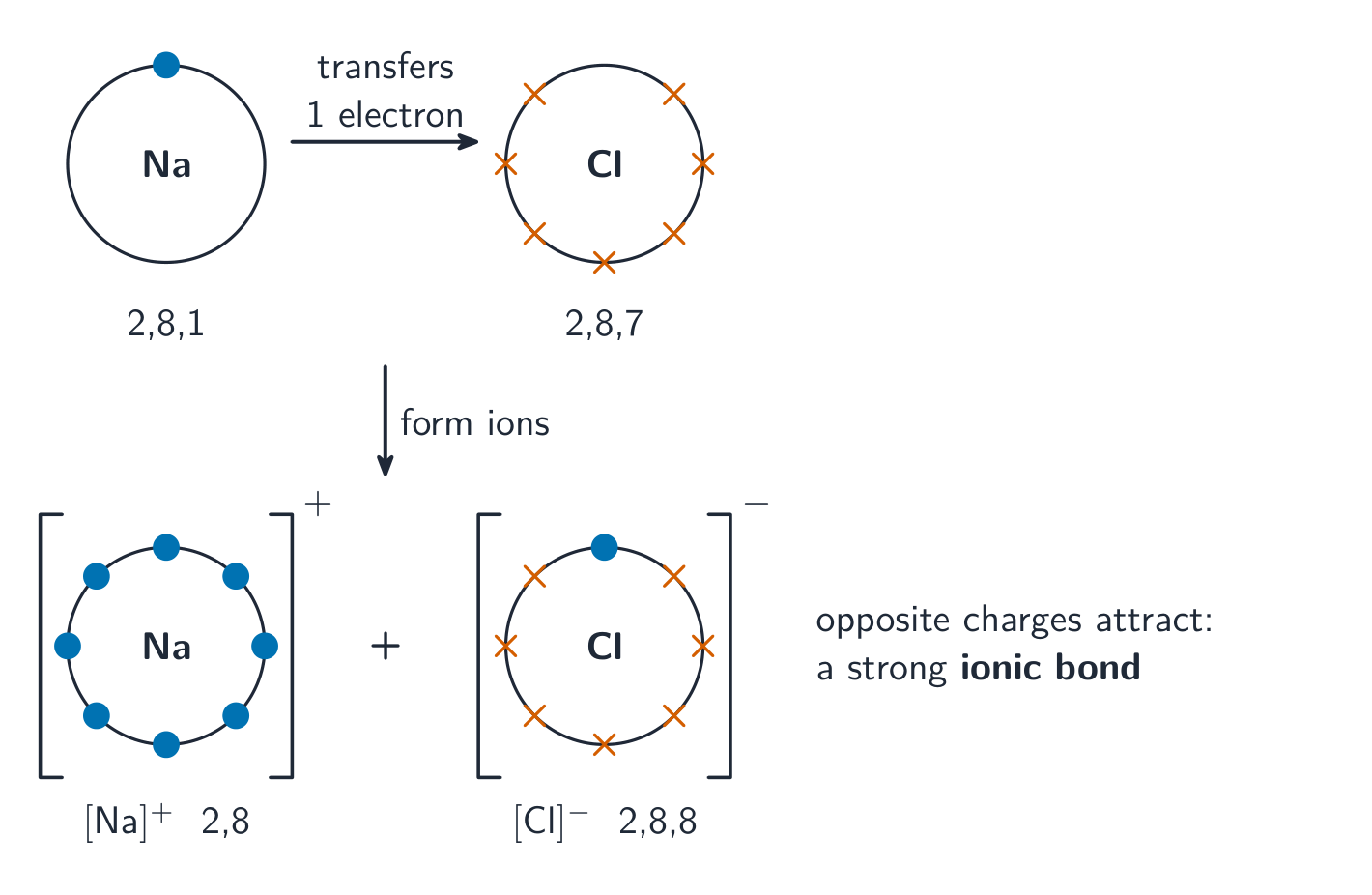
Sodium gives its outer electron to chlorine; both reach full outer shells and the opposite charges attract
Formation d'une liaison ionique (NaCl)
Step through it. A metal hands its outer electron to a non-metal; the oppositely charged ions then attract and pack into a giant lattice.
Liaison ionique (transfert d'électron)
Step through it: the metal hands its outer electron(s) to the non-metal, both reach full shells, and the resulting + and − ions attract — an ionic bond.
An ionic bond is the attraction between:
Difficulté 1/5 · 100 pièces + un petit bonus lors de la première réussite aujourd'hui
Oppositely charged ions attract.
In ionic bonding, electrons are transferred from the non-metal to the metal.
Difficulté 1/5 · 100 pièces + un petit bonus lors de la première réussite aujourd'hui
False. The metal loses electrons to form a positive ion and the non-metal gains them to form a negative ion.
Ionic bonding 离子键
- An ionic bond is the strong attraction between oppositely charged ions.
- Electrons transfer from the metal to the non-metal, and the ions then attract.
Worked example. Sodium (2,8,1) gives its 1 outer electron to chlorine (2,8,7). Sodium becomes Na⁺ and chlorine becomes Cl⁻. The opposite charges attract — an ionic bond in sodium chloride.
An element in Group I forms an ion with a charge of:
Difficulté 1/5 · 100 pièces + un petit bonus lors de la première réussite aujourd'hui
Group I loses 1 electron → +1.
Working out the charge
- The charge equals how many electrons are lost or gained.
- Group I → +1, Group II → +2; Group VII → −1, Group VI → −2.
Metals lose, non-metals gain. Losing electrons leaves more protons than electrons → a positive ion. Gaining electrons gives more electrons than protons → a negative ion.
Worked example: magnesium oxide
Magnesium (2, 8, 2) reacts with oxygen (2, 6). Describe the bonding.
- Magnesium loses its 2 outer electrons → Mg²⁺ (2, 8). Oxygen gains 2 electrons → O²⁻ (2, 8). Both now have a full outer shell, like neon.
- In a dot-and-cross diagram, draw Mg²⁺ with an empty outer shell (or just 2, 8) and O²⁻ with 6 dots and 2 crosses, each in square brackets with its charge.
- The 2+ and 2− charges cancel, so the formula is MgO. Compare sodium chloride: Na⁺ and Cl⁻, one electron moves, formula NaCl.
Calcium (Group II) reacts with chlorine (Group VII). What is the formula of the compound formed?
Difficulté 1/5 · 100 pièces + un petit bonus lors de la première réussite aujourd'hui
Ca loses 2 electrons (Ca²⁺); each Cl gains 1 (Cl⁻). Two Cl⁻ balance one Ca²⁺.
What is the electronic configuration of an oxide ion, O²⁻?
Difficulté 1/5 · 100 pièces + un petit bonus lors de la première réussite aujourd'hui
Oxygen (2, 6) gains 2 electrons to fill its outer shell: 2, 8.
You've got it
- an ion is a charged atom that has lost or gained electrons to fill its outer shell
- metals lose → positive ions; non-metals gain → negative ions
- an ionic bond is the attraction between oppositely charged ions
Write from the data given
- A magnesium atom has 12 electrons.
- It loses the two electrons in its outer shell and forms an ion.
What is the charge on the ion?
Losing electrons leaves a positive ion.
What is the charge on this magnesium ion?
Difficulté 1/5 · 100 pièces + un petit bonus lors de la première réussite aujourd'hui
Two lost electrons give a 2+ charge. Other options — 2− (as if electrons were gained); 1+ (the sodium ion).