Ethical design, data and evaluation
Introduit| English | Sens |
|---|---|
| ethical guidelines | rules that researchers follow to protect participants, such as consent, right to withdraw and confidentiality |
| informed consent/ɪnˈfɔːmd kənˈsent/ | Voluntary agreement to participate after receiving and understanding information about what participation involves and its relevant risks. |
| right to withdraw | Participants may leave a study at any time. |
| debriefing | Telling participants the full aims after a study. |
| anonymised | Processed so individuals cannot reasonably be identified from the data, rather than merely replacing their names with reversible codes. |
| operationalise | to define a variable precisely in terms of how it will be done or measured |
| descriptive statistics/dɪˈskrɪptɪv stəˈtɪstɪks/ | Numbers that summarise data, such as the mean and standard deviation. |
| inferential test | a statistical test that shows whether a difference or relationship in data is likely to be due to chance |
An experiment that changed the rules, 1963
- In 1963 Stanley Milgram reported that 26 of 40 men obeyed an experimenter's orders to give what they believed were dangerous electric shocks to another person. The shocks were fake, but many participants sweated, trembled and protested.
- In 1964 the psychologist Diana Baumrind argued that the stress and deception harmed participants. Debates like this led to the ethical guidelines 伦理准则 every psychology study now follows.
In Milgram's 1963 report, how many of the 40 participants obeyed to the end?
Difficulté 2/5 · 140 pièces + un petit bonus lors de la première réussite aujourd'hui
26 of 40, or 65%.
Ethics in your experiment
- Informed consent 知情同意: participants know what the study involves and agree; for under-16s, a parent or guardian consents too. Right to withdraw 退出权: they may leave at any time.
- Debriefing 事后说明: after the study, explain its aim. Keep data anonymised 匿名化 and confidential, and cause no harm or undue stress.
Match each guideline to its meaning.
Difficulté 2/5 · 140 pièces + un petit bonus lors de la première réussite aujourd'hui
Each guideline protects participants.
For participants under 16, a parent or guardian should also consent.
Difficulté 1/5 · 100 pièces + un petit bonus lors de la première réussite aujourd'hui
Younger participants need extra protection.
Designing the experiment
- Your experiment changes one IV and measures one DV. Operationalise 操作化 each: say exactly how it is done and measured — "number of words correctly recalled in two minutes".
- Choose a design: independent samples (different people in each condition) or repeated measures (the same people in both), and justify the choice.
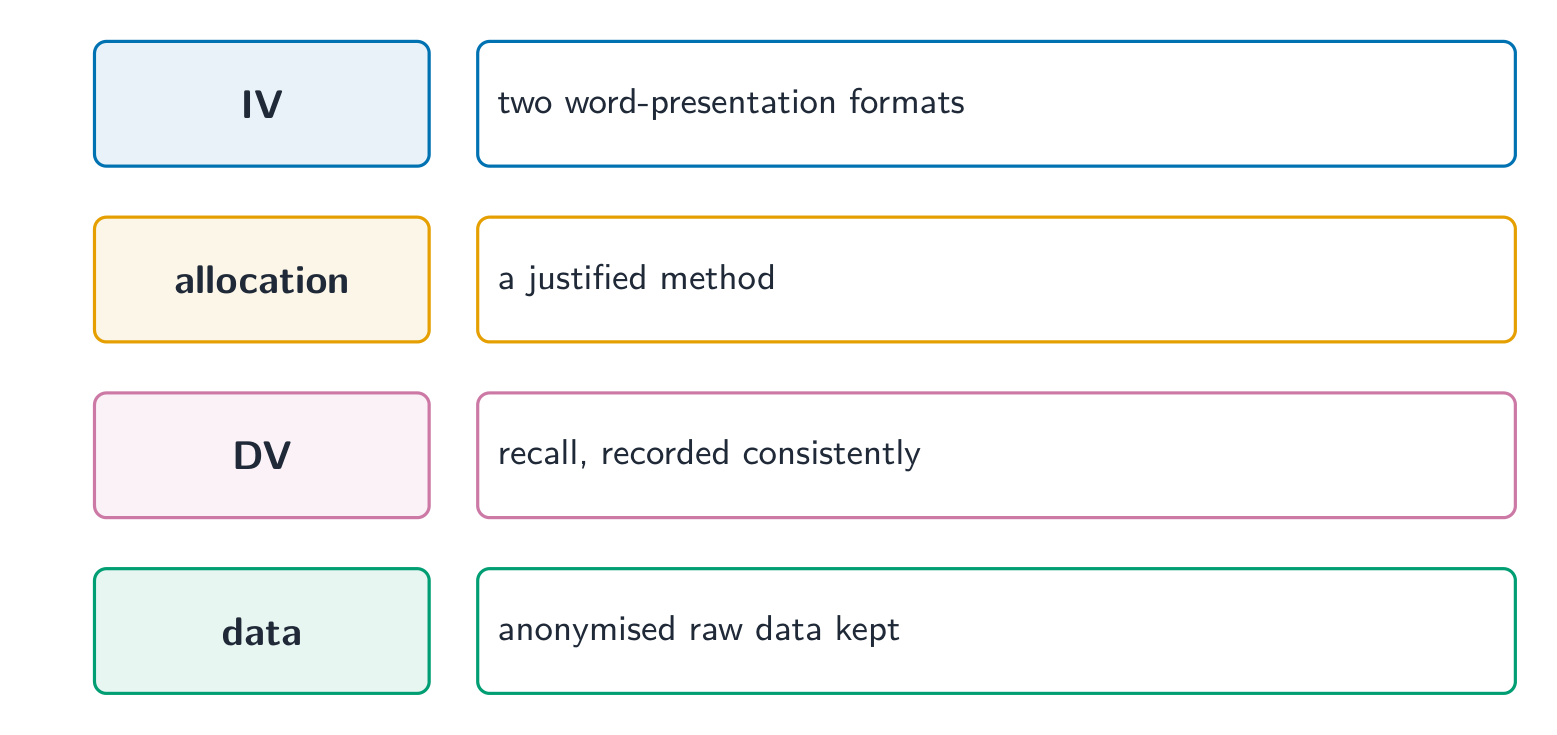
Which DV is operationalised?
Difficulté 1/5 · 100 pièces + un petit bonus lors de la première réussite aujourd'hui
Operationalising says exactly how it is measured.
Worked example: words or pictures?
Aim: does presenting words as pictures improve recall? (Based on dual-coding theory, Paivio, 1971.)
- IV: 20 concrete nouns shown as written words or as simple pictures. DV: number correctly written down in two minutes.
- Design: independent samples, because the same people cannot learn the same list twice; participants randomly allocated to conditions.
- Ethics and data: consent forms signed, right to withdraw stated, participants debriefed; results recorded by number, not name. Mean recall: words 9.4, pictures 12.1.
Why was an independent samples design chosen in the worked example?
Difficulté 1/5 · 100 pièces + un petit bonus lors de la première réussite aujourd'hui
Repeated measures would cause practice effects.
In the worked example, by how many words did mean recall improve with pictures?
Difficulté 2/5 · 140 pièces + un petit bonus lors de la première réussite aujourd'hui
12.1 − 9.4 = 2.7 words.
Descriptive and inferential statistics
- Descriptive statistics 描述统计 summarise data: mean, median, standard deviation, and a graph that compares conditions.
- An inferential test 推断统计检验 (such as a Mann–Whitney U test for independent samples) shows whether the difference is likely to be due to chance.
An inferential test shows whether a difference is likely to be due to chance.
Difficulté 1/5 · 100 pièces + un petit bonus lors de la première réussite aujourd'hui
Descriptive statistics summarise; inferential tests judge chance.
Evaluating your design
- Identify controls you used (same list, same time, same instructions) and remaining weaknesses: a small sample, participants who guessed the aim, a lab task unlike real learning.
- Suggest specific improvements: "use a larger, more varied sample from two schools".
"There were no ethical problems" is not enough. Show exactly how you met each guideline — consent, withdrawal, debriefing, anonymity, no harm — and keep the evidence, such as signed forms.
Plan an experiment with an operationalised IV and DV, a justified design and random allocation. Follow ethical guidelines — informed consent, right to withdraw, debriefing, anonymity, no harm. Summarise with descriptive statistics, test with an inferential test, and evaluate controls and limits.
Plan a simple experiment on whether background music affects reading comprehension, with IV, DV, design and two ethical steps.
IV, DV, design, ethics.