Evaluating qualitative and quantitative research
Introduit| English | Sens |
|---|---|
| quantitative/ˈkwɒntɪteɪtɪv/ | Based on numerical values, measurements or counts. |
| qualitative/ˈkwɒlɪteɪtɪv/ | Describing qualities or categories rather than numerical measurements. |
| transferable | able to apply to other, similar settings beyond the one studied |
| credibility/ˌkredɪˈbɪlɪti/ | The degree to which a source, claim or speaker deserves to be trusted. |
| reflexivity/ˌriːflekˈsɪvɪti/ | Examining how one's own position, assumptions and actions influence research or interpretation. |
| transferability/trænsˌfɜːrəˈbɪlɪti/ | transférabilité |
| triangulation | Using several methods or sources to check findings. |
Measuring how fast people walked, 1933
- In 1933 Marie Jahoda, Paul Lazarsfeld and Hans Zeisel published their study of Marienthal, an Austrian village where the factory had closed and most families were unemployed. They timed men walking down the main street: unemployed men walked more slowly and stopped more often than the employed.
- They also collected diaries, life stories and interviews, which showed days losing their structure: with no work to go to, time stopped being organised. The study combined quantitative 定量 and qualitative 定性 data.
What did the Marienthal researchers find when they timed men walking?
Difficulté 1/5 · 100 pièces + un petit bonus lors de la première réussite aujourd'hui
Time lost its shape for the unemployed.
Two kinds of data
- Quantitative data are numbers: walking speed, test scores, ratings. They allow comparison and statistics.
- Qualitative data are words, images and meanings: interviews, diaries, observations. They show how people interpret their experience.
Classify each piece of data.
Difficulté 2/5 · 140 pièces + un petit bonus lors de la première réussite aujourd'hui
Numbers versus meanings.
Judging an interview study
- A small interview study — say, six volunteers describing an experience — gives depth: how each person interprets it.
- But volunteer recruitment shapes whose views appear: people with strong feelings or free time are more likely to volunteer.
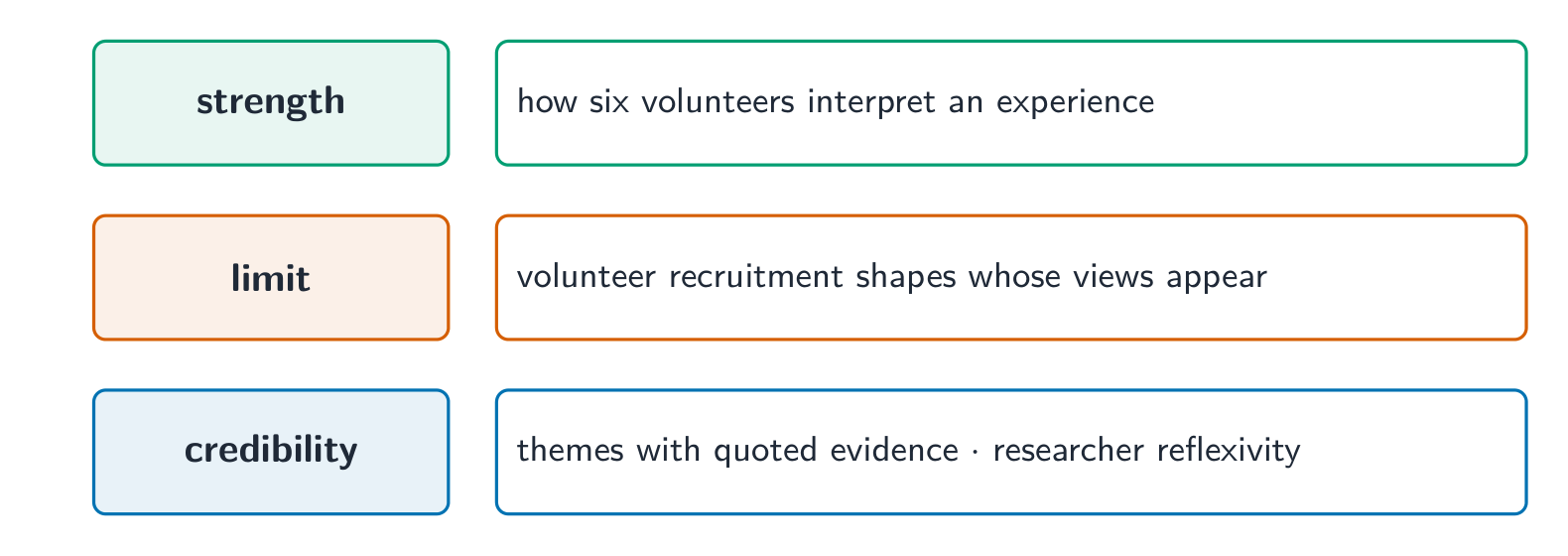
Volunteer recruitment can shape whose views appear in a study.
Difficulté 1/5 · 100 pièces + un petit bonus lors de la première réussite aujourd'hui
People with strong feelings or free time are more likely to volunteer.
Worked example: evaluating a qualitative study
An example study: six first-year university students who volunteered were interviewed about homesickness. Themes found: missing routines, food and family language.
- Strength: rich detail — one student said she phoned home "just to hear the kitchen noises" — showing what homesickness means to people.
- Limit: only six volunteers; students who felt worst or best may have chosen not to take part, so the themes may not be transferable 可迁移 to all students.
- Credibility: each theme is supported by quotations; the researcher, herself an international student, reports how her experience might shape her reading (reflexivity 反思性). A second researcher coding the same interviews would add credibility 可信度.
What is reflexivity in the worked example?
Difficulté 1/5 · 100 pièces + un petit bonus lors de la première réussite aujourd'hui
Reflexivity makes the researcher's position visible.
Criteria for each kind of research
- Quantitative research is judged by reliability (would the result repeat?), validity and generalisation to a population.
- Qualitative research is judged by credibility (do the themes match the data?), transferability (to similar settings) and reflexivity.
Match each criterion to the research it mainly judges.
Difficulté 2/5 · 140 pièces + un petit bonus lors de la première réussite aujourd'hui
Each kind of research has its own criteria.
Combining methods
- Triangulation 三角验证 combines methods, researchers or data sources. Marienthal's walking-speed times and diaries told the same story in two ways, strengthening both.
- In an essay, compare what each method can and cannot show for the same question.
Triangulation combines methods or data sources to strengthen conclusions.
Difficulté 1/5 · 100 pièces + un petit bonus lors de la première réussite aujourd'hui
Marienthal combined timings and diaries.
Do not judge a qualitative study by quantitative standards alone. "Only six people, so it is useless" misses its purpose. Ask whether the themes are credible and well evidenced, and to what settings they might transfer.
A qualitative study with six participants is useless.
Difficulté 1/5 · 100 pièces + un petit bonus lors de la première réussite aujourd'hui
Judge it by credibility and transferability.
Quantitative data give numbers for comparison; qualitative data show meaning. Judge quantitative research by reliability, validity and generalisation, and qualitative research by credibility, transferability and reflexivity. Triangulation combines methods to strengthen conclusions.
Design a study of exam stress that uses both quantitative and qualitative data, and give one strength of each.
Two methods, two strengths.