Stars, radiation and scale
Introduit| English | Sens |
|---|---|
| flux/flʌks/ | Flux radiant |
| luminosity/ˌluːmɪˈnɒsɪti/ | luminosité |
What would explain this observation?
- Two stars can have the same apparent brightness while having different luminosities. Distance changes the flux 辐射通量密度 reaching an observer.
Build the model
- Luminosity 光度 is total power emitted; flux is power received per area.
- A stellar spectrum carries information about surface temperature and composition.
- Fusion transfers energy as light nuclei combine.
- luminosity: Total emitted power.
- flux: Power received per unit area.

At fixed luminosity, what happens to flux when distance doubles?
Difficulté 1/5 · 100 pièces + un petit bonus lors de la première réussite aujourd'hui
Flux follows an inverse-square law, F proportional to 1/d^2, because the same luminosity spreads over a sphere of area 4 pi d^2. Doubling d gives 1/4 of the flux - not a half.
Match each technical term to its precise meaning.
Difficulté 2/5 · 140 pièces + un petit bonus lors de la première réussite aujourd'hui
Use the definitions to distinguish related quantities and processes.
Choose evidence that can test it
- For isotropic emission without absorption, flux follows an inverse-square relationship with distance.
- Observed brightness alone therefore cannot establish luminosity.
In the lab: Keep distance units consistent, identify which quantities are intrinsic to the star, and distinguish observational evidence from a model of stellar evolution. Do not confuse a red giant stage with every possible final remnant.
Which two habits make the investigation or model in this case more defensible?
Difficulté 2/5 · 140 pièces + un petit bonus lors de la première réussite aujourd'hui
Stating the conditions and assumptions lets others repeat the work exactly, and recording the supporting evidence lets them check the conclusion. Hiding disagreeing results removes the evidence that could challenge a wrong conclusion, and one measurement can never establish a wider claim.
Work from known quantities
- Known: distance doubles while luminosity remains fixed.
- Use F proportional to 1/d².
- Flux ratio = 1/2² = 1/4.
- A flux of 12 units becomes 3 units.
- This assumes no change in absorption or source output.
Your turn: A source gives flux 18 units. Find flux at three times the distance.
Distance, luminosity and apparent brightness
At unchanged luminosity, doubling distance reduces flux from 12 units to 3. Then compare a source four times as luminous at twice the distance: its apparent brightness matches the reference.
A source gives flux 18 units. Find flux at three times the distance.
Difficulté 2/5 · 140 pièces + un petit bonus lors de la première réussite aujourd'hui
The result is 2 . Known: flux 18 units at the original distance; distance triples. Use F proportional to 1/d^2. New flux = 18/3^2 = 18/9 = 2 units. This assumes constant luminosity and no extra absorption.
Check the conclusion and its limits
- The Sun is not expected to become a supernova.
- Redshift can support cosmological expansion; it does not mean every nearby object must move away from every observer.
Not true: Apparent brightness alone always determines a star luminosity. Apparent brightness depends on distance as well as luminosity (F = L/4 pi d^2). A dim-looking star may be very luminous but far away, so brightness alone cannot fix luminosity without a distance.
- Luminosity is total power emitted; flux is power received per area.
- For isotropic emission without absorption, flux follows an inverse-square relationship with distance.
- Watch for: the Sun is not expected to become a supernova.
Apparent brightness alone always determines a star luminosity.
Difficulté 1/5 · 100 pièces + un petit bonus lors de la première réussite aujourd'hui
Apparent brightness depends on distance as well as luminosity (F = L/4 pi d^2). A dim-looking star may be very luminous but far away, so brightness alone cannot fix luminosity without a distance.
Total emitted power: write the technical term.
Difficulté 1/5 · 100 pièces + un petit bonus lors de la première réussite aujourd'hui
luminosity means Total emitted power.
Write from a flux of 45 units
- An isolated source gives flux 45 units at distance r, with fixed isotropic luminosity and no absorption.
- Find the flux at three times the distance. Apparent brightness alone does not give luminosity.
An isolated source gives flux 45 units at distance r. With fixed isotropic luminosity and no absorption, what is the flux at three times the distance, and why does apparent brightness alone not give luminosity?
Flux ratio F₂/F₁ = (r/(3r))² = 1/9. Hence F₂ = 45/9 = 5 units. This assumes fixed isotropic luminosity and no absorption. Since F = L/(4πr²), the same apparent brightness can correspond to different luminosities at different distances.
An isolated star gives a flux of 45 units at distance r. In an inverse-square model with unchanged luminosity and no absorption, what is the flux at distance 3r?
Difficulté 1/5 · 100 pièces + un petit bonus lors de la première réussite aujourd'hui
3 squared is 9, and 45 divided by 9 is 5. Other options — 2 units (the lesson flux of 18 units at three times the distance); 45 units (the original flux).
Explain pressure support without freezing the gas
- Hydrostatic equilibrium means the net force on a stellar layer is approximately zero. Gravity acts inward. Pressure is greater on the layer's inner face than its outer face, so the pressure gradient provides an outward supporting force. Gas and radiation can both contribute. Equal pressure on all sides would not produce a net outward force, and equilibrium does not mean every particle stops moving.
- In the stable main-sequence feedback model, extra energy generation can expand the core; expansion cools it and reduces temperature-sensitive fusion. Reduced generation can allow contraction and heating. This regulation explains a stable stage, rather than proving every stellar state is stable or every star follows one path. Hydrostatic force balance and the balance of energy generation/transport are related questions with different meanings.
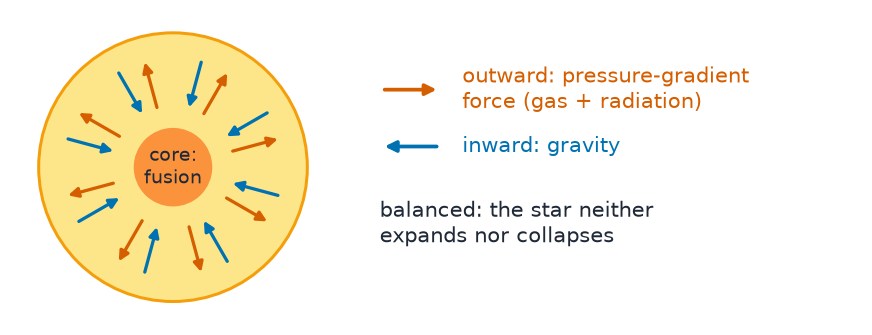
What gives a stellar layer its net outward pressure support?
Difficulté 1/5 · 100 pièces + un petit bonus lors de la première réussite aujourd'hui
The pressure gradient gives an outward force balancing gravity. Hydrostatic equilibrium does not mean microscopic motion stops.
Count the proton–proton chain correctly
- In the Sun's proton–proton chain, two protons form deuterium while a proton converts to a neutron through a weak interaction, emitting a positron and electron neutrino. Deuterium captures another proton to form helium-3 and a photon. Two such branches supply two helium-3 nuclei; these combine into helium-4 and return two protons. Net consumption is four protons, not the six entering the drawn intermediate branches.
- This is not spontaneous decay of an isolated proton and does not establish a stable two-proton nucleus. The net nuclear equation has helium-4, two positrons and two neutrinos as products. Positrons can subsequently annihilate with electrons. A quoted total including that annihilation must be distinguished from the nuclear step alone, and some energy escapes with neutrinos rather than heating the star.
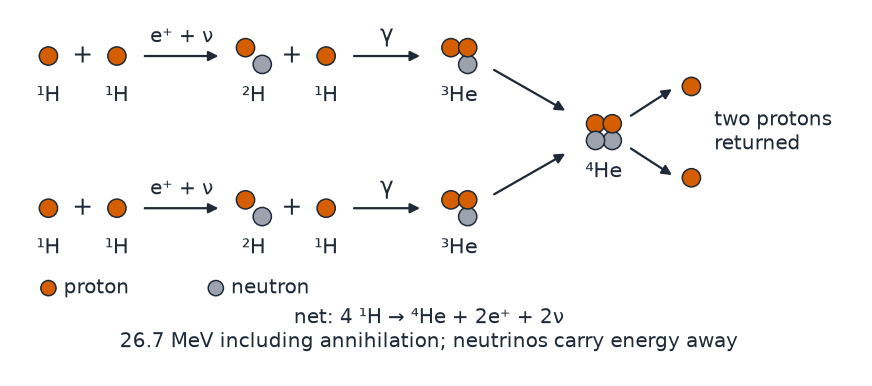
The drawn proton–proton chain uses two three-proton branches and returns two protons. How many protons are consumed net?
Difficulté 2/5 · 140 pièces + un petit bonus lors de la première réussite aujourd'hui
Six enter intermediate branches but two are returned: four are consumed to form helium-4, with positrons and neutrinos also produced.
Use atomic masses consistently for hydrogen burning
- With assigned atomic masses hydrogen-1 1.007825 u and helium-4 4.002603 u, the initial sum is $4(1.007825)=4.031300$ u. The difference is $0.028697$ u. Taking $1\ \mathrm{u}\,c^2=931.5$ MeV gives $Q=26.73$ MeV for the complete net accounting that includes positron annihilation; using bare proton, nuclear and positron masses without a consistent electron convention would answer a different energy question.
- The mass-conversion fraction is $0.028697/4.031300=0.007119$, about 0.71%. Most original mass remains in helium rather than disappearing. Positive released energy corresponds to a rest-energy decrease with total energy conserved. For a different fusion channel, use its own masses; a generic binding-energy trend does not guarantee every possible reaction releases the same energy or is exothermic.
Use hydrogen-1 atomic mass 1.007825 u, helium-4 atomic mass 4.002603 u and 1 u c² = 931.5 MeV. Find the complete net energy including positron annihilation.
Difficulté 2/5 · 140 pièces + un petit bonus lors de la première réussite aujourd'hui
Initial atomic mass is 4mH = 4(1.007825) = 4.031300 u. The defect is 4.031300 − 4.002603 = 0.028697 u. Thus Q = Δmc² = 0.028697 × 931.5 = 26.7312555 MeV ≈ 26.7 MeV. A nuclear-only equation with explicit positron rest masses has different intermediate energy accounting.
For initial mass 4.031300 u and mass difference .028697 u, find the percentage converted to released energy.
Difficulté 2/5 · 140 pièces + un petit bonus lors de la première réussite aujourd'hui
Converted fraction = Δm/minitial = 0.028697/4.031300 = 0.00711855. Multiply by 100 for 0.711855%, or 0.71% to two significant figures. Most initial mass remains in helium.
Separate consumed fuel from radiated mass-equivalent
- Using the assigned solar photon luminosity $L_\odot=3.83\times10^{26}$ W and $c=3.00\times10^8$ m/s, the photon mass-equivalent rate is $L_\odot/c^2=4.26\times10^9$ kg per second. This is an energy-outflow calculation, not a statement that the same mass of hydrogen is consumed each second. Most fuel mass remains in nuclear products.
- In an assigned simplified model with conversion fraction 0.0071, hydrogen consumption is $(4.26\times10^9)/0.0071\approx6.0\times10^{11}$ kg per second. Escaping neutrino energy and material carried away by a stellar wind are separate from the given photon luminosity. Keep the system boundary clear before calling a number the star's complete mass-loss rate.
Using photon luminosity 3.83 × 10²⁶ W and c = 3.00 × 10⁸ m/s, find the photon mass-equivalent rate in units of 10⁹ kg/s.
Difficulté 2/5 · 140 pièces + un petit bonus lors de la première réussite aujourd'hui
Photon mass-equivalent rate = L/c² = (3.83 × 10²⁶)/(3.00 × 10⁸)² = 4.25556 × 10⁹ kg/s. Enter the coefficient 4.25556, or 4.26 to three significant figures (4.3 to two). This excludes neutrino energy and material loss in a wind, and differs from fuel consumed.
Why is hydrogen consumption much larger than its converted mass-equivalent rate?
Difficulté 1/5 · 100 pièces + un petit bonus lors de la première réussite aujourd'hui
Only about .71% converts in the assigned H-to-He model. Most mass becomes helium; keep this separate from other escaping energy and material.
Estimate a lifetime and name the assumptions
- Assign effective available hydrogen fuel $0.10M_\odot$, with $M_\odot=1.99\times10^{30}$ kg and conversion fraction 0.0071. The energy budget is $E=0.10M_\odot(0.0071)c^2\approx1.27\times10^{44}$ J. Dividing by an assumed constant photon luminosity gives about $3.32\times10^{17}$ s, or $1.05\times10^{10}$ years using $3.16\times10^7$ s per year.
- This is a rough total main-sequence lifetime, not time remaining and not a claim that exactly 10% of a real star is pure hydrogen at one temperature. Luminosity changes during evolution and the available fuel fraction depends on stellar structure. More massive main-sequence stars have more fuel but often much greater luminosity, so their fuel is used much faster; more mass does not automatically mean a longer lifetime.
What does available fuel energy divided by an assumed constant luminosity estimate?
Difficulté 1/5 · 100 pièces + un petit bonus lors de la première réussite aujourd'hui
The approximation depends on effective fuel mass, conversion fraction and energy-outflow model. Initial mass alone does not specify remaining life.
Compare a classical barrier with actual stellar fusion
- The electrical potential energy for charges $+e$ separated by 2.0 fm is $U=ke^2/r$. With $k=8.99\times10^9\ \dfrac{\mathrm{N\,m^2}}{\mathrm{C^2}}$ and $e=1.60\times10^{-19}$ C, this is $1.15\times10^{-13}$ J, or 0.719 MeV using $1\ \mathrm{MeV}=1.60\times10^{-13}$ J. With Boltzmann constant $k_B=1.38\times10^{-23}$ J/K, equating it to mean thermal energy $3k_BT/2$ would require about $5.56\times10^9$ K, far above the Sun's roughly $1.5\times10^7$ K core temperature.
- Real particles have a distribution of collision energies and quantum tunnelling allows penetration below the classical barrier. At $1.5\times10^7$ K, $3k_BT/2\approx0.00194$ MeV, not 0.7 MeV. The weak-interaction first step also limits proton–proton fusion. High stellar density and long gravitational confinement sustain enough encounters; neither an average-energy threshold nor one universal temperature describes every fuel and setting.
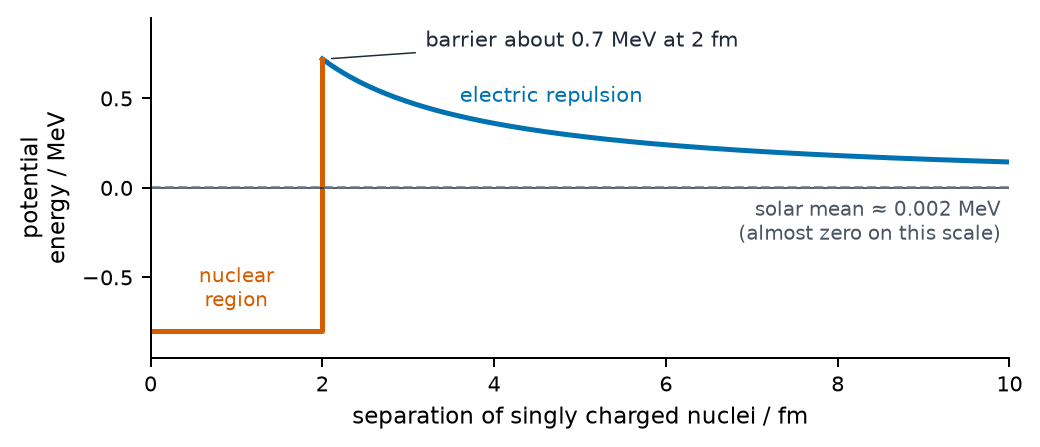
Use k = 8.99 × 10⁹ N m²/C² and e = 1.60 × 10⁻¹⁹ C. Find ke²/r in joules for separation 2.0 × 10⁻¹⁵ m.
Difficulté 2/5 · 140 pièces + un petit bonus lors de la première réussite aujourd'hui
U = ke²/r = 1.15072 × 10⁻¹³ J, or 1.2 × 10⁻¹³ J to two significant figures. This is a classical electric energy scale, not the Sun’s mean thermal energy or an exact universal fusion threshold.
Why can stellar fusion occur when mean thermal energy is far below the quoted classical barrier?
Difficulté 1/5 · 100 pièces + un petit bonus lors de la première réussite aujourd'hui
The mean does not describe every particle, tunnelling changes the classical picture, and the weak-interaction pp step also limits the rate.
Compare fusion and fission with specified reactions
- Favourable light-nucleus fusion and heavy-nucleus fission can both increase total product binding energy. Hydrogen-to-helium conversion yields about $6.4\times10^{14}$ J per kilogram in the complete assigned model, compared with roughly $8.2\times10^{13}$ J per kilogram for ideal uranium-235 fission at 200 MeV per fission. These are particular fuel models, not universal constants for every process called fusion or fission.
- For assigned atomic masses D 2.014102 u, T 3.016049 u, He-4 4.002603 u and neutron 1.008665 u, D–T fusion has mass difference $0.018883$ u and energy about 17.6 MeV. Its neutron can activate materials, and tritium is radioactive. Confinement, deposited-energy balance and materials still matter; producing helium does not imply that an entire fusion system has no radioactive material or waste.
Which statement correctly qualifies fusion products and waste?
Difficulté 1/5 · 100 pièces + un petit bonus lors de la première réussite aujourd'hui
Energy yield and radioactive-material issues depend on the reaction and the system. Helium production does not imply a waste-free plant.
Choose distance units before using an angle
- An astronomical unit is a defined length close to the Earth–Sun orbital semimajor axis, about $1.50\times10^{11}$ m. A light year is a distance, about $9.46\times10^{15}$ m, not a time unit. A parsec is the distance at which 1 AU subtends one arc-second; use $1\ \mathrm{pc}\approx3.09\times10^{16}$ m or 3.26 ly for these exercises.
- One arc-second is $1/3600$ of a degree. In the small-angle parallax relation $d(\mathrm{pc})=1/p(\mathrm{arcsec})$, the numerical angle must be in arc-seconds. An assigned $p=0.050$ arc-seconds gives 20 pc, about 65 ly or $6.2\times10^{17}$ m to two significant figures. Inserting degrees or radians without changing the conversion factors gives a different number.
An assigned parallax is .050 arc-seconds. Find distance in parsecs.
Difficulté 2/5 · 140 pièces + un petit bonus lors de la première réussite aujourd'hui
d(pc) = 1/p(arcsec) = 20 pc. A light year and a parsec are distances; the angular units in this numerical relation matter.
Measure the parallax amplitude rather than any apparent shift
- Earth's changing orbital position changes the sightline to a nearby star relative to much more distant objects. In the ideal geometry shown, the maximum difference between opposite observing positions is $2p$, while the formula uses the semi-amplitude $p$. Using the full shift as $p$ would underestimate distance by a factor of two. The figure greatly exaggerates the angles.
- Real astrometry fits repeated observations to the annual pattern and separates proper motion, instrumental effects and other motion. The useful range depends on angular precision and the target, not one universal 100 pc ground-based cutoff. Space observations can improve precision, but a catalogue parallax is still a measured quantity with uncertainty, not an exact geometrical label.
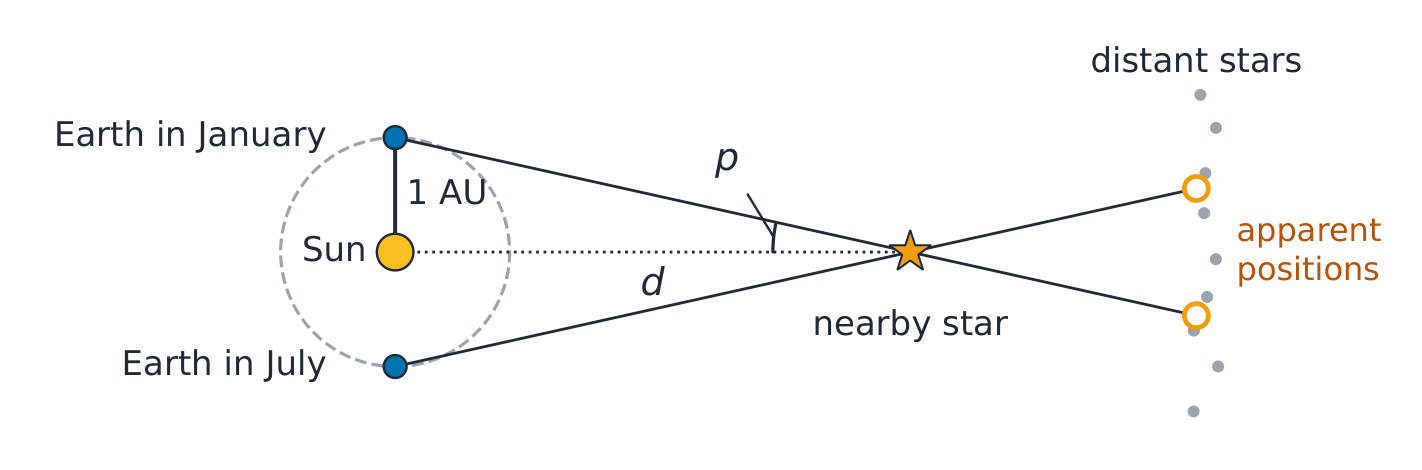
In the ideal geometry, opposite observations differ by .100 arc-seconds. Find distance in parsecs using parallax semi-amplitude.
Difficulté 2/5 · 140 pièces + un petit bonus lors de la première réussite aujourd'hui
The semi-amplitude is p = .050 arc-seconds, half the full shift. d = 1/.050 = 20 pc; using .100 directly would incorrectly give 10 pc.
Carry angular uncertainty into distance
- For $d=1/p$, a small relative uncertainty gives $\Delta d/d\approx\Delta p/p$. With assigned $p=0.050\pm0.002$ arc-seconds, the fractional uncertainty is 0.04: $d\approx20\pm0.8$ pc. This is not an additional 0.002 pc. Invert the endpoints to check the direction: smaller parallax gives larger distance.
- If relative angular uncertainty is large, direct inversion does not produce a simple symmetric reliable distance interval. Very small or even negative noisy fitted parallaxes do not mean stars have negative physical distances. They indicate that a fuller statistical distance inference is needed. For classroom small-error examples, state the approximation and round the distance consistently with its uncertainty.
For p = .050 ± .002 arc-seconds, use the small-error approximation to find the absolute distance uncertainty in pc.
Difficulté 2/5 · 140 pièces + un petit bonus lors de la première réussite aujourd'hui
Distance d = 1/p = 1/0.050 = 20 pc. The small-error fractional uncertainty is Δd/d ≈ Δp/p = 0.002/0.050 = 0.04. Thus Δd ≈ 20 × 0.04 = 0.8 pc. This approximation is not a general solution for very noisy parallaxes.
Distinguish total luminosity from received flux
- Luminosity $L$ is total emitted power in W. Bolometric apparent brightness $b$ is received power per area across all wavelengths. For approximately isotropic emission and negligible absorption, $b=L/(4\pi d^2)$. If distance triples at fixed luminosity, brightness becomes $1/9$ as large. A nearby faint emitter and a distant powerful emitter can therefore have the same measured brightness.
- Extinction removes radiation along the path, and a detector restricted to one wavelength band does not automatically measure bolometric brightness. Correct these effects or state that they are neglected before inferring $L=4\pi d^2b$. With assigned $L=3.0\times10^{28}$ W and $d=50$ pc, convert to $1.545\times10^{18}$ m before squaring; the predicted unattenuated flux is about $1.00\times10^{-9}\ \dfrac{\mathrm{W}}{\mathrm{m^2}}$.
Use L = 3.0 × 10²⁸ W, d = 50 pc and 1 pc = 3.09 × 10¹⁶ m. Neglect extinction; find flux in units of 10⁻⁹ W/m².
Difficulté 2/5 · 140 pièces + un petit bonus lors de la première réussite aujourd'hui
Convert d = 50 × 3.09 × 10¹⁶ = 1.545 × 10¹⁸ m. Then b = L/(4πd²) = (3.0 × 10²⁸)/[4π(1.545 × 10¹⁸)²] = 1.000125 × 10⁻⁹ W/m². Enter 1.000125 in the requested units. Brightness needs distance and an emission/absorption model to give luminosity.
What must be considered before using L = 4πd²b for observed data?
Difficulté 1/5 · 100 pièces + un petit bonus lors de la première réussite aujourd'hui
Bolometric flux and unattenuated isotropic propagation are the assumptions. A one-band or extinguished reading needs further treatment.
Read temperature and composition from different spectral evidence
- An approximately black-body wavelength continuum obeys $\lambda_\mathrm{max}T=2.9\times10^{-3}$ m K in the rounded model. A 350 nm peak therefore gives about 8300 K; first convert nanometres to metres. The relation concerns a wavelength spectrum, not an unchanged peak read from a frequency spectrum. Surface effective temperature is not the much hotter core temperature.
- Absorption-line patterns can identify elements and ionisation states in the atmosphere. Use several calibrated features; line strengths also depend on temperature, populations and physical conditions. A missing or weak line does not alone establish absence or low abundance. Perceived stellar colour comes from a broad visible spectrum rather than one monochromatic photon at the continuum peak.
An ideal wavelength-continuum peak is 350 nm. Use λmax T = 2.9 × 10⁻³ m K; find temperature.
Difficulté 2/5 · 140 pièces + un petit bonus lors de la première réussite aujourd'hui
Convert 350 nm to 3.50 × 10⁻⁷ m before division: T = 8285.7 K, or 8300 K to two significant figures. Surface effective temperature is not the core temperature.
A weak stellar absorption line proves which conclusion by itself?
Difficulté 1/5 · 100 pièces + un petit bonus lors de la première réussite aujourd'hui
Use several calibrated lines and an atmospheric model. Temperature and state populations influence line visibility and strength.
Combine measurements for an assigned hot star
- For an invented star, assign parallax 0.379 arc-seconds, bolometric brightness $1.1\times10^{-7}\ \dfrac{\mathrm{W}}{\mathrm{m^2}}$ and wavelength-continuum peak 293 nm, with no extinction. Distance is $1/0.379=2.6385$ pc or $8.1530\times10^{16}$ m. Keeping that unrounded distance gives $L=4\pi d^2b\approx9.19\times10^{27}$ W, about 24 solar luminosities for $L_\odot=3.83\times10^{26}$ W.
- Wien's law gives $T\approx9898$ K. Then the black-body radius relation $R=\sqrt{L/(4\pi\sigma T^4)}$, with $\sigma=5.67\times10^{-8}\ \dfrac{\mathrm{W}}{\mathrm{m^2\,K^4}}$, gives about $1.16\times10^9$ m or 1.67 assigned solar radii. These are linked calculations from the supplied model, not measurements being claimed for Sirius or another named star.
An invented star has p = .379 arc-seconds and bolometric b = 1.1 × 10⁻⁷ W/m². Use 1 pc = 3.09 × 10¹⁶ m and neglect extinction. Find luminosity in units of 10²⁷ W.
Difficulté 2/5 · 140 pièces + un petit bonus lors de la première réussite aujourd'hui
Parallax gives d = 1/0.379 = 2.63852 pc. In metres, d = (1/0.379)(3.09 × 10¹⁶) = 8.15303 × 10¹⁶ m. Then L = 4πd²b = 4π[(3.09 × 10¹⁶)/0.379]²(1.1 × 10⁻⁷) = 9.188425 × 10²⁷ W. Enter 9.188425 in the requested units. Retain the unrounded distance rather than treating a rounded intermediate as exact.
Read the HR diagram without reversing an axis
- An HR diagram places luminosity vertically and surface temperature horizontally, conventionally decreasing to the right. Hot luminous main-sequence stars are towards the upper left; cool dim ones are towards the lower right. A main-sequence position is principally related to mass and other stellar properties, not a timeline that every star traverses from one end to the other.
- Red giants are cool and luminous, white dwarfs hot and dim, and supergiants occupy high luminosities over a range of temperatures. The instability strip contains many pulsating variables; its schematic position does not guarantee identical pulsation in every object. The plotted regions are broad physical populations, not exact boundaries into which every measured star must fit without uncertainty.
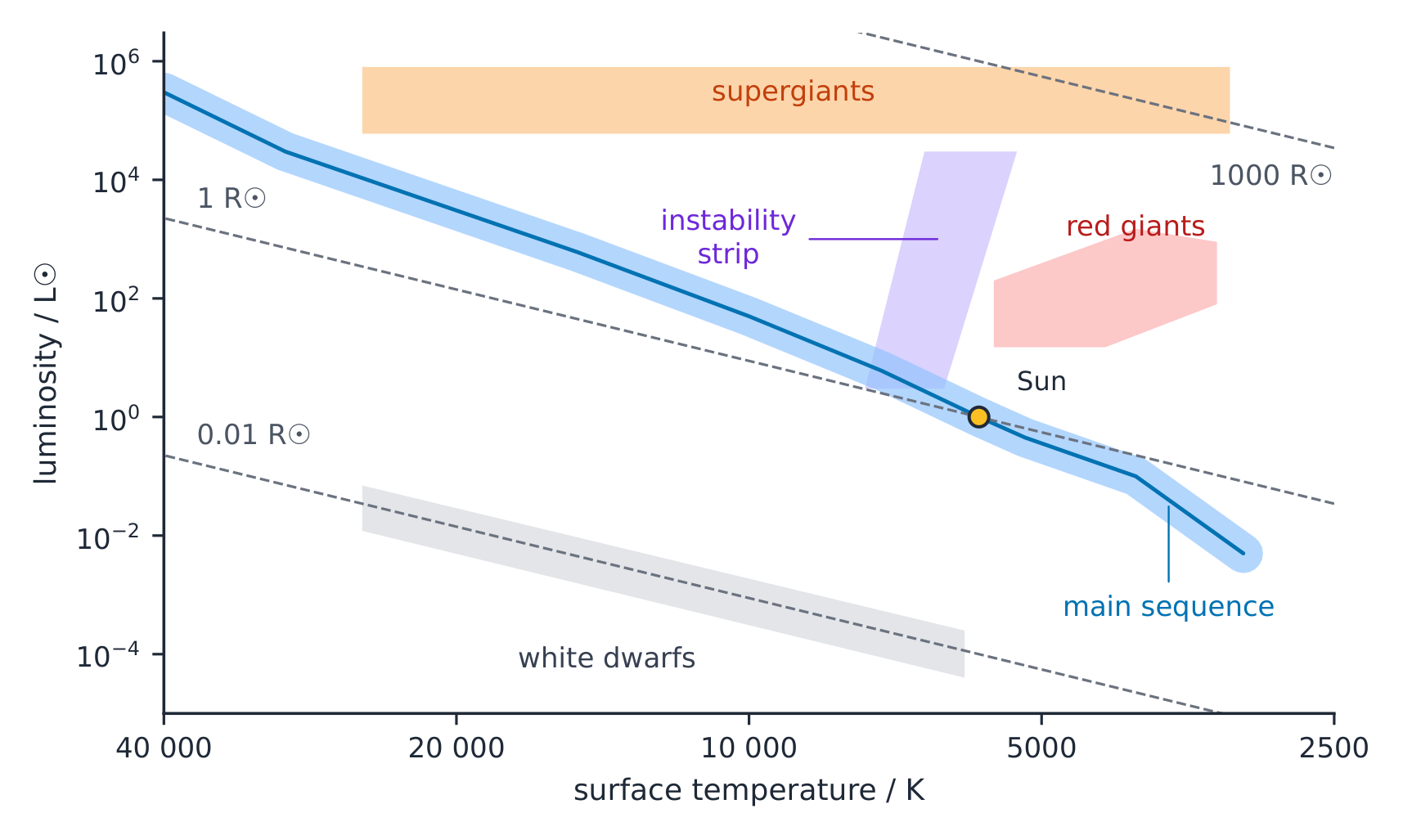
Where are hot, low-luminosity white dwarfs on the conventional HR diagram?
Difficulté 1/5 · 100 pièces + un petit bonus lors de la première réussite aujourd'hui
Luminosity depends on emitting area as well as temperature. The HR diagram shows a population, not one universal age track.
Use luminosity and temperature to infer radius
- In the effective black-body relation $L=4\pi R^2\sigma T^4$, a cool star needs a large area to be very luminous. At fixed $R$, luminosity varies as $T^4$: on the reversed-temperature log HR axes, a constant-radius line falls towards the right. At the same temperature, a more luminous star has larger radius; at the same luminosity, a hotter one has smaller radius.
- Dividing by a solar reference gives $R/R_\odot=\sqrt{L/L_\odot}(T_\odot/T)^2$. For equal luminosities and $T_A=2T_B$, $R_A/R_B=1/4$, not one-half. Most ordinary images do not resolve stellar discs, but interferometry can measure angular diameters for some stars; angular size plus distance offers another radius estimate.
Stars A and B have equal luminosity, but TA = 2TB. Find RA/RB.
Difficulté 2/5 · 140 pièces + un petit bonus lors de la première réussite aujourd'hui
At fixed L, R ∝ 1/T². Doubling temperature gives one quarter the radius, not one half.
Check radius examples against the HR regions
- An invented red-supergiant example has $L=1.2\times10^5L_\odot$ and $T=3500$ K. With assigned $T_\odot=5800$ K, the ratio formula gives $R\approx951R_\odot$. The result follows from both luminosity and temperature, rather than from calling the star red. These are illustrative inputs, not an exact reported radius for Betelgeuse.
- An invented hot white dwarf with $L=0.026L_\odot$ and $T=25\,000$ K instead gives $R\approx0.00868R_\odot$, about $6.0\times10^6$ m using $R_\odot=6.96\times10^8$ m. Its high surface temperature does not make it highly luminous because its area is small. Check radius, luminosity and temperature together before assigning a region.
An invented star has L = 1.2 × 10⁵ solar luminosities and T = 3500 K. With solar T = 5800 K, find radius in solar radii from the ratio formula.
Difficulté 2/5 · 140 pièces + un petit bonus lors de la première réussite aujourd'hui
R/Rsun = sqrt(1.2 × 10⁵)(5800/3500)² = 951.3. The radius follows from both assigned luminosity and temperature, not from a colour label alone.
Follow a Sun-like path without applying it to every star
- A gas cloud can contract under gravity to a protostar, with gravitational energy contributing to heating before sustained hydrogen-core burning. A Sun-like main-sequence star later exhausts core hydrogen; contraction heats the core while shell hydrogen burning and structural changes expand the outer layers. It becomes a red giant: surface temperature decreases while luminosity can increase. The core and outer layers can change in different directions.
- Helium burning in an appropriate Sun-like evolved core makes carbon and oxygen. Loss of the envelope can produce a planetary nebula and leave a white dwarf, supported mainly by electron degeneracy rather than continuing core fusion. The approximate 1.4-solar-mass white-dwarf limit concerns the remnant, not the initial star. Very low-mass stars and interacting binaries need other qualifications; this is a selected single-star path.
Which statement describes the selected Sun-like remnant without confusing initial and final mass?
Difficulté 1/5 · 100 pièces + un petit bonus lors de la première réussite aujourd'hui
Degenerate support and changing structure matter. The initial mass and the remaining core mass are different quantities.
Distinguish a remaining core from the original massive star
- Massive stars can progress through further burning stages towards iron-group material. Continued fusion to substantially heavier nuclei no longer provides the earlier exothermic energy source. An iron-group core can be temporarily supported, but continued evolution can destabilise it and lead to rapid collapse. A massive star need not follow exactly one red-supergiant trajectory or produce the same visible explosion.
- A collapsing core can leave a neutron star or black hole. Initial stellar mass and final compact-core mass differ because material can be lost; composition, rotation, binary effects and high-density physics also matter. Approximate classroom mass boundaries are guides, not exact universal remnant rules. Some black holes can form through collapse without a bright supernova; the Sun-like path does not predict a supernova for the Sun.
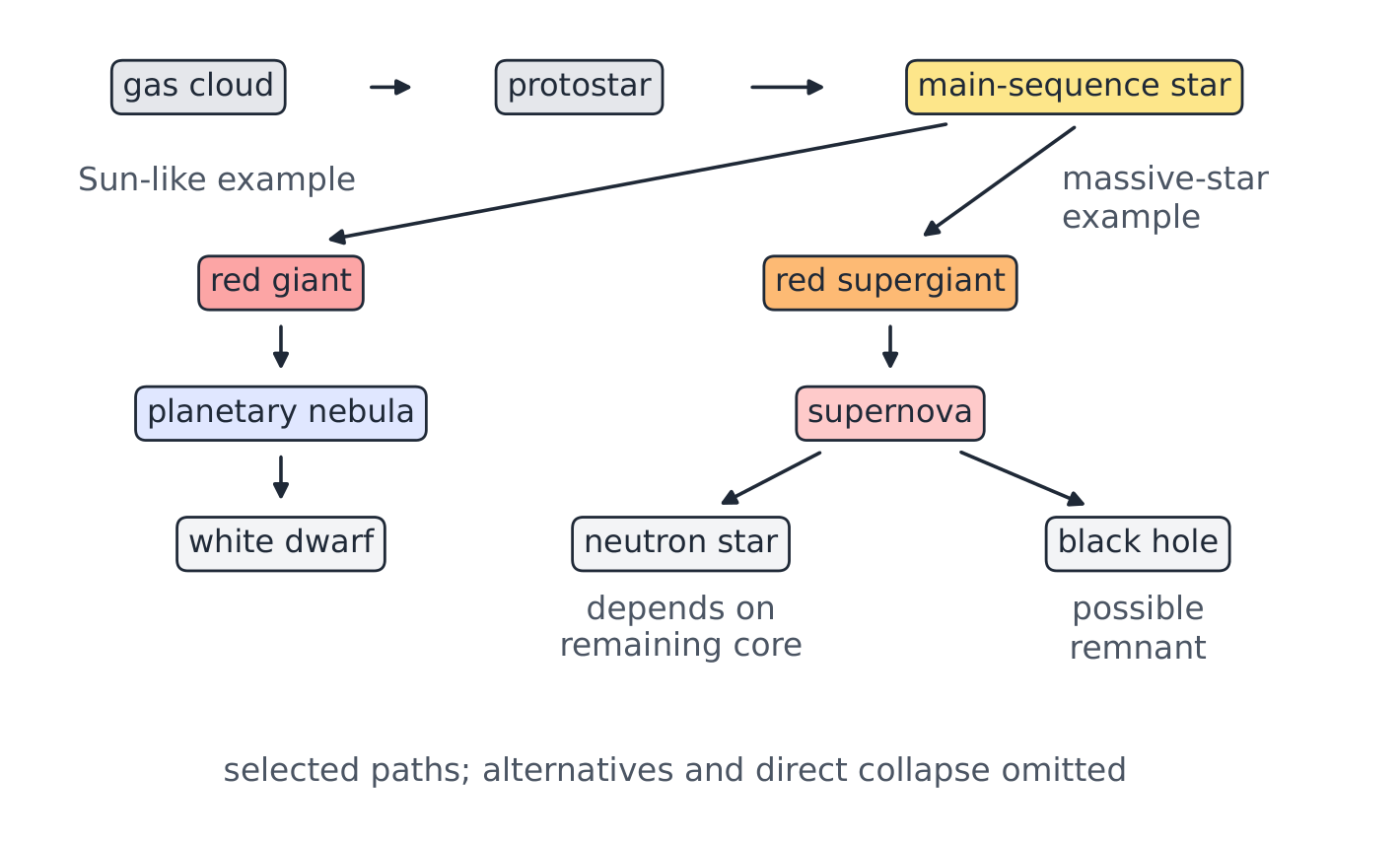
Can one exact initial-mass threshold determine every neutron-star versus black-hole outcome?
Difficulté 1/5 · 100 pièces + un petit bonus lors de la première réussite aujourd'hui
Approximate classroom branches are useful but are not universal exact remnant rules; alternatives include direct collapse.
Explain element origins without one universal factory
- The early universe supplied hydrogen, much of the helium and some lithium. Stellar burning makes many heavier nuclei, including carbon, oxygen and iron-group material. The origin of every element is not simply the same chain repeated in a massive stellar core, and initial composition already affects later stellar evolution.
- Neutron capture can build nuclei beyond iron: slow capture in evolved stars is illustrated by ESO's lead-star observations, while rapid capture occurs in extreme neutron-rich events including neutron-star mergers. Stellar winds and explosions distribute enriched matter into later systems. Different sites contribute, and a simple HR position does not reveal one star's exact full chemical-production history.
Which correction is needed to the claim that every element beyond iron must come from the same type of explosion?
Difficulté 1/5 · 100 pièces + un petit bonus lors de la première réussite aujourd'hui
Nucleosynthesis has several sites and processes; the early universe also supplied much of the light-element inventory.
Explain the complete fusion-and-stars inference
- Begin with reaction bookkeeping and a consistent mass/energy convention. Distinguish photon power, fuel consumed and a simplified lifetime budget. Explain pressure-gradient support, thermal regulation, tunnelling and the limitations of a classical barrier estimate. Keep assigned stellar data separate from real observations.
- Combine parallax, corrected bolometric brightness and a wavelength-continuum model to infer distance, luminosity, temperature and radius; include units and uncertainty. Read the reversed HR axis and distinguish a population diagram from an individual evolutionary track. Finish with a selected stellar path, the distinction between initial and remnant mass, and several nucleosynthesis routes rather than an absolute claim about every star or element.
Explain a complete fusion-and-stars inference, including energy, equilibrium, distance, spectrum, radius and selected evolutionary paths.
Use each observable to constrain a particular quantity, and separate the calculation from assumptions about the source and its evolution.