Ethical fieldwork and analysis
Introduit| English | Sens |
|---|---|
| informed consent/ɪnˈfɔːmd kənˈsent/ | consentement éclairé |
| anonymity/ˌænəˈnɪmɪti/ | Keeping a research participant's identity hidden in the material that is shared. |
| do no harm | The ethical rule that research must not harm participants. |
A study that broke the rules, 1970
- In 1970 the sociologist Laud Humphreys published a study of men meeting secretly in public toilets. He recorded their car number plates, traced their homes and later interviewed them in disguise, without telling them who he was.
- The study caused outrage and helped create today's research ethics codes. Your anthropology inquiry must protect the people you study as carefully as it gathers data.
A narrow research question
- Choose a small, observable setting you can access — a school canteen, a club, a market stall — and one concept. "How does seating in the canteen relate to friendship groups?" is better than "How do teenagers live?"
- Your question should be answerable in a few weeks of observation and conversation.
Which is the best research question for a school inquiry?
Difficulté 1/5 · 100 pièces + un petit bonus lors de la première réussite aujourd'hui
It is small, observable and linked to a concept.
Ethics in practice
- Informed consent 知情同意: people know what you are doing and agree, and can withdraw at any time. Anonymity 匿名: no names, faces or details that identify people.
- The first rule of the American Anthropological Association's code is do no harm 不伤害原则. Avoid sensitive topics, never record secretly, and store notes safely.
Match each principle to its meaning.
Difficulté 2/5 · 140 pièces + un petit bonus lors de la première réussite aujourd'hui
These protect the people in the study.
Once a participant has agreed, they cannot withdraw from the study.
Difficulté 1/5 · 100 pièces + un petit bonus lors de la première réussite aujourd'hui
Informed consent includes the right to withdraw at any time.
Methods
- Observation with field notes: what happens, when, where, who. Maps and diagrams: where people sit or stand. Short informal interviews: why they do what they do.
- Record observation and interpretation separately: "Five students sat at the window table every day" (observation); "they seem to be a close group" (interpretation).
Classify each field note.
Difficulté 2/5 · 140 pièces + un petit bonus lors de la première réussite aujourd'hui
Keep what you saw separate from what you think it means.
Worked example: canteen seating
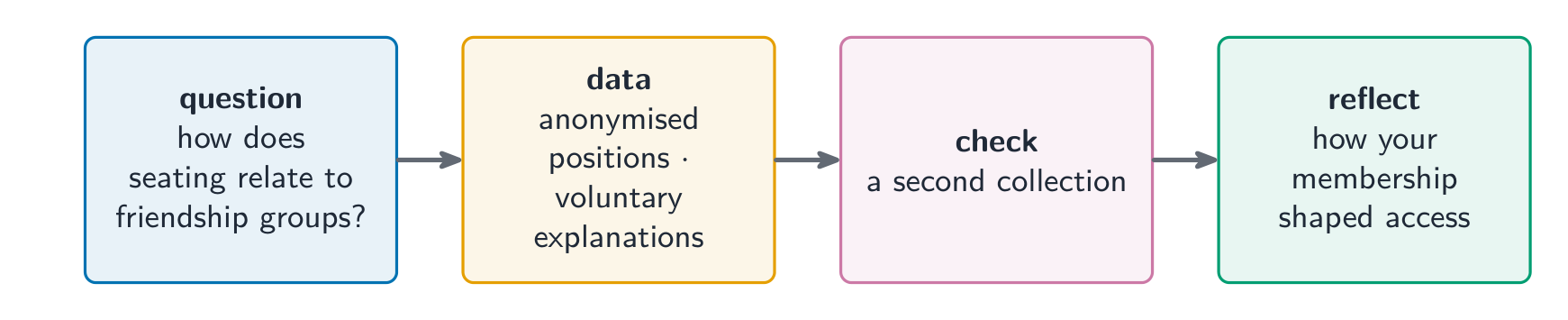
Over five lunchtimes a student maps where 40 Grade 10 students sit, with their consent and without names. The same 6 groups sit at the same tables on 4 of 5 days. Three students explain, voluntarily, that "you sit with the people from your old middle school". Analyse.
- Pattern: seating is stable — 6 groups, the same tables on 80 % of days.
- Emic explanation: students link seating to shared school history, a form of belonging.
- Check and reflect: a second collection a month later would test whether the pattern lasts. As a Grade 10 student herself, the researcher's own friendships may have shaped who talked to her — she must say so.
The same groups sat at the same tables on 4 of 5 days. What percentage of days is that?
Difficulté 2/5 · 140 pièces + un petit bonus lors de la première réussite aujourd'hui
$\dfrac{4}{5} \times 100 = 80\,\%$.
Why does the researcher plan a second collection a month later?
Difficulté 1/5 · 100 pièces + un petit bonus lors de la première réussite aujourd'hui
Repeating the observation checks reliability.
From data to concept
- Link your findings to a key concept — belonging, identity, power, space — and, if you can, to an ethnography you have studied.
- Say what your small study can and cannot show. Five days in one canteen do not explain every school.
"Recording people secretly gives more natural data" is not acceptable. Secret recording breaks consent and can harm people if the data leak. Anthropologists accept that being known as a researcher changes behaviour a little, and they reduce the effect by staying longer, not by hiding.
Recording a conversation secretly is acceptable if it gives more natural data.
Difficulté 1/5 · 100 pièces + un petit bonus lors de la première réussite aujourd'hui
It breaks consent and risks harm.
Pick a small, accessible setting and one concept. Get informed consent, keep people anonymous and do no harm. Observe, map and talk, keeping observation and interpretation apart; check patterns with a second collection, link findings to a concept and state the limits and your own position.
Plan a small, ethical study of how students use the school library during lunch.
Question, ethics, methods, analysis, reflection.