Theory and competing interpretations
Introduit| English | Sens |
|---|---|
| theory/ˈθɪəri/ | théorie |
| functionalism/ˈfʌŋkʃənəlɪzəm/ | An approach that explains social practices by the roles they play in maintaining society. |
| power/ˈpaʊə/ | pouvoir |
The feast that was banned, 1884–1951
- Peoples of the Pacific Northwest coast, such as the Kwakwakaʼwakw, held potlatches: feasts where a host gave away — or even destroyed — huge amounts of blankets, canoes and copper. In 1884 Canada banned the potlatch as "wasteful"; the ban lasted until 1951.
- To officials it looked like madness. Anthropologists offered competing explanations, each using a different theory 理论. HL asks you to compare such interpretations.
Functionalism
- Functionalism 功能主义 asks what a practice does to keep society working. Potlatch redistributed food and goods between groups and smoothed out good and bad years.
- Strength: it explains why "wasteful" practices last. Weakness: it can ignore conflict and change.
Which question does functionalism ask about a practice?
Difficulté 1/5 · 100 pièces + un petit bonus lors de la première réussite aujourd'hui
Functionalism looks at a practice's role in maintaining society.
Interpretive and symbolic approaches
- Interpretive anthropology, led by Clifford Geertz (The Interpretation of Cultures, 1973), reads practices like texts. His famous essay on the Balinese cockfight showed how a bet expressed status and pride.
- A symbolic reading of potlatch looks at the meanings of names, songs and crests passed on at the feast.
What did Geertz's study of the Balinese cockfight show?
Difficulté 1/5 · 100 pièces + un petit bonus lors de la première réussite aujourd'hui
Geertz read the cockfight as a story Balinese people told about themselves.
Power and political economy
- A power 权力 approach asks who gains and who loses. Pierre Bourdieu's idea of symbolic capital explains how giving away wealth turns it into prestige and rank.
- Political economy adds history: after European trade brought new wealth and epidemics killed many title-holders, potlatches grew larger as rivals competed for vacant ranks.
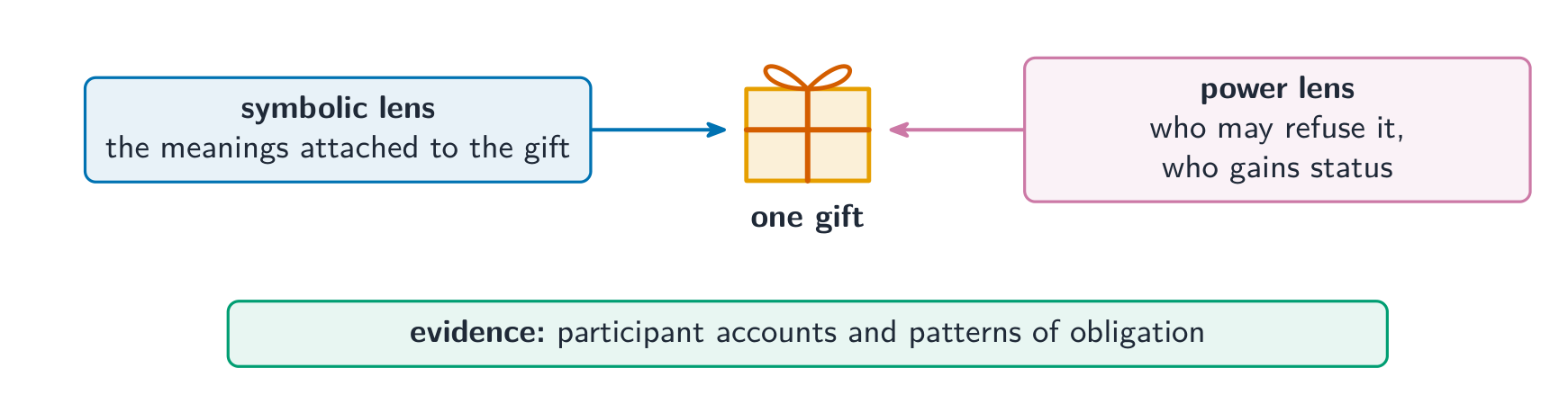
Match each theory to its question.
Difficulté 2/5 · 140 pièces + un petit bonus lors de la première réussite aujourd'hui
Each lens highlights a different side of the same practice.
For Bourdieu, giving away wealth can turn economic capital into symbolic capital such as prestige.
Difficulté 1/5 · 100 pièces + un petit bonus lors de la première réussite aujourd'hui
Generosity can create rank and obligation.
Worked example: potlatch through two lenses
Why did 19th-century potlatches become so large? Compare a symbolic and a power interpretation.
- Symbolic: the feast publicly confirmed names, crests and stories; the more given, the more strongly the host's claim was witnessed and remembered.
- Power: giving away wealth created debts and turned goods into rank; when epidemics left many titles empty and trade brought new wealth, more people competed, so feasts grew.
- Evaluation: the two are complementary — meaning explains why rank was claimed through giving, power explains the timing of growth. Historical records of trade and population support the power reading; participants' accounts of names support the symbolic one.
According to the power interpretation, why did potlatches grow in the 19th century?
Difficulté 1/5 · 100 pièces + un petit bonus lors de la première réussite aujourd'hui
Competition for vacant ranks explains the timing of growth.
Choosing between theories
- Test each theory against evidence: participants' accounts, historical records, patterns of who gives to whom. A good theory explains more of the evidence with fewer gaps.
- Often the strongest answer combines lenses and says what each misses.
Which evidence could test interpretations of potlatch?
Difficulté 2/5 · 140 pièces + un petit bonus lors de la première réussite aujourd'hui
An outsider's judgement is not evidence about meaning or function.
"Theories are just opinions, so any interpretation is fine" is wrong. Theories make claims that can be checked against ethnographic and historical evidence. The power interpretation of potlatch predicts larger feasts after epidemics — and the records show they were.
Because theories differ, any interpretation of a practice is equally valid.
Difficulté 1/5 · 100 pièces + un petit bonus lors de la première réussite aujourd'hui
Interpretations can be tested against evidence.
HL compares theoretical lenses on the same practice: functionalism (what it does for society), interpretive approaches (what it means), and power and political economy (who gains, and how history changes it). Test each against evidence, and combine lenses where each explains something the others miss.
Interpret expensive wedding banquets in a society you know using two theoretical lenses.
Compare lenses, then evaluate.