Reading and comparing ethnographies
Introduit| English | Sens |
|---|---|
| ethnography/eθˈnɒɡrəfi/ | ethnographie |
| belonging/bɪˈlɒŋɪŋ/ | the sense of being accepted as a member of a group or community |
Two books about Samoa, 1928 and 1983
- In 1928 Margaret Mead published Coming of Age in Samoa, arguing that Samoan teenagers had an easy, stress-free adolescence because their culture allowed sexual freedom. It became a bestseller.
- In 1983 Derek Freeman, who had worked in Samoa for years, attacked her findings, claiming her informants had joked with her. The debate shows why you must read an ethnography 民族志 critically: who wrote it, where, when and how.
What an ethnography is
- An ethnography is a detailed written account of a group's life, based on fieldwork. It makes an argument about what practices mean and how they connect.
- Ethnographies are about specific people in a specific place and time, not about a whole nation forever.
What is an ethnography?
Difficulté 1/5 · 100 pièces + un petit bonus lors de la première réussite aujourd'hui
Ethnographies are fieldwork-based and make an argument about meaning.
Reading an ethnography
- For each ethnography, note the setting, the dates of fieldwork, the methods, the author's position and the main argument.
- Then pick out the evidence: quotations from participants, descriptions of events, numbers. Ask whether the evidence supports the argument.
Which should you note when reading an ethnography?
Difficulté 2/5 · 140 pièces + un petit bonus lors de la première réussite aujourd'hui
These shape what the author could observe and claim.
Comparing two ethnographies
- Compare by one concept — for example, how people show belonging 归属感 — in two different settings. Similarities and differences both teach something.
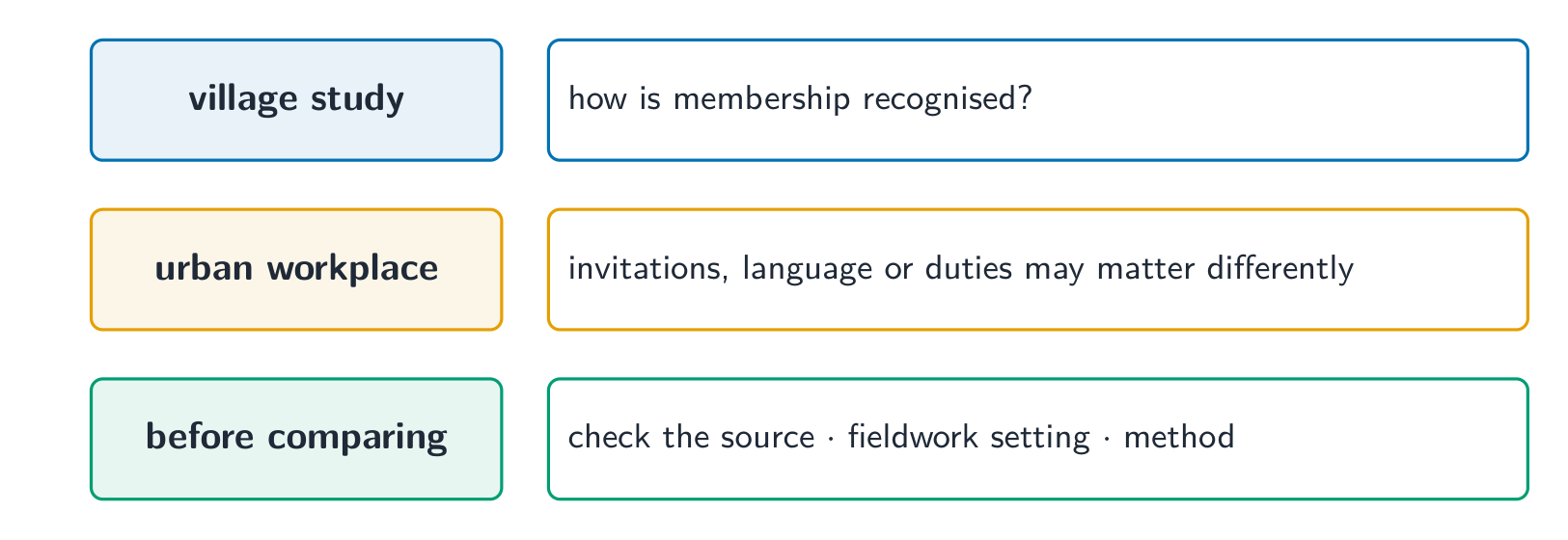
- Before comparing, check the context: a village study from 1960 and an urban workplace study from 2015 differ in method and time as well as place.
What is the best basis for comparing two ethnographies?
Difficulté 1/5 · 100 pièces + un petit bonus lors de la première réussite aujourd'hui
A concept gives a fair point of comparison.
Worked example: belonging in two places
Ethnography A (a rural village, 1960s fieldwork): belonging comes from birth into a lineage and taking part in harvest work. Ethnography B (a city office, 2010s fieldwork): new staff belong once they are invited to after-work dinners and learn the team's slang. Compare.
- Similarity: in both, belonging is shown by taking part in shared activities, not just by being present.
- Difference: in A it is mostly given by birth; in B it is earned and can be lost when someone changes job.
- Context check: the two studies are fifty years apart and used different methods — A long residence, B months of office observation — so some differences may come from method and time, not only from the setting.
In the worked example, match each statement to the ethnography.
Difficulté 2/5 · 140 pièces + un petit bonus lors de la première réussite aujourd'hui
The contrast is between given and earned belonging.
Differences between two ethnographies always come from differences between the societies.
Difficulté 1/5 · 100 pièces + un petit bonus lors de la première réussite aujourd'hui
Method, time of fieldwork and author position can also explain differences.
Evaluating evidence
- Strong ethnographies show how the author gathered evidence, include participants' voices, and admit limits. Ask: how long was the fieldwork? Did the author speak the language? Whom could they not reach?
- Mead spent nine months in Samoa and relied on a small number of teenage girls; Freeman worked mainly with older men. Each had partial access.
Why is the Mead–Freeman debate useful for students?
Difficulté 1/5 · 100 pièces + un petit bonus lors de la première réussite aujourd'hui
Each author had partial access to Samoan life.
"Ethnography A describes the Samoans" is too broad. An ethnography describes particular people, in a particular place, at the time of fieldwork. Name the group, place and date, and avoid treating a study as a timeless picture of a whole culture.
An ethnography of one village in 1960 describes the whole nation today.
Difficulté 1/5 · 100 pièces + un petit bonus lors de la première réussite aujourd'hui
Ethnographies are specific to people, place and time.
Read each ethnography for setting, date, method, author position, argument and evidence. Compare two ethnographies through one concept, noting similarities and differences, and check whether differences come from the societies or from method and time. Evaluate how the evidence was gathered.
Write a short paragraph comparing how two groups you know (for example, a sports team and an online gaming group) show belonging.
Practise comparing through one concept.