Votre plan d'apprentissage · Continuer · Réviser →
把 avancé (把 + Obj + Verbe + Résultat)
IntroduitVotre position enregistrée reste dans ce navigateur. Reprendre ne termine pas la leçon ni ne répond à ses questions.
Révision d'un rapport
- Votre manager vous rend votre ébauche avec des instructions.
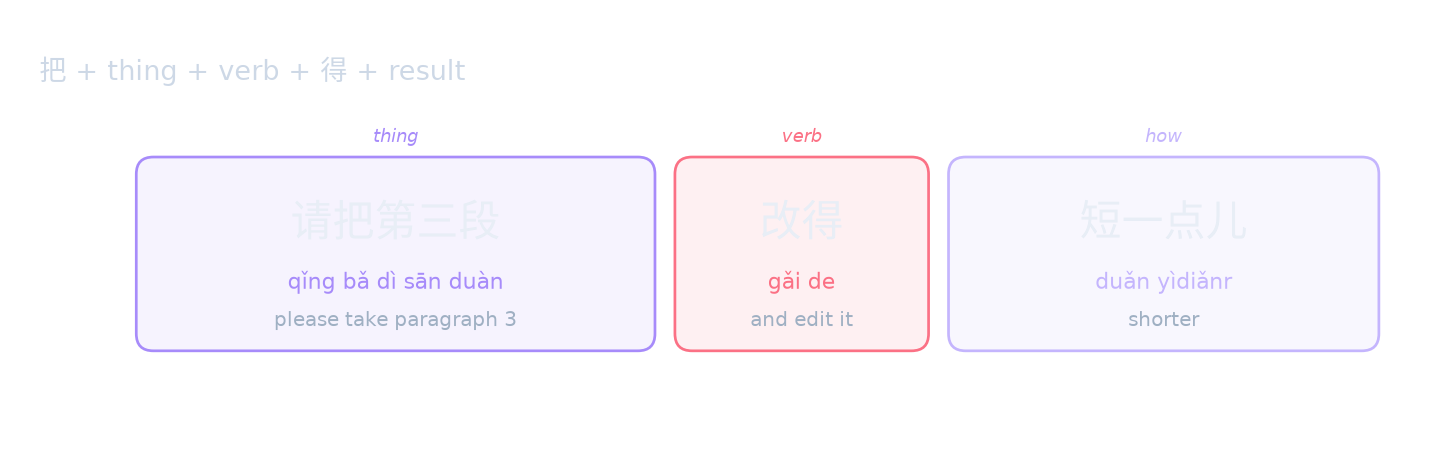
- please请(把: marks the object)把第三段to change改(degree marker)得short短erhua variant of 一点一点儿,again / then再(把: marks the object)把chart图表放到final最后。 — « Veuillez rendre le troisième paragraphe un peu plus court, puis déplacer le graphique à la fin. »
(把: marks the object)把 + Objet + Verbe + résultat complexe
- Au HSK 5, ce qui suit le verbe peut être un complément (degree marker)得, un changement into成 / for为, ou un lieu ou une direction : to change改(degree marker)得short短erhua variant of 一点一点儿, translate翻译into成Chinese中文, 放到final最后, to give (as a gift); to see off送to return home回家.
- L'objet doit être spécifique et le verbe ne doit pas rester seul.
please请把this这sentence句话translate翻译into成Chinese中文。
Complete: “Please translate this sentence into English.” 请把这句话翻译____英文。
Difficulté 1/5 · 100 pièces + un petit bonus lors de la première réussite aujourd'hui
翻译成 = translate into (a change).
Changement, lieu, manière
- Changement : he / him他(把: marks the object)把drawing room客厅to change into变成(completed / change)了study (room)书房。 — « Il a transformé le salon en bureau. »
- Manière avec (degree marker)得 : she她(把: marks the object)把the room房间clean打扫(degree marker)得spotless干干净净。 — « Elle a nettoyé la pièce jusqu'à ce qu'elle soit immaculée. »
she她把the room房间clean打扫得spotless干干净净。
Build: “She cleaned the room spotless.”
Difficulté 3/5 · 200 pièces + un petit bonus lors de la première réussite aujourd'hui
把 + object + verb + 得 + result.
Négations et modaux avant (把: marks the object)把
- not / haven't没 / not不 / don't别 / can / be able to能 / want / will / need要 / should应该 précèdent (把: marks the object)把 : you你should应该(把: marks the object)把question问题variant of 说说distinct清楚, pas you你(把: marks the object)把question问题should应该variant of 说说distinct清楚.
- Les verbes de perception et de sentiment (to see看见, to know知道, to like喜欢) ne prennent pas (把: marks the object)把.
Which sentence is correct?
Difficulté 1/5 · 100 pièces + un petit bonus lors de la première réussite aujourd'hui
你应该把问题说清楚 is right: modal verbs and negatives (应该, 要, 不) go before 把, not between 把 and the verb.
Pourquoi utiliser (把: marks the object)把 ?
- (把: marks the object)把 met l'accent sur ce qui arrive à un objet spécifique : I我(把: marks the object)把my wallet钱包lose丢(completed / change)了 — « J'ai perdu mon portefeuille. »
- Sans (把: marks the object)把, la même idée peut sembler inachevée ou neutre : I我lose丢(completed / change)了my wallet钱包.
I我把my wallet钱包lose丢了。
我把他看见了 is a natural sentence.
Difficulté 1/5 · 100 pièces + un petit bonus lors de la première réussite aujourd'hui
Perception verbs like 看见 don't take 把.
Résumé
- (把: marks the object)把 + objet spécifique + Verbe + résultat (complément (degree marker)得, into成, to / arrive到 + lieu, direction).
- Négatifs / modaux avant (把: marks the object)把 ; pas de (把: marks the object)把 avec les verbes de perception ou de sentiment.
Lisez la référence complète : HSK 5 grammaire — Structures de phrases.
Your manager hands back your draft with instructions. Close the examples. Say a Mandarin response, then write it in Chinese. Explain briefly in English what the lesson’s pattern adds. Compare with the model, then change one detail and try again.
This is supported productive practice. Compare meaning and structure; your answer need not copy the model. A partner or teacher must hear the spoken response to comment on pronunciation.