Votre plan d'apprentissage · Continuer · Réviser →
Verbe + 来 + Verbe + 去 (aller et retour)
IntroduitVotre position enregistrée reste dans ce navigateur. Reprendre ne termine pas la leçon ni ne répond à ses questions.
A restless dog before the storm
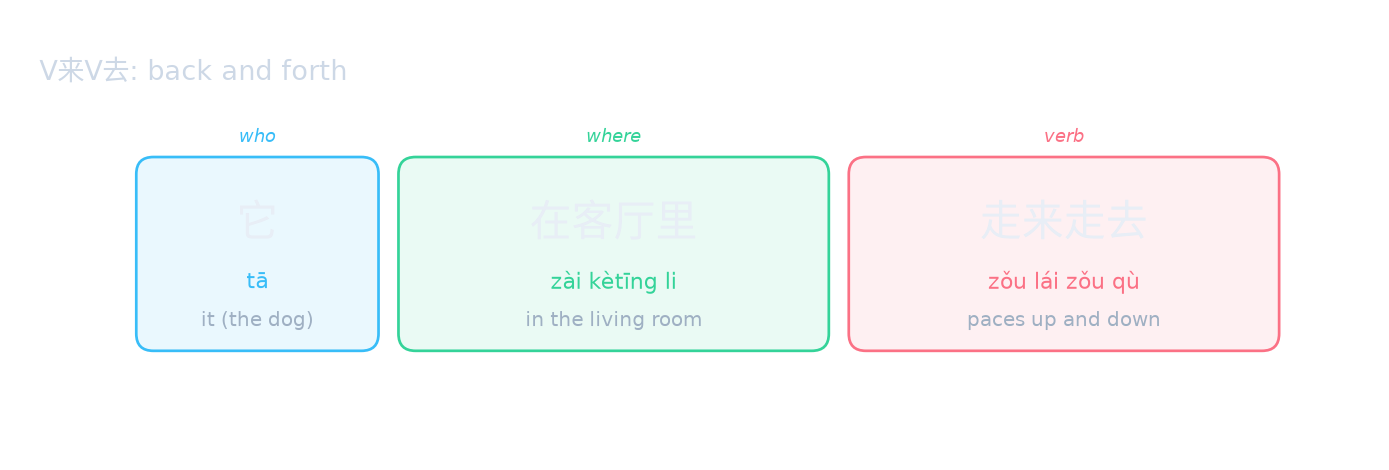
- Your dog can't settle before the storm and keeps pacing around the living room.
- it它in在living room客厅(in)里walk走(here)来walk走(there)去。 — "It keeps pacing back and forth in the living room."
- Goal: describe repeated back-and-forth action with verb + (here)来 + verb + (there)去.
Verb + (here)来 + Verb + (there)去
- V(here)来V(there)去 = do something repeatedly, back and forth: walk走(here)来walk走(there)去, to scamper跑来跑去, to fly about飞来飞去.
- The same verb repeats; (here)来 and (there)去 show movement in different directions.
the children孩子们in在the park公园(in)里run跑(here)来run跑(there)去。
Complete: “Birds are flying back and forth.” 鸟儿飞来飞____。
Difficulté 1/5 · 100 pièces + un petit bonus lors de la première réussite aujourd'hui
V来V去.
Repeating with no result
- With thinking and talking, it often means "over and over again": I我think想(here)来think想(there)去,after all还是decided决定not不(there)去(completed / change)了。 — "I thought it over and over and decided not to go after all."
- they他们to speak说(here)来to speak说(there)去after all还是that那几句话。 — "They kept going round in circles saying the same things."
I我think想(over)来think想(and over)去,after all还是decided决定not不go去了。
Build: “I thought it over and over and decided not to go.”
Difficulté 3/5 · 200 pièces + un petit bonus lors de la première réussite aujourd'hui
想来想去 + decision.
Same verb, one syllable
- Use the same verb in both places: walk走(here)来walk走(there)去, not walk走(here)来run跑(there)去.
- It describes a repeated activity, so it rarely takes a result complement: walk走(here)来walk走(there)去, not walk走(here)来walk走(there)去to finish完.
- Movement or thinking: he他in在room房间(in)里walk走(here)来walk走(there)去。 — "He paced around the room." I我think想(here)来think想(there)去,decided决定(there)去(completed / change)了。 — "I thought it over and over, and decided to go."
Which is correct?
Difficulté 1/5 · 100 pièces + un petit bonus lors de la première réussite aujourd'hui
In verb + 来 + verb + 去 the same verb repeats to show movement back and forth: 他走来走去 “He paces up and down.” Mixing two verbs or adding 了完 breaks the pattern.
Versus back and forth来回
- back and forth来回 + verb also means back and forth: he他in在the door门口back and forth来回walk走 — "He's walking back and forth by the door."
- back and forth来回 can be a noun: 一个back and forth来回 — "a round trip".
he他at在the door门口back and forth来回walk走。
一个来回 means “a round trip”.
Difficulté 1/5 · 100 pièces + un petit bonus lors de la première réussite aujourd'hui
True. 来回 can be a noun meaning “a round trip”: 一个来回要两个小时. As an adverb it means “back and forth”.
Recap
- V(here)来V(there)去 = do repeatedly, back and forth (walk走(here)来walk走(there)去); with think想 / to speak说 = over and over.
- Same verb twice; back and forth来回 + verb is a near equivalent.
Read the full reference: HSK 5 grammar — Complements.
Your dog can't settle before the storm and keeps pacing around the living room. Close the examples. Say a Mandarin response, then write it in Chinese. Explain briefly in English what the lesson’s pattern adds. Compare with the model, then change one detail and try again.
This is supported productive practice. Compare meaning and structure; your answer need not copy the model. A partner or teacher must hear the spoken response to comment on pronunciation.