Votre plan d'apprentissage · Continuer · Réviser →
要不 … 吧 (et si on…)
IntroduitVotre position enregistrée reste dans ce navigateur. Reprendre ne termine pas la leçon ni ne répond à ses questions.
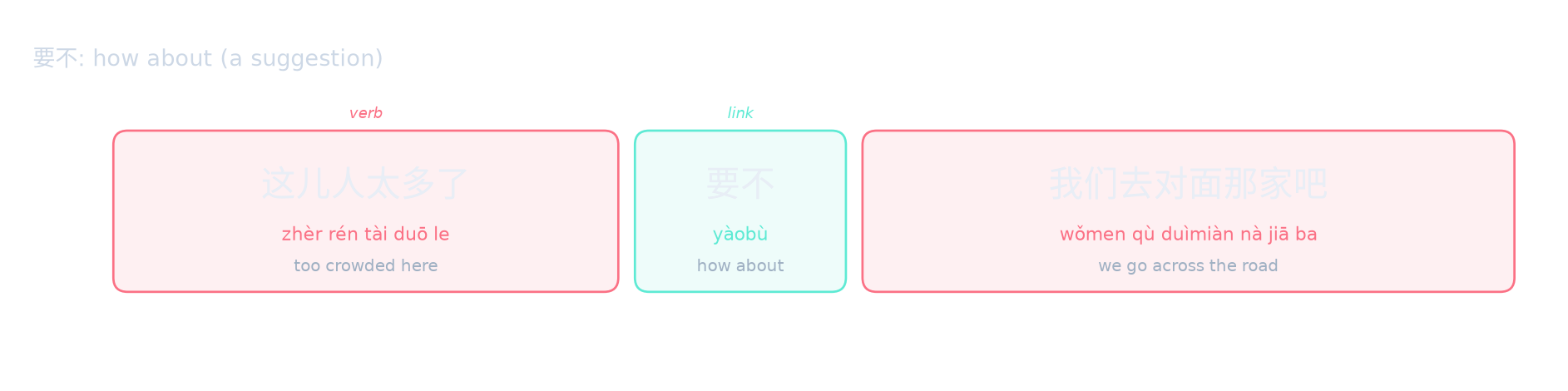
Trop bondé ici
- Vous et un ami entrez dans un café, et toutes les tables sont prises.
- here这儿人太多(completed / change)了,want / will / need要not不we我们to go去opposite对面that那home; family家(suggestion)吧。 — « Il y a trop de monde ici ; on va à celle d’en face ? »
want / will / need要not不 + suggestion + (suggestion)吧
- want / will / need要not不 au début d’une proposition propose une alternative : « Et si …, sinon … ».
- (suggestion)吧 à la fin adoucit la suggestion : want / will / need要not不tomorrow明天to say again再说(suggestion)吧.
how about要不we我们tomorrow明天then再talk about it说吧。
Suggest: “How about we take a taxi?” ____我们打车吧。
Difficulté 1/5 · 100 pièces + un petit bonus lors de la première réussite aujourd'hui
要不 + suggestion + 吧.
Après un problème
- afternoon下午maybe / possible可能to rain下雨,want / will / need要not不we我们(把: marks the object)把the picnic野餐to change改to / arrive到indoors室内(suggestion)吧。 — « Il pourrait pleuvoir cet après-midi ; on déplace le pique-nique à l’intérieur ? »
- want / will / need要not不 souvent suit une raison pour laquelle le plan initial ne fonctionne pas.
how about要不we我们把the picnic野餐move to改到indoors室内吧。
Build: “It might rain; how about moving the picnic indoors?”
Difficulté 3/5 · 200 pièces + un petit bonus lors de la première réussite aujourd'hui
Reason, then 要不 + suggestion.
want / will / need要not不 versus if it were not for要不是
- if it were not for要不是 = « si ce n'était pour » : if it were not for要不是you你to remind提醒I / me我,I / me我then / just就to forget忘(completed / change)了 — « Si tu ne m'avais pas rappelé, je l'aurais oublié. »
- otherwise要不然 = « sinon / autrement » : fast; soon快to walk走,otherwise要不然then / just就to arrive late迟到(completed / change)了. Différent de la suggestion want / will / need要not不.
What does 要不是你帮我,我就完了 mean?
Difficulté 1/5 · 100 pièces + un petit bonus lors de la première réussite aujourd'hui
要不是 means “if it weren't for”: it introduces a condition contrary to fact. 要不是你帮我,我就完了 “If you hadn't helped me, I'd have been done for.”
要不然 means “otherwise”.
Difficulté 1/5 · 100 pièces + un petit bonus lors de la première réussite aujourd'hui
True. 要不然 (also 要不) means “otherwise”: 快走,要不然就迟到了 “Hurry up, otherwise we'll be late.”
want / will / need要not不 versus had better还是…(suggestion)吧
- had better还是…(suggestion)吧 recommande après avoir pesé les options : had better还是take坐the subway地铁(suggestion)吧.
- want / will / need要not不…(suggestion)吧 propose timidement une nouvelle idée : want / will / need要not不we我们take坐the subway地铁(suggestion)吧 ?
we我们had better还是take坐the subway地铁吧。
Résumé
- want / will / need要not不 + suggestion + (suggestion)吧 = comment si … ? (une nouvelle idée douce).
- if it were not for要不是 = si ce n'était pour ; otherwise要不然 = sinon / autrement.
Lire la référence complète : Grammaire HSK 5 — Conjonctions.
You and a friend walk into a café, and every table is taken. Close the examples. Say a Mandarin response, then write it in Chinese. Explain briefly in English what the lesson’s pattern adds. Compare with the model, then change one detail and try again.
This is supported productive practice. Compare meaning and structure; your answer need not copy the model. A partner or teacher must hear the spoken response to comment on pronunciation.