Votre plan d'apprentissage · Continuer · Réviser →
Mot interrogatif + 都 (chaque/tout)
IntroduitVotre position enregistrée reste dans ce navigateur. Reprendre ne termine pas la leçon ni ne répond à ses questions.
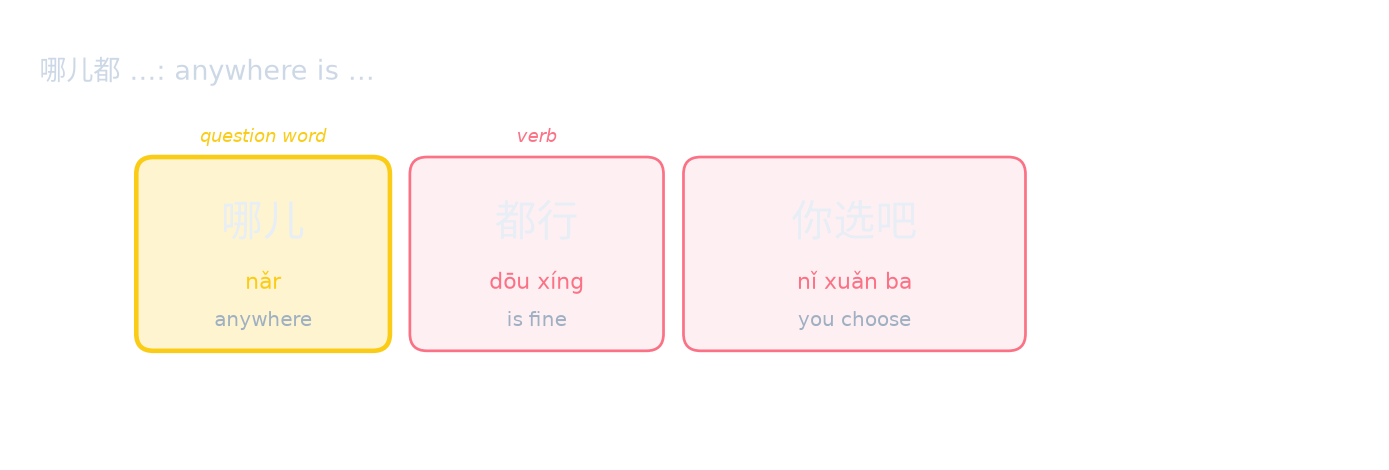
Anywhere is fine
- Your friend asks where you want to eat. You are hungry and not fussy.
- where哪儿all都OK / to walk行,you你to choose选(suggestion)吧。 — "Anywhere is fine; you choose."
Question word + all都 = every-, any-
- who谁all都 (everyone), anything什么all都 (everything), where哪儿all都 (everywhere), anything什么time; when时候all都 (any time), however怎么all都 (however).
- The QW goes before all都 and the verb.
he他anything什么all都can do会。
Complete: “He can do anything.” 他____都会。
Difficulté 1/5 · 100 pièces + un petit bonus lors de la première réussite aujourd'hui
什么 + 都 = everything / anything.
Negatives: no one, nothing
- I我anything什么all都unexpectedly不想to eat吃。 — "I don't want to eat anything."
- however怎么all都look找not to arrive不到。 — "I can't find it no matter how I look."
I我however怎么(still)都look找(can't)不find到。
Build: “I can't find it no matter how I look.”
Difficulté 3/5 · 200 pièces + un petit bonus lors de la première réussite aujourd'hui
怎么 + 都 + potential complement.
QW first
- I我anything什么all都to eat吃, not I我to eat吃anything什么all都: the QW moves before all都.
- With a noun: which哪个 / anything什么 + noun + all都: anything什么dish (of food); vegetable菜all都tasty好吃.
Which says “Every dish is delicious”?
Difficulté 1/5 · 100 pièces + un petit bonus lors de la première réussite aujourd'hui
Question word + noun + 都 means “every”: 什么菜都好吃 “Every dish is delicious.” 什么 must come directly before the noun, and 都 before the predicate.
Versus no matter不管 + QW
- QW + all都 is short and spoken: who谁all都can / may可以comes来.
- no matter不管 + QW,all都 … spells out the condition: no matter不管who谁comes来,I我all都welcome欢迎.
no matter不管who谁comes来,I我(all)都welcome欢迎。
谁都可以来 means “Anyone can come.”
Difficulté 1/5 · 100 pièces + un petit bonus lors de la première réussite aujourd'hui
True. A question word before 都 means “any / every”: 谁都可以来 “Anyone can come.”
Recap
- QW + all都 + verb = every- / any-; with (can't)不 / not / haven't没 = no- / nothing.
- QW before all都; no matter不管 + QW is the longer form.
Read the full reference: HSK 4 grammar — Basic sentence patterns.
Your friend asks where you want to eat. You are hungry and not fussy. Close the examples. Say a Mandarin response, then write it in Chinese. Explain briefly in English what the lesson’s pattern adds. Compare with the model, then change one detail and try again.
This is supported productive practice. Compare meaning and structure; your answer need not copy the model. A partner or teacher must hear the spoken response to comment on pronunciation.