Votre plan d'apprentissage · Continuer · Réviser →
任何 + Nom + 都 / 也 (n'importe quel)
IntroduitVotre position enregistrée reste dans ce navigateur. Reprendre ne termine pas la leçon ni ne répond à ses questions.
Des questions ?
- À la fin du cours, votre professeur veut s'assurer que tout le monde a compris.
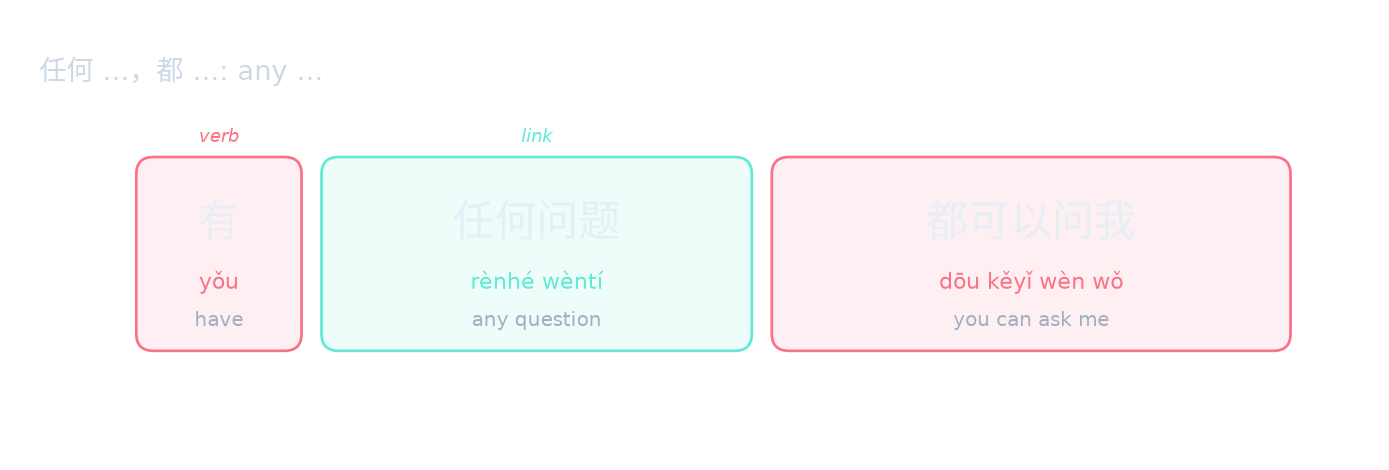
- to have / there is有any任何question问题,(all)都can可以to ask问I我。 — « Si vous avez la moindre question, n'hésitez pas à me poser des questions. »
any任何 + Nom + (all)都 / also也
- any任何 + nom = « quelconque (au total) » ; (all)都 ou also也 suit généralement : any任何person人(all)都can可以take part参加 (« Tout le monde peut y participer »).
- Dans une phrase négative : any任何person人(all)都won't不to know知道 / he / him他not have / haven't没有any任何question问题 — « personne / aucun … au total ».
any任何person人(all)都can可以take part参加。
Complete: “Anyone can take part.” ____人都可以参加。
Difficulté 1/5 · 100 pièces + un petit bonus lors de la première réussite aujourd'hui
任何 + noun + 都.
Déclarations totales
- I我improbable不会tell告诉any任何person人。 — « Je ne le dirai à personne. »
- any任何time; when时候you你(all)都can可以to / for / give给I我to make a telephone call打电话。 — « Vous pouvez m'appeler à tout moment. »
I我won't不(will)会tell告诉any任何person人。
Build: “I won't tell anyone.”
Difficulté 3/5 · 200 pièces + un petit bonus lors de la première réussite aujourd'hui
Negative verb + 任何 + noun.
Ajouter (all)都 comme sujet
- En tant que sujet, any任何 + nom nécessite (all)都 / also也 : any任何person人(all)都to know知道 (« Tout le monde sait »), et non any任何person人to know知道.
- any任何 précède uniquement un nom ; il ne se tient pas seul : any任何person人 (« toute personne »), et non simplement any任何.
Which sentence is correct?
Difficulté 1/5 · 100 pièces + un petit bonus lors de la première réussite aujourd'hui
任何人都知道这件事 is right: 任何 + noun as the subject needs 都 before the verb, and 任何 always comes before its noun.
any任何 versus mot interrogatif + (all)都
- À l'oral : anyone谁(all)都can可以come来 — « N'importe qui peut venir. »
- any任何person人(all)都can可以come来 exprime la même idée mais de manière plus formelle.
anyone谁(all)都can可以come来。
谁都可以来 is a spoken way to say 任何人都可以来.
Difficulté 1/5 · 100 pièces + un petit bonus lors de la première réussite aujourd'hui
QW + 都 is the spoken equivalent.
Résumé
- any任何 + nom + (all)都 / also也 = quelconque … au total ; négatif = aucun … au total.
- Nécessite un nom et, en tant que sujet, (all)都 / also也. anyone谁(all)都 est l'équivalent oral.
Lire la référence complète : Grammaire HSK 4 — Structures de phrase.
At the end of the lesson your teacher wants to be sure everyone understood. Close the examples. Say a Mandarin response, then write it in Chinese. Explain briefly in English what the lesson’s pattern adds. Compare with the model, then change one detail and try again.
This is supported productive practice. Compare meaning and structure; your answer need not copy the model. A partner or teacher must hear the spoken response to comment on pronunciation.