Votre plan d'apprentissage · Continuer · Réviser →
Verbes séparables (离合词)
IntroduitVotre position enregistrée reste dans ce navigateur. Reprendre ne termine pas la leçon ni ne répond à ses questions.
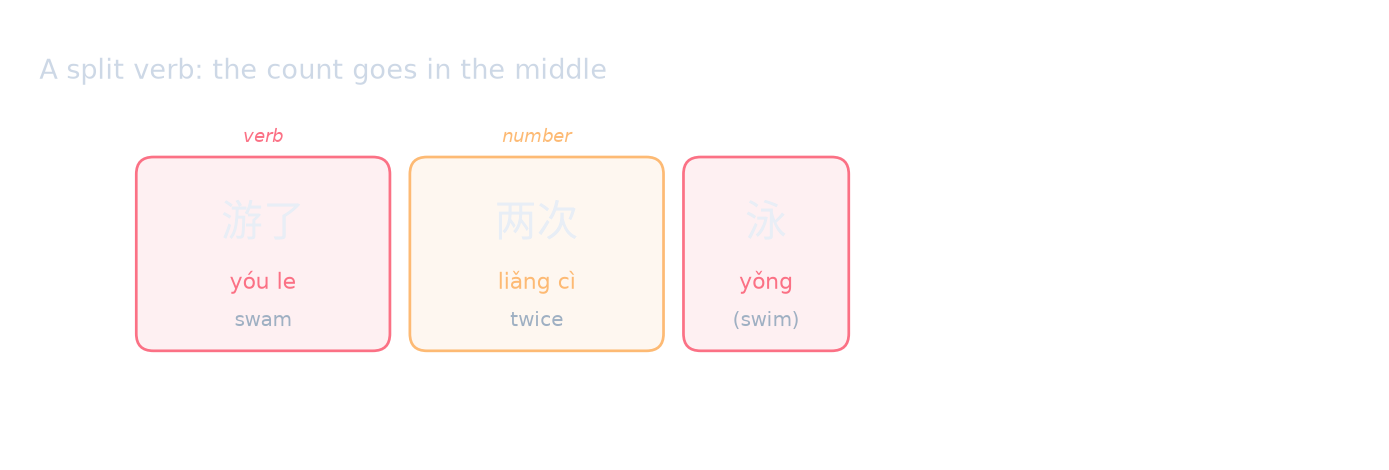
Un verbe qui se scinde en deux
- Vous dites à un ami que vous êtes allé nager deux fois cette semaine et que vous avez aussi coupé vos cheveux.
- I我texture理(completed / change)了first一次to send out发,to walk游(completed / change)了两次swimming泳。 — "J'ai fait couper mes cheveux une fois et je suis allé nager deux fois."
Mots verbe-objet (clutch (in car gearbox)离合word词)
- Certains mots sont en réalité verbe + objet en un seul mot : to swim游泳 (nager), meet见面 (rencontrer : voir + visage), to sleep睡觉 (dormir), to help帮忙 (aider : aider + tâche).
- Les mots comme (completed / change)了, (before)过, les quantités et (at)的 vont entre les deux parties : met见(completed / change)了face面, to sleep睡(completed / change)了一个hour小时to feel觉.
we我们met见(before)过face面。
Complete: “We have met before.” 我们见____面。
Difficulté 1/5 · 100 pièces + un petit bonus lors de la première réussite aujourd'hui
过 goes inside the verb-object word: 见过面.
Pas de second objet
- Car ils contiennent déjà un objet, ils ne peuvent pas en prendre un autre : with跟a friend朋友meet见面, et non meet见面a friend朋友.
- Utilisez une préposition pour la personne : to help帮I我一个busy忙 / to / for / give给him他to help帮忙, et non to help帮忙him他.
I我tomorrow明天with跟a friend朋友meet见面。
Build: “Could you do me a favour?”
Difficulté 3/5 · 200 pièces + un petit bonus lors de la première réussite aujourd'hui
帮 + person + 一个 + 忙.
Deux erreurs classiques
- N'ajoutez pas d'objet après eux : with跟him他meet见面, et non meet见面him他 ; to / for / give给I我to help帮忙, et non to help帮忙I我.
- Placez la durée et (completed / change)了 à l'intérieur : to sleep睡(completed / change)了八个hour小时to feel觉 ou to sleep睡觉to sleep睡(completed / change)了八个hour小时, et non to sleep睡觉(completed / change)了八个hour小时.
Which sentence is correct?
Difficulté 1/5 · 100 pièces + un petit bonus lors de la première réussite aujourd'hui
见面 cannot take another object; use 跟 + person.
Verbes séparablets courants
- to marry结婚 (se marier) : with跟she / her她to marry结婚, knot结(before)过两次to marry婚. to get angry生气 (se fâcher) : be生him他(at)的angry气 — "être fâché contre lui".
- to go to class上课, graduation毕业, to bathe洗澡, to sing唱歌, to dance跳舞 fonctionnent de la même manière : to sing唱(completed / change)了一首歌.
don't别be生him他(at)的angry气。
他结过两次婚 puts the amount inside 结婚.
Difficulté 1/5 · 100 pièces + un petit bonus lors de la première réussite aujourd'hui
Separable verbs take 过 and amounts in the middle.
Résumé
- clutch (in car gearbox)离合word词 = verbe + objet dans un seul mot (to swim游泳, meet见面, to help帮忙, to sleep睡觉) : (completed / change)了 / (before)过 / les quantités se placent à l'intérieur.
- Aucun objet supplémentaire : utilisez with跟 / to / for / give给 + personne, ou be生…(at)的angry气.
Lisez la référence complète : Grammaire HSK 4 — Phrases verbales.
You tell a friend you went swimming twice this week and had a haircut too. Close the examples. Say a Mandarin response, then write it in Chinese. Explain briefly in English what the lesson’s pattern adds. Compare with the model, then change one detail and try again.
This is supported productive practice. Compare meaning and structure; your answer need not copy the model. A partner or teacher must hear the spoken response to comment on pronunciation.