Votre plan d'apprentissage · Continuer · Réviser →
Mot interrogatif + 都 (tous / tout)
IntroduitVotre position enregistrée reste dans ce navigateur. Reprendre ne termine pas la leçon ni ne répond à ses questions.
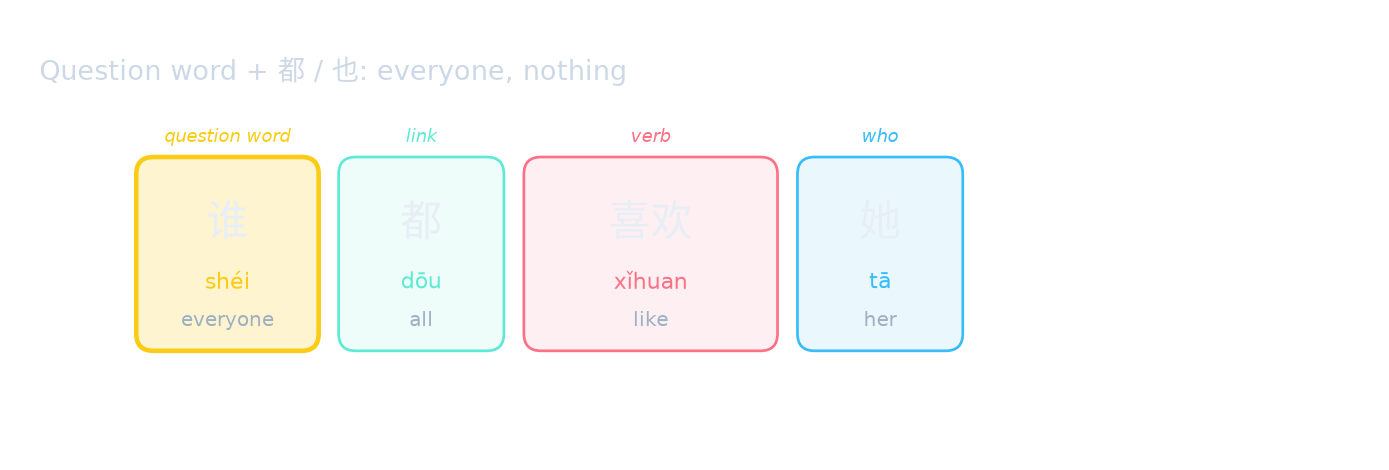
Tout le monde l'aime
- Un nouveau professeur vient d'arriver dans votre établissement et tous les élèves parlent de lui.
- who谁all都to like喜欢she / her她。 — «Tout le monde l'aime.»
Mot interrogatif + all都 / (at all)也
- QW + all都 + Verbe = tout, n'importe quel : who谁all都 (tout le monde), anything什么all都 (tout), where哪儿all都 (n'importe où).
- Le mot interrogatif précède all都 et le verbe, il ne se place pas après le verbe.
I我anything什么all都eat吃。
Complete: “Everyone knows him.” 谁____认识他。
Difficulté 1/5 · 100 pièces + un petit bonus lors de la première réussite aujourd'hui
QW + 都 + verb = every-.
Avec not不 / not没 : personne, rien, nulle part
- he他anything什么(at all)也not没say说。 — «Il n'a rien dit.»
- weekend周末I我where哪儿all都unexpectedly不想to go去。 — «Je ne veux aller nulle part ce week-end.»
he他anything什么(at all)也not没say说。
Build: “He didn't say anything.”
Difficulté 3/5 · 200 pièces + un petit bonus lors de la première réussite aujourd'hui
Subject + QW + 也 + 没 + verb.
Ordre des mots
- Le QW se déplace avant all都 / (at all)也 : I我anything什么all都eat吃, pas I我eat吃anything什么all都.
- Dans la négation, (at all)也 et all都 fonctionnent tous deux : anything什么(at all)也unexpectedly不想eat吃 / anything什么all都unexpectedly不想eat吃.
Which says “I don't want to eat anything.”?
Difficulté 1/5 · 100 pièces + un petit bonus lors de la première réussite aujourd'hui
QW + 都 + 不 + verb.
Avec un nom : which哪 + MW + Nom + all都
- every哪个 / which哪kind种 + nom + all都 = n'importe lequel d'entre eux : every哪个dish菜all都delicious好吃 — «Chaque plat est délicieux.»
- anything什么time; when时候all都can / may可以 — «N'importe quand.»
every哪个dish菜all都delicious好吃。
哪个菜都好吃 means “every dish is delicious”.
Difficulté 1/5 · 100 pièces + un petit bonus lors de la première réussite aujourd'hui
哪个 + noun + 都 = any/every one of them.
Résumé
- QW + all都 + Verbe = tout / n'importe quel : who谁all都, anything什么all都, where哪儿all都, anything什么time; when时候all都.
- QW + (at all)也/all都 + not不/not没 = personne, rien, nulle part. Le QW précède all都.
Lisez la référence complète : Grammaire HSK 3 — Modèles de phrases de base.
A new teacher has just started at your school, and every student is talking about her. Close the examples. Say a Mandarin response, then write it in Chinese. Explain briefly in English what the lesson’s pattern adds. Compare with the model, then change one detail and try again.
This is supported productive practice. Compare meaning and structure; your answer need not copy the model. A partner or teacher must hear the spoken response to comment on pronunciation.