Votre plan d'apprentissage · Continuer · Réviser →
的 / 得 / 地 (les trois “de”)
IntroduitVotre position enregistrée reste dans ce navigateur. Reprendre ne termine pas la leçon ni ne répond à ses questions.
Three characters, one sound
- A friend texts you: he他to run跑(that)的very很fast; soon快。 It looks wrong to a Chinese reader, but why?
- he他to run跑(degree marker)得very很fast; soon快。 Tā pǎo de hěn kuài. — "He runs fast." (that)的, (degree marker)得 and (adverb -ly)地 are all read de, but each has its own job.
- Goal: choose the right "de" by looking at the words next to it, and use (degree marker)得 to say how well someone does something.
1 · The quick test: look at the neighbours
| Particle | Where it stands | Example |
|---|---|---|
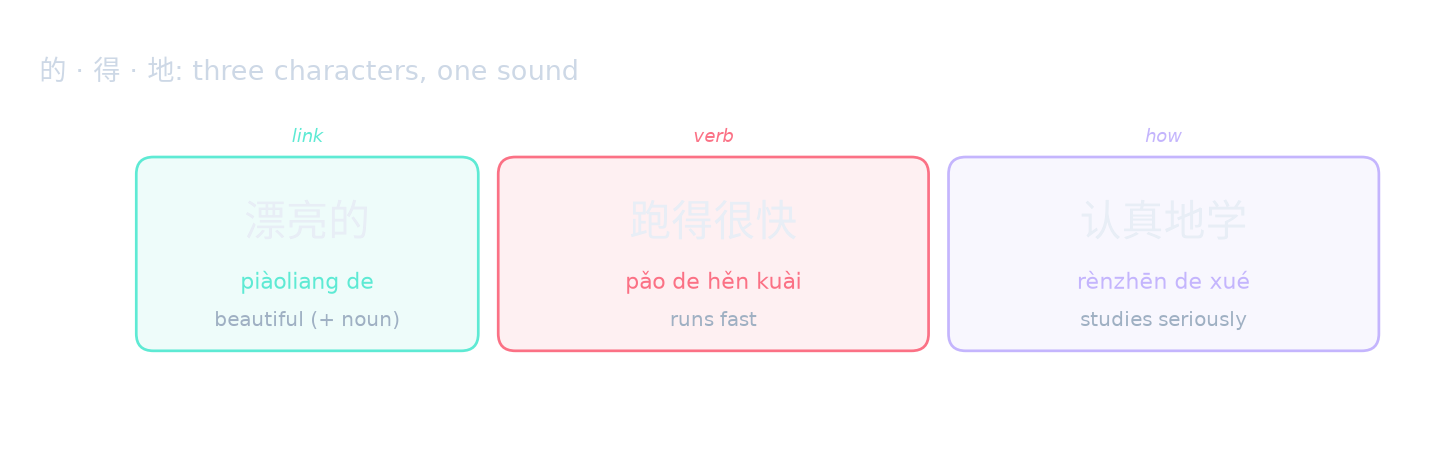
| (that)的 | before a noun | pretty漂亮(that)的clothes衣服 — beautiful clothes |
| (adverb -ly)地 | before a verb | carefully认真(adverb -ly)地to study; to learn学习 — study hard |
| (degree marker)得 | after a verb | to run跑(degree marker)得very很fast; soon快 — run fast |
- Ask two questions: what comes after it (a noun or a verb)? What comes before it (a verb)?
Match each phrase to its particle.
Difficulté 2/5 · 140 pièces + un petit bonus lors de la première réussite aujourd'hui
Before a noun → 的; before a verb → 地; after a verb → 得.
2 · (that)的: describing a noun
- (that)的 joins an owner or a description to a noun: my我(that)的book书 — my book, yesterday昨天bought买(that)的thing; stuff东西 — the things I bought yesterday.
- this这is是mum; mother妈妈to do; to make做(that)的dish (of food); vegetable菜。 Zhè shì māma zuò de cài. — "This is the food Mum made." mum; mother妈妈to do; to make做 describes dish (of food); vegetable菜, so (that)的.
- The noun can be left out when it is clear: this这this (formal) / originally / (measure: books)本book书is是my我(that)的。 — "This book is mine."
this这is是my我yesterday昨天bought买(that)的book书。
In 妈妈做的菜, 的 is correct because 菜 is a noun.
Difficulté 1/5 · 100 pièces + un petit bonus lors de la première réussite aujourd'hui
妈妈做 describes the noun 菜, so 的.
3 · (adverb -ly)地: how someone does an action
- (adverb -ly)地 comes after a describing word and before the verb. It answers "in what way?"
- she她carefully认真(adverb -ly)地read看(completed / change)了once through一遍。 Tā rènzhēn de kàn le yí biàn. — "She read it through carefully."
- child孩子(plural)们happily高兴(adverb -ly)地to run跑(completed / change)了to go out出去。 Háizimen gāoxìng de pǎo le chūqu. — "The children ran out happily."
she她carefully认真地read看了once through一遍。
Fill the gaps: 我__朋友慢慢__走过来。
Difficulté 1/5 · 100 pièces + un petit bonus lors de la première réussite aujourd'hui
我的朋友 (before a noun) and 慢慢地走 (before a verb).
4 · (degree marker)得: how well, how much
- (degree marker)得 follows the verb and gives a comment on it: she她speak说(degree marker)得very很fluently流利。 Tā shuō de hěn liúlì. — "She speaks fluently."
- Negative: put not不 after (degree marker)得: he他to run跑(degree marker)得unhappy不快。 — "He doesn't run fast." ✗ he他not不跑得快。
- Question: he他跑得快unhappy不快? or he他跑得快(yes/no ?)吗? — "Does he run fast?"
- With an object, say the verb twice: he他speak说Chinese汉语speak说(degree marker)得very很well好。 Tā shuō Hànyǔ shuō de hěn hǎo. — "He speaks Chinese very well." ✗ he他speak说Chinese汉语(degree marker)得very很well好。 You can also drop the first verb: he他Chinese汉语speak说(degree marker)得very很well好。
he他speak说Chinese汉语speak说得very很well好。
Complete: “She sings very well.” 她唱____很好。
Difficulté 1/5 · 100 pièces + un petit bonus lors de la première réussite aujourd'hui
After a verb, 得 introduces how well.
Which says “He writes characters well”?
Difficulté 1/5 · 100 pièces + un petit bonus lors de la première réussite aujourd'hui
With an object, say the verb twice: 写字 + 写得很好. (他字写得很好 is also right.)
Build: “My brother doesn't swim fast.”
Difficulté 3/5 · 200 pièces + un petit bonus lors de la première réussite aujourd'hui
不 goes after 得: 游得不快.
5 · Worked example: fix the message
- A classmate writes: ✗ my我(that)的friend朋友happy开心(that)的speak说,she她yesterday昨天test考(that)的very很well好。
- happy开心 _ speak说: the next word speak说 is a verb → (adverb -ly)地. test考 _ very很well好: the word before is the verb test考 → (degree marker)得. my我(that)的friend朋友: the next word is a noun → (that)的 stays.
- Corrected: ✓ my我(that)的friend朋友happy开心(adverb -ly)地speak说,she她yesterday昨天test考(degree marker)得very很well好。 Wǒ de péngyou kāixīn de shuō, tā zuótiān kǎo de hěn hǎo. — "My friend said happily that she did well in the test yesterday."
Fix the message: 他认真__做作业,做__很快。
Difficulté 1/5 · 100 pièces + un petit bonus lors de la première réussite aujourd'hui
认真地 + verb 做; then after the verb 做 comes 得 + how fast.
Common mistakes
- (that)的 after a verb: ✗ to run跑(that)的very很fast; soon快 ✓ to run跑(degree marker)得very很fast; soon快. After the verb + before very很, it is always (degree marker)得.
- (degree marker)得 with an object right behind it: ✗ he他to write characters写字(degree marker)得very很well好 ✓ he他to write characters写字to write写(degree marker)得very很well好 or he他Chinese character字to write写(degree marker)得very很well好.
- not不 before the verb: ✗ he他not不speak说(degree marker)得well好 ✓ he他speak说(degree marker)得no good不好.
Recap
- (that)的 + noun (my我(that)的book书) · (adverb -ly)地 + verb (carefully认真地学) · verb + (degree marker)得 + how well (to run跑(degree marker)得very很fast; soon快).
- With (degree marker)得: negative to run跑(degree marker)得unhappy不快; question 跑得快unhappy不快; with an object speak说Chinese汉语speak说(degree marker)得very很well好.
- All three are read de; choose by the word before and after.
Read the full reference: HSK 3 grammar — Particles.
A friend texts you about a classmate who runs fast, but writes the wrong "de" and the sentence looks odd. Close the examples. Say a Mandarin response, then write it in Chinese. Explain briefly in English what the lesson’s pattern adds. Compare with the model, then change one detail and try again.
This is supported productive practice. Compare meaning and structure; your answer need not copy the model. A partner or teacher must hear the spoken response to comment on pronunciation.