Votre plan d'apprentissage · Continuer · Réviser →
了 final de phrase (changement d'état)
IntroduitVotre position enregistrée reste dans ce navigateur. Reprendre ne termine pas la leçon ni ne répond à ses questions.
Il a commencé à pleuvoir
- Vous alliez sortir, mais vous regardez par la fenêtre et voyez de la pluie.
- to rain下雨(completed / change)了! — « Il pleut maintenant ! » Le (completed / change)了 final indique que la situation a changé.
Phrase + (completed / change)了 = quelque chose a changé
- (completed / change)了 à la fin d'une phrase annonce une nouvelle situation : it's cold (weather)天冷(completed / change)了 (il fait froid maintenant), I我hungry饿(completed / change)了 (j'ai faim maintenant).
- Ce n'est pas un temps passé ; il marque un changement par rapport au passé.
the weather天cold冷了。
The light turns green: “It's green now, let's go.” 绿灯____,走吧。
Difficulté 1/5 · 100 pièces + un petit bonus lors de la première réussite aujourd'hui
Final 了 announces the change.
Nouvelles informations, nouveaux projets, nouvel âge
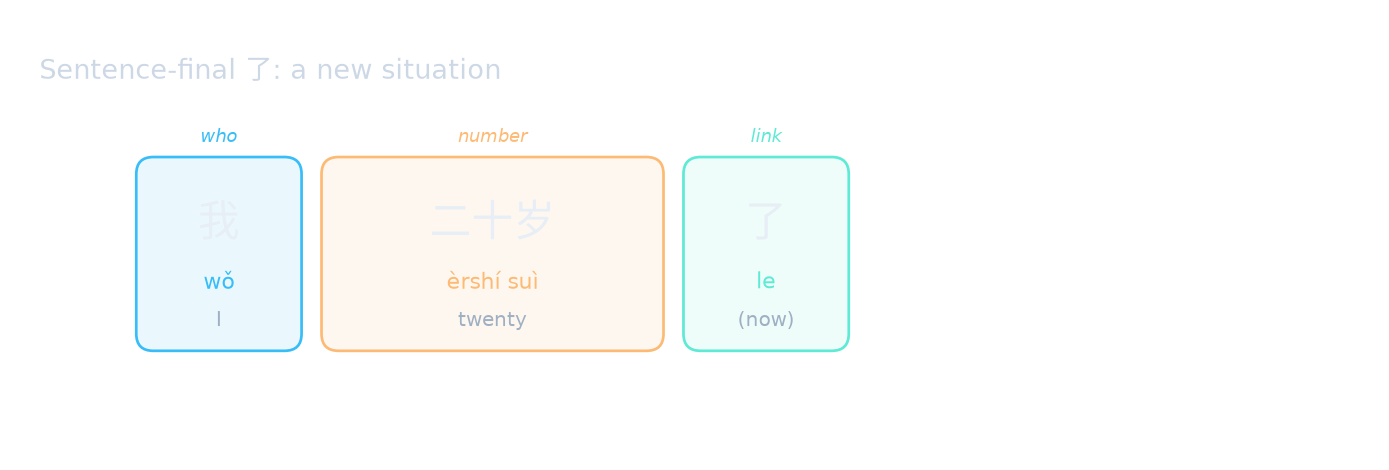
- I我二十岁(completed / change)了。 — « J'ai vingt ans maintenant. » he他not不come来(completed / change)了。 — « Il ne viendra plus. »
- Avec fast; soon快 ou want / will / need要 : 快到(completed / change)了。 — « Nous y sommes presque. »
he他not不come来了。
Build: “We're almost there.”
Difficulté 3/5 · 200 pièces + un petit bonus lors de la première réussite aujourd'hui
快 + verb + 了 = about to.
Pas seulement le passé
- Un ancien habituel sans changement ne prend pas de (completed / change)了 : I我before以前often常常to go去, pas I我before以前often常常to go去(completed / change)了.
- not不…(completed / change)了 = ne plus : I我not不喝咖啡(completed / change)了 signifie « J'ai cessé de boire du café », pas « Je n'ai pas bu de café. »
What does 我不抽烟了 mean?
Difficulté 1/5 · 100 pièces + un petit bonus lors de la première réussite aujourd'hui
不…了 = no longer.
我以前常常去了 is correct for a past habit.
Difficulté 1/5 · 100 pièces + un petit bonus lors de la première réussite aujourd'hui
A past habit with no change takes no 了.
(completed / change)了 final versus verbe (completed / change)了
- Verbe + (completed / change)了 marque une action terminée : I我eat吃(completed / change)了an一个apple苹果 — « J'ai mangé une pomme. »
- Le (completed / change)了 final marque un changement : I我not不hungry饿(completed / change)了 — « Je n'ai plus faim. » Certaines phrases en comportent les deux.
I我eat吃了an一个apple苹果。
Résumé
- Le (completed / change)了 en fin de phrase = une nouvelle situation, un changement : to rain下雨(completed / change)了, I我hungry饿(completed / change)了, he他not不come来(completed / change)了.
- not不…(completed / change)了 = ne plus ; fast; soon快…(completed / change)了 = bientôt. Ce n'est pas un simple temps du passé.
Lire la référence complète : Grammaire HSK 3 — Particules.
You were about to go out, but you look out of the window and see rain. Close the examples. Say a Mandarin response, then write it in Chinese. Explain briefly in English what the lesson’s pattern adds. Compare with the model, then change one detail and try again.
This is supported productive practice. Compare meaning and structure; your answer need not copy the model. A partner or teacher must hear the spoken response to comment on pronunciation.