Transport thermique, calorimétrie et expansion
Introduit| English | Sens |
|---|---|
| thermal resistance/ˈθɜːml rɪˈzɪstəns/ | résistance thermique |
| latent heat/ˈleɪtənt hiːt/ | chaleur latente |
| thermal expansion/ˈθɜːml ekˈspænʃn/ | dilatation thermique |
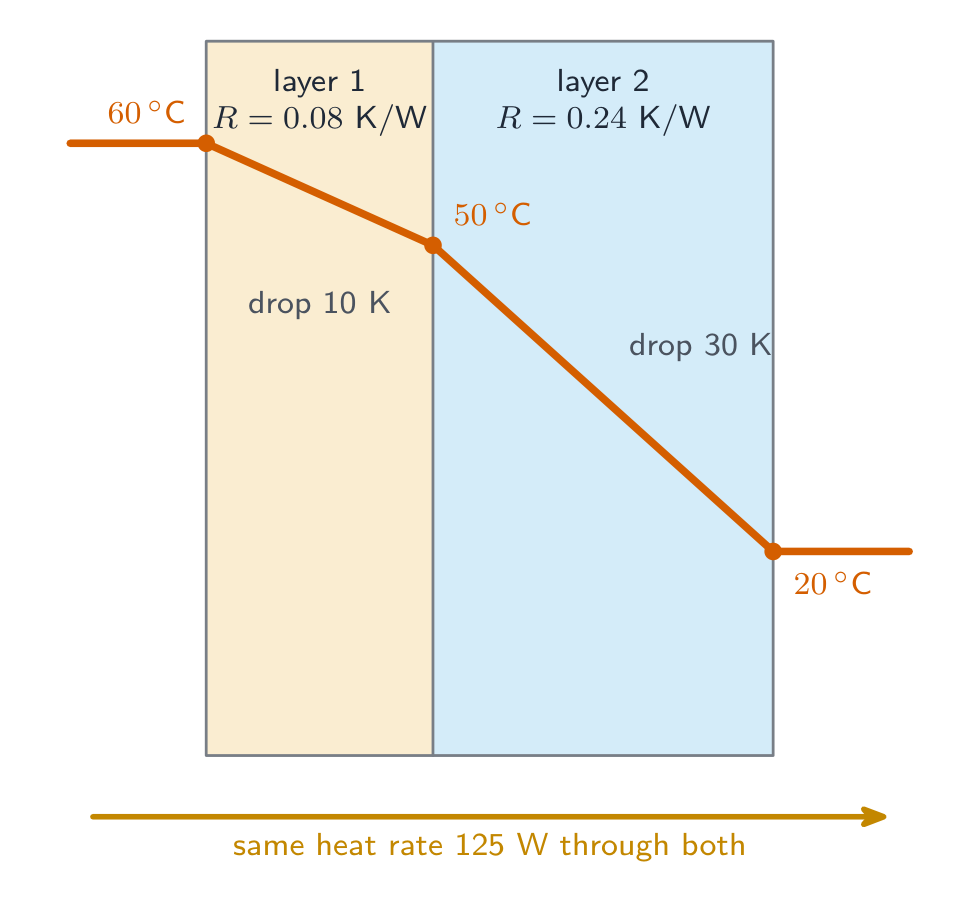
Same heat rate, unequal drops
- Two layers of a wall carry exactly the same heat per second, yet one may take 30 K of the temperature drop and the other only 10 K.
- GRE thermal questions test conduction and thermal resistance 热阻, calorimetry with phase changes, expansion, Newton cooling and radiation.
Conduction and thermal resistance
- $\dot Q = \dfrac{\kappa A\Delta T}{L}$; thermal resistance $R_{\text{th}} = \dfrac{L}{\kappa A}$ (K/W), and the drop across a layer is $\dot QR_{\text{th}}$, just like $V = IR$.
- Series layers: same $\dot Q$, resistances add, and the larger resistance takes the larger share of the drop. Parallel paths: heat rates add.
$A = 0.5$ m²; layer 1: $L = 0.02$, $\kappa = 0.5$ → $R = 0.08$ K/W; layer 2: $L = 0.03$, $\kappa = 0.25$ → $R = 0.24$ K/W. From 60 °C to 20 °C: $\dot Q = 40/0.32 = 125$ W, drops 10 K and 30 K, interface 50 °C, flux 250 W/m².
A slab 0.10 m thick, $\kappa = 0.8$ W/(m·K), area 2 m², 25 K across it. Heat rate in W?
Difficulté 2/5 · 140 pièces + un petit bonus lors de la première réussite aujourd'hui
Fourier conduction: $P = \kappa A\Delta T/d = 0.8 \times 2 \times 25/0.1 = 400$ W.
Two equal-thickness layers, conductivities 3κ (hot side, 80 °C) and κ (cold side, 0 °C). Interface temperature in °C?
Difficulté 2/5 · 140 pièces + un petit bonus lors de la première réussite aujourd'hui
Resistances in ratio 1 : 3, so the hot layer takes a quarter of the 80 K drop: $80 - 20 = 60$ °C.
Calorimetry and latent heat 潜热
- Isolated system: $\sum m c\,\Delta T = 0$ (include the container). Equal $c$: 2 kg at 80 °C + 1 kg at 20 °C → 60 °C, the mass-weighted mean.
- At a phase change, $Q = m\ell$ changes phase, not temperature (water: $\ell_f = 334$ kJ/kg, $\ell_v = 2260$ kJ/kg). Budget first: is there enough heat to finish the transition? If not, the mixture stays at the transition temperature.
3 kg of water at 90 °C mixes with 1 kg at 10 °C, no losses. Final temperature in °C?
Difficulté 2/5 · 140 pièces + un petit bonus lors de la première réussite aujourd'hui
Heat lost equals heat gained, so the final temperature is the mass-weighted mean: $(3 \times 90 + 1 \times 10)/4 = 70$ °C.
How much heat (kJ) melts 0.50 kg of ice at 0 °C? ($\ell_f = 334$ kJ/kg)
Difficulté 2/5 · 140 pièces + un petit bonus lors de la première réussite aujourd'hui
$Q = m\ell_f = 0.5 \times 334 = 167$ kJ, with no change in temperature.
Expansion and thermal stress
- Linear thermal expansion 热膨胀: $\Delta L = \alpha L\Delta T$; area $2\alpha$, volume $3\alpha$. Holes expand with the material, as if the hole were made of the same metal.
- 2 m rod, $\alpha = 10^{-5}$ K⁻¹, +50 K: 1 mm longer. Clamped, $Y = 100$ GPa: stress $-Y\alpha\Delta T = -50$ MPa (compressive).
A 5 m steel rail, $\alpha = 1.2\times10^{-5}$ K⁻¹, warms by 40 K. Lengthening in mm?
Difficulté 2/5 · 140 pièces + un petit bonus lors de la première réussite aujourd'hui
$\Delta L = \alpha L\Delta T = 1.2\times10^{-5} \times 5 \times 40 = 2.4\times10^{-3}$ m, which is 2.4 mm.
Heating a metal plate makes a hole in it larger.
Difficulté 1/5 · 100 pièces + un petit bonus lors de la première réussite aujourd'hui
True. Thermal expansion scales every length in the plate, including the hole's diameter, as if the hole were made of metal too.
Convection and radiation
- Net radiation $\varepsilon\sigma A(T^4 - T_{\text{env}}^4)$ in kelvin. For small differences it is roughly proportional to $T - T_{\text{env}}$.
- Newton cooling: the excess temperature $T - T_{\text{env}}$ decays exponentially with time constant $\tau = C/hA$. Tea at 90 °C in a 20 °C room that cools to 55 °C in 10 min (excess halved) will reach 37.5 °C after another 10 min, not 20 °C.
Conduction, convection ou rayonnement ?
Nommez le mécanisme de transfert de chaleur.
A surface at 27 °C radiates to surroundings at 0 °C. In $T^4 - T_{\text{env}}^4$ utiliser
Difficulté 1/5 · 100 pièces + un petit bonus lors de la première réussite aujourd'hui
Radiation laws use absolute temperature: 27 °C is 300 K and 0 °C is 273 K.
Soup at 80 °C in a 20 °C room cools to 50 °C in 12 min. Temperature after 24 min, in °C?
Difficulté 2/5 · 140 pièces + un petit bonus lors de la première réussite aujourd'hui
The excess halves every 12 min: 60 → 30 → 15 K, so $20 + 15 = 35$ °C.
Worked GRE question: ice in warm water
0.10 kg of ice at 0 °C is dropped into 0.50 kg of water at 40 °C in an insulated cup. ($c = 4.2$ kJ/(kg·K), $\ell_f = 334$ kJ/kg.) The final temperature is about
- (A) 0 °C
- (B) 13 °C
- (C) 20 °C
- (D) 27 °C
- (E) 33 °C
Fast route. Melting needs $0.1 \times 334 = 33.4$ kJ. The warm water cooling to 0 °C could give $0.5 \times 4.2 \times 40 = 84$ kJ, so all the ice melts with 50.6 kJ to spare, shared by 0.6 kg: $\Delta T = 50.6/(0.6 \times 4.2) \approx 20$ °C. Answer (C).
Traps. (E) ignores the latent heat (a plain mix of 0 °C and 40 °C water). (A) assumes some ice is left; check the budget first.
Worked GRE question: the interface temperature
A wall has two layers of equal thickness; the hot side (100 °C) has conductivity $\kappa$, the cold side (0 °C) has $2\kappa$. The temperature at the interface is about
- (A) 25 °C
- (B) 33 °C
- (C) 50 °C
- (D) 67 °C
- (E) 75 °C
Fast route. $R \propto 1/\kappa$, so the hot layer has twice the resistance and takes $\tfrac23$ of the 100 K drop: interface $= 100 - 67 = 33$ °C. Answer (B).
Traps. (D) gives the larger drop to the better conductor. (C) assumes equal drops for equal thicknesses.
Common errors
- Equal drops across layers. Drops follow thermal resistance.
- Skipping latent heat, or not checking whether a phase change completes.
- Holes shrinking when heated. They grow with the material.
- Newton cooling as a straight line. The excess decays exponentially.
Recap
- Series slabs share $\dot Q$; drops are proportional to $R_{\text{th}} = L/\kappa A$.
- Calorimetry sums to zero; budget the latent heat first at a transition.
- $\Delta L = \alpha L\Delta T$; constrained rods feel $Y\alpha\Delta T$.
- Radiation uses kelvin; Newton cooling halves the excess every $\tau\ln 2$.
- thermal expansion: The increase in size of a material as its temperature rises.
- thermal resistance: How strongly a layer opposes heat flow: the temperature drop per watt.
- latent heat: Heat that changes a substance's phase without changing its temperature.