Dérivées de partition, fluctuations d'énergie et capacité thermique
Introduit| English | Sens |
|---|---|
| heat capacity/hiːt kəˈpæsɪti/ | capacité calorifique |
| free energy/friː ˈenədʒi/ | énergie libre |
| partition function/pɑːˈtɪʃn ˈfʌŋkʃn/ | fonction de partition |
Small heat capacity, hot and cold
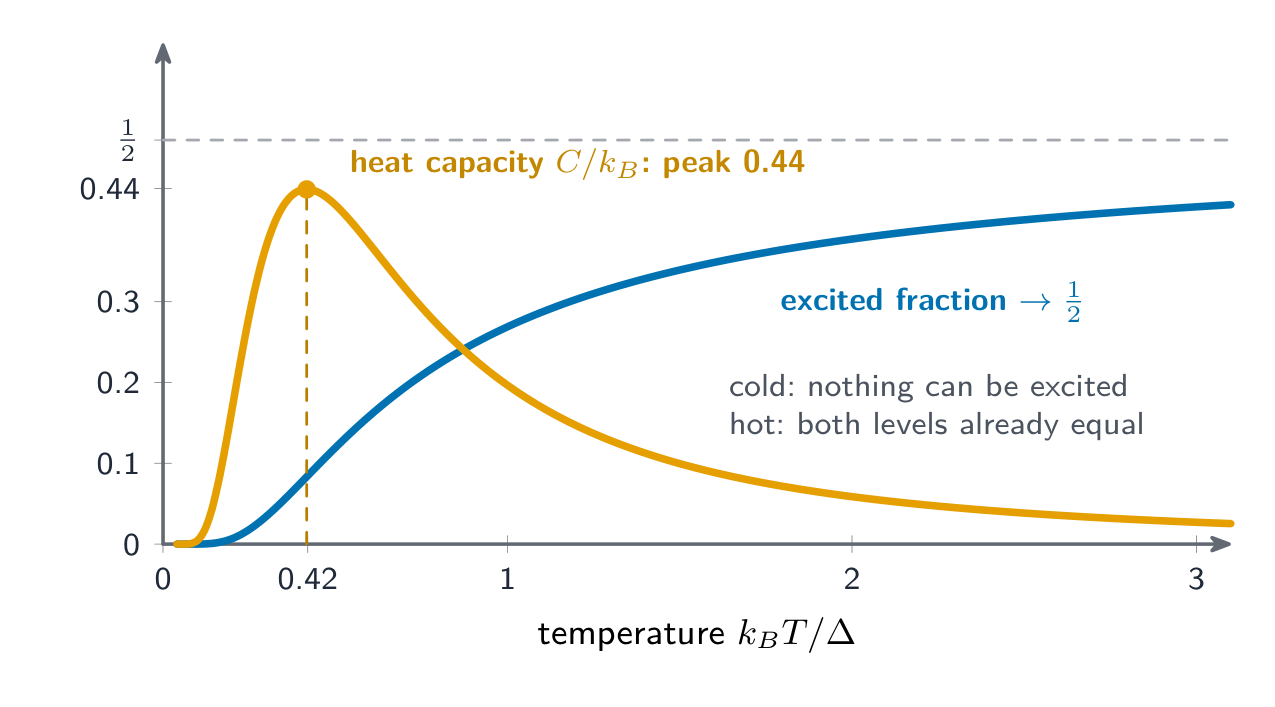
- A two-level system absorbs little heat when it is very cold (it cannot reach the upper level) and again when very hot (both levels are already equally filled). Its heat capacity 热容 peaks in between.
- GRE statistical mechanics tests $Z$ and its derivatives: mean energy, free energy 自由能, entropy, heat capacity and energy fluctuations.
The partition function 配分函数
- $Z = \sum_i g_ie^{-\beta E_i}$, $\beta = 1/k_BT$. Level probability $g_ie^{-\beta E_i}/Z$; $U = -\partial\ln Z/\partial\beta$ with the spectrum held fixed.
- Independent distinguishable subsystems: $Z_{\text{tot}} = z^N$, $U_{\text{tot}} = Nu$.
- Quantum oscillator (levels $n\hbar\omega$): $z = \dfrac{1}{1 - e^{-\beta\hbar\omega}}$. Unlike a two-level system it has infinitely many levels, so at high $T$ its heat capacity approaches $k_B$ (equipartition) instead of falling to zero.
Ground level $g = 1$ at 0; excited level $g = 2$ at $\Delta = k_BT\ln2$. Find $Z$.
Difficulté 2/5 · 140 pièces + un petit bonus lors de la première réussite aujourd'hui
$Z = 1 + 2e^{-\ln 2} = 1 + 2 \times 1/2 = 2$.
Quantum oscillator with $e^{-\beta\hbar\omega} = \tfrac12$. Find its partition function $z$.
Difficulté 2/5 · 140 pièces + un petit bonus lors de la première réussite aujourd'hui
$z = 1/(1 - \tfrac12) = 2$.
Free energy, entropy, heat capacity
- $F = -k_BT\ln Z$; $S = k_B(\ln Z + \beta U)$; $C_V = (\partial U/\partial T)_V$.
- Shifting every level by a constant $\varepsilon$ shifts $U$ and $F$ by $\varepsilon$ and leaves probabilities, $S$ and $C$ unchanged.
- Limits of $S$: at $T \to 0$, $S \to k_B\ln g_0$ (ground degeneracy); at $T \to \infty$, $S \to k_B\ln(\text{number of states})$.
Adding a constant $\varepsilon$ to every energy level changes
Difficulté 1/5 · 100 pièces + un petit bonus lors de la première réussite aujourd'hui
U shifts by ε; the others do not.
A system whose ground level has degeneracy 4. As $T \to 0$, its entropy approaches
Difficulté 1/5 · 100 pièces + un petit bonus lors de la première réussite aujourd'hui
Only the 4 ground states remain, equally likely: $S = k_B\ln4$.
Fluctuations
- $\text{Var}(E) = \langle E^2\rangle - U^2$ and $C_V = \dfrac{\text{Var}(E)}{k_BT^2}$, so $C_V \ge 0$. Relative fluctuations shrink like $1/\sqrt N$.
Levels $0$ and $\Delta$ with $\Delta/k_BT = \ln3$: $z = \tfrac43$, $p_{\text{exc}} = \tfrac14$, $U = \Delta/4$, $\text{Var} = \tfrac{3}{16}\Delta^2$, so $C/k_B = \tfrac{3}{16}(\ln3)^2 \approx 0.226$.
At very high temperature, the two-level energy variance is $k\Delta^2$. Find $k$.
Difficulté 2/5 · 140 pièces + un petit bonus lors de la première réussite aujourd'hui
At very high temperature each level has probability 1/2: $\langle E^2\rangle - \langle E\rangle^2 = \Delta^2/2 - \Delta^2/4 = \Delta^2/4$.
The two-level system
- $x = \Delta/k_BT$: $p_{\text{exc}} = \dfrac{1}{1 + e^x}$, $\dfrac{C}{k_B} = \dfrac{x^2e^x}{(1 + e^x)^2}$.
- Low $T$: everything freezes out. High $T$: $p_{\text{exc}} \to \tfrac12$, $U \to \Delta/2$, $S \to k_B\ln2$, $C \to 0$.
Limite froide ou limite chaude ?
Rappeler les limites de basse et haute température d'un système à deux niveaux.
Two nondegenerate levels with $\Delta/k_BT = \ln 2$. Excited-state probability (three decimal places)?
Difficulté 2/5 · 140 pièces + un petit bonus lors de la première réussite aujourd'hui
The excited weight is $e^{-\ln2} = 1/2$ against 1 for the ground state, so $p = (1/2)/(1 + 1/2) = 1/3$.
The heat capacity of a two-level system grows without limit as the temperature rises.
Difficulté 1/5 · 100 pièces + un petit bonus lors de la première réussite aujourd'hui
The heat capacity of a two-level system peaks (the Schottky anomaly) and then falls to zero once both levels are equally filled.
1000 two-level atoms, gap 2 meV, at very high temperature. Total energy in meV (ground at 0)?
Difficulté 2/5 · 140 pièces + un petit bonus lors de la première réussite aujourd'hui
Each atom averages $\varepsilon/2 = 1$ meV: $1000$ meV.
Worked GRE question: N atoms, very hot
A system of $N$ independent atoms, each with two nondegenerate levels separated by $\varepsilon$, is in thermal equilibrium. As $T \to \infty$, the total energy (ground level at zero) approaches
- (A) 0
- (B) $N\varepsilon/2$
- (C) $N\varepsilon$
- (D) $Nk_BT$
- (E) $\tfrac32Nk_BT$
Fast route. At high $T$ both levels are equally likely, so each atom averages $\varepsilon/2$. Answer (B).
Traps. (C) would need population inversion, which a positive temperature never gives. (D) and (E) apply equipartition, which needs unbounded levels.
Worked GRE question: energy from Z
A system has a ground level at 0 and a triply degenerate level at $\varepsilon$, so $Z = 1 + 3e^{-\beta\varepsilon}$. At the temperature where $e^{-\beta\varepsilon} = \tfrac13$, the mean energy is
- (A) $\varepsilon/4$
- (B) $\varepsilon/3$
- (C) $\varepsilon/2$
- (D) $3\varepsilon/4$
- (E) $\varepsilon$
Fast route. $Z = 1 + 1 = 2$; the excited level has weight 1, so its probability is $\tfrac12$ and $U = \varepsilon/2$. Answer (C). (Or $U = -\partial\ln Z/\partial\beta = 3\varepsilon e^{-\beta\varepsilon}/Z$.)
Traps. (A) drops the degeneracy: $\tfrac13/(1 + \tfrac13) = \tfrac14$. (D) counts the three states as equally likely as the ground state.
Common errors
- Forgetting degeneracies in $Z$.
- Expecting equipartition from a finite spectrum. A two-level system's $C \to 0$ at high $T$.
- Thinking an energy shift changes $C$ or $S$. Only $U$ and $F$ move.
- Sign in $U = -\partial\ln Z/\partial\beta$.
Recap
- Include degeneracies in $Z$; differentiate with the levels fixed.
- $F = -kT\ln Z$; $C_V = \text{Var}(E)/kT^2$.
- A finite spectrum gives a heat-capacity peak, vanishing at both ends; an oscillator tends to $k_B$.
- partition function: The sum of Boltzmann factors over all states, from which thermodynamic quantities follow.
- heat capacity: The heat needed to raise a body’s temperature by one kelvin.
- free energy: The quantity minus kT ln Z, minimised at equilibrium.