Processus gazeux, entropie et cycles réversibles
Introduit| English | Sens |
|---|---|
| coefficient of performance/ˌkəʊɪˈfɪʃənt ɒv pəˈfɔːməns/ | coefficient de performance |
| isothermal/ˌaɪsəˈθɜːml/ | isotherme |
| adiabatic/ˌædiəˈbætɪk/ | adiabatique |
Moving more heat than the work supplied
- A refrigerator pumps 560 J out of a 280 K interior using only 40 J of work: its coefficient of performance 性能系数 (COP) is 14. That is not an efficiency above 100%; the heat is moved, not created.
- Thermodynamics and statistical mechanics are about a tenth of the GRE Physics test. Here: the first law with correct signs, the four standard ideal-gas processes, reading $P$–$V$ diagrams, entropy (including irreversible processes), and the Carnot limits.
The first law and the four processes
- $\Delta U = Q - W$, where $Q$ is heat into the gas and $W = \int P\,dV$ is work by the gas. For an ideal gas $U$ depends only on $T$: $\Delta U = nC_V\Delta T$, with $C_V = \tfrac32R$ (monatomic) or $\tfrac52R$ (diatomic), and $C_P = C_V + R$, $\gamma = C_P/C_V$ ($\tfrac53$ or $\tfrac75$).
- Each process makes one quantity simple:
| Process | Stays fixed | Work by gas $W$ | Heat in $Q$ |
|---|---|---|---|
| Isochoric | $V$ | 0 | $nC_V\Delta T$ |
| Isobaric | $P$ | $P\Delta V$ | $nC_P\Delta T$ |
| Isothermal 等温的 | $T$ | $nRT\ln(V_2/V_1)$ | $= W$ (since $\Delta U = 0$) |
| Adiabatic 绝热的 | no heat | $\dfrac{P_1V_1 - P_2V_2}{\gamma - 1}$ | 0 |
- Adiabatic means no heat, not constant temperature: $PV^\gamma$ and $TV^{\gamma-1}$ stay constant, so compression heats the gas.
Quelle grandeur est nulle ?
Identifier Q = 0, W = 0 ou ΔU = 0 pour les processus du gaz idéal.
In an adiabatic process,
Difficulté 1/5 · 100 pièces + un petit bonus lors de la première réussite aujourd'hui
Adiabatic means no heat crosses the boundary: $Q = 0$, so $\Delta U = W$ on the gas.
Heat needed to warm 2.0 mol of a monatomic ideal gas by 10 K at constant pressure, in J? ($R = 8.31$ J/(mol·K))
Difficulté 2/5 · 140 pièces + un petit bonus lors de la première réussite aujourd'hui
$Q = nC_P\Delta T = 2.0 \times \tfrac52(8.31) \times 10 = 416$ J. At constant volume it would be only $nC_V\Delta T = 249$ J; the rest becomes work $P\Delta V = nR\Delta T$.
Reading $P$–$V$ diagrams
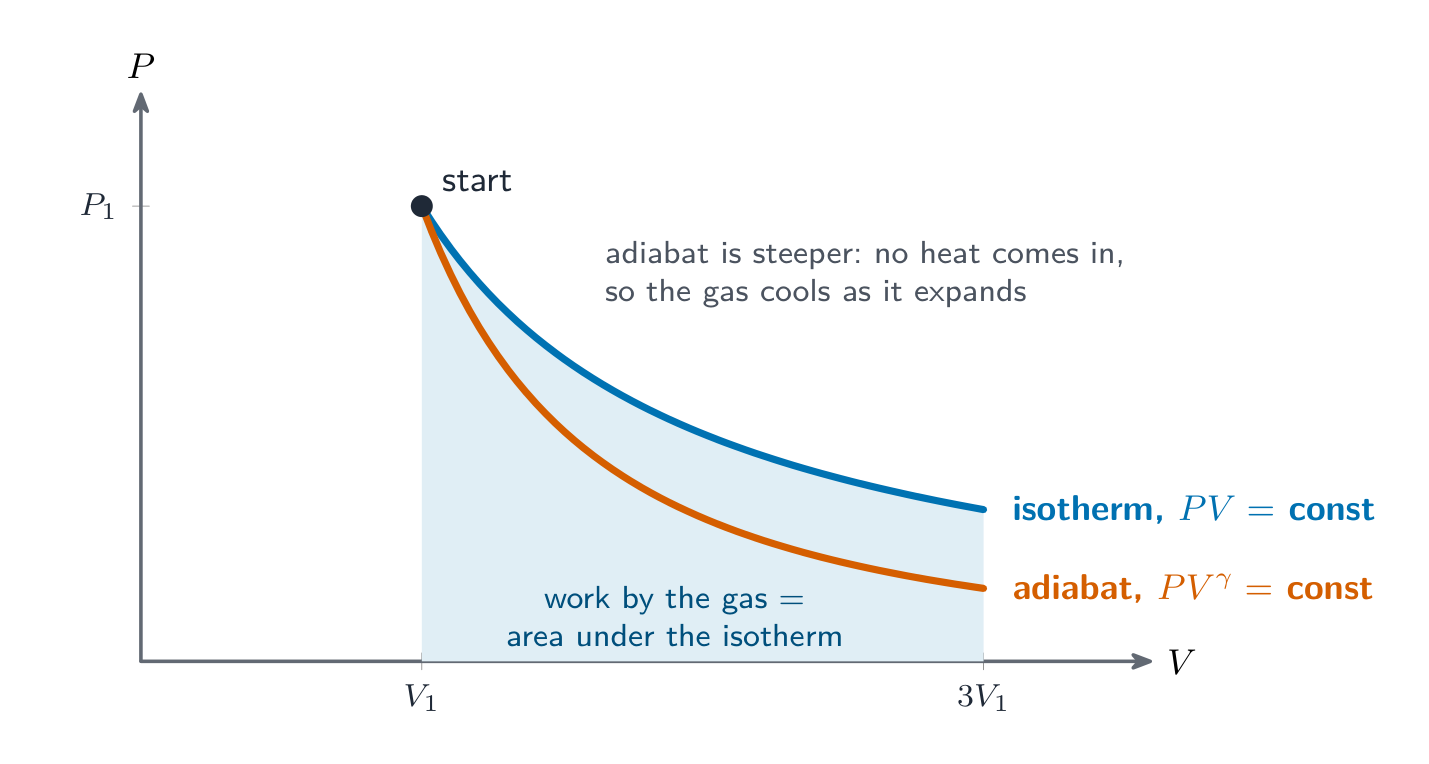
- Work by the gas is the area under the path, in pascals times cubic metres. Around a cycle $\Delta U = 0$, so net heat in equals net work, the enclosed area: positive for a clockwise cycle.
- From the same start, an adiabat is steeper than an isotherm: with no heat coming in, the gas cools as it expands, so its pressure falls faster.
Rectangle from $1$ to $3\times10^5$ Pa and $0.001$ to $0.004$ m³: $W = 2\times10^5 \times 0.003 = 600$ J. In litres you would get 0.6 and be wrong by $10^3$.
A clockwise rectangular cycle spans $2\times10^5$ à $4\times10^5$ Pa and 1 L to 3 L. Net work in J?
Difficulté 2/5 · 140 pièces + un petit bonus lors de la première réussite aujourd'hui
$2\times10^5 \times 0.002$.
Entropy
- $dS = \delta Q_{\text{rev}}/T$, and $S$ is a state function: $\Delta S$ depends only on the end states. For an ideal gas, $\Delta S = nC_V\ln(T_2/T_1) + nR\ln(V_2/V_1)$, whatever path the gas really took.
- So in a free expansion into vacuum ($Q = 0$, $W = 0$, $T$ unchanged), the gas still gains $\Delta S = nR\ln(V_2/V_1)$: compute it along a reversible isotherm between the same states. A reversible process has zero total entropy change; any irreversible one (free expansion, heat flowing across a finite temperature difference) has $\Delta S_{\text{total}} > 0$.
One mole of ideal gas doubles its volume reversibly and isothermally. Entropy change in J/K (two decimal places)?
Difficulté 2/5 · 140 pièces + un petit bonus lors de la première réussite aujourd'hui
For a reversible isothermal expansion $\Delta S = nR\ln(V_2/V_1) = 8.314 \ln 2 = 5.76$ J/K.
1.0 kg of water at 300 K is mixed with 1.0 kg at 350 K in an insulated cup. Total entropy change in J/K? ($c = 4186$ J/(kg·K), one decimal place)
Difficulté 2/5 · 140 pièces + un petit bonus lors de la première réussite aujourd'hui
Final temperature 325 K. $\Delta S = mc\ln\tfrac{325}{300} + mc\ln\tfrac{325}{350} = 4186\ln\dfrac{325^2}{300 \times 350} = 4186 \times 0.00593 = 24.8$ J/K $> 0$: irreversible.
Engines, refrigerators, heat pumps
- Carnot limits, with temperatures in kelvin: engine $\eta = 1 - \dfrac{T_C}{T_H}$; refrigerator $\text{COP} = \dfrac{T_C}{T_H - T_C}$; heat pump $\text{COP} = \dfrac{T_H}{T_H - T_C}$. The two COPs can exceed 1, and heat pump COP $=$ refrigerator COP $+ 1$.
- A Carnot cycle is a rectangle on a $T$–$S$ diagram: $Q_H = T_H\Delta S$, $Q_C = T_C\Delta S$, $W = (T_H - T_C)\Delta S$.
Carnot refrigerator, $T_C = 280$ K, $T_H = 300$ K, entropy transfer 2 J/K: $Q_C = 560$ J, $Q_H = 600$ J, $W = 40$ J, COP $= 560/40 = 14 = 280/20$.
Carnot refrigerator COP between 270 K and 300 K?
Difficulté 2/5 · 140 pièces + un petit bonus lors de la première réussite aujourd'hui
A Carnot refrigerator has $\text{COP} = T_C/(T_H - T_C) = 270/30 = 9$.
Carnot heat-pump COP between the same temperatures?
Difficulté 2/5 · 140 pièces + un petit bonus lors de la première réussite aujourd'hui
A heat pump delivers $Q_H$, so $\text{COP} = T_H/(T_H - T_C) = 300/30 = 10$, one more than the refrigerator.
A refrigerator with a coefficient of performance of 14 violates energy conservation.
Difficulté 1/5 · 100 pièces + un petit bonus lors de la première réussite aujourd'hui
It moves 14 J of heat per joule of work; it does not create energy.
Worked GRE question: adiabatic compression
A monatomic ideal gas is compressed adiabatically and reversibly to one-eighth of its original volume. By what factor does its absolute temperature increase?
- (A) 2
- (B) 4
- (C) 8
- (D) 16
- (E) 32
Fast route. $TV^{\gamma-1}$ is constant with $\gamma - 1 = \tfrac23$. So $T_2/T_1 = 8^{2/3} = 4$. Answer (B).
Traps. (E) is the pressure factor, $8^{5/3} = 32$. (C) treats it as if $P$ stayed constant. (A) uses $\gamma - 1 = \tfrac13$.
A diatomic ideal gas ($\gamma = 7/5$) is compressed adiabatically to 1/32 of its volume. Factor by which $T$ rises?
Difficulté 2/5 · 140 pièces + un petit bonus lors de la première réussite aujourd'hui
$T_2/T_1 = 32^{\gamma - 1} = 32^{2/5} = 4$.
Worked GRE question: free expansion
One mole of an ideal gas is in one half of an insulated box; the other half is vacuum. The partition is removed and the gas fills the box. The entropy change of the gas is
- (A) 0, because no heat flows
- (B) $R\ln 2$
- (C) $-R\ln 2$
- (D) $2R$
- (E) $\tfrac32R\ln 2$
Fast route. Same start and end states as a reversible isothermal doubling ($T$ is unchanged in a free expansion of an ideal gas). So $\Delta S = R\ln 2 \approx 5.76$ J/K. Answer (B).
Traps. (A) uses $Q/T$ along the real, irreversible path; $dS = \delta Q/T$ holds only for reversible paths. (C) has the wrong sign: spreading out raises entropy. (E) uses $C_V$ although $T$ does not change.
Common errors
- Treating adiabatic as isothermal. Adiabatic means $Q = 0$; the temperature changes.
- Sign of $W$. In $\Delta U = Q - W$, $W$ is work by the gas; compression has $W < 0$.
- Zero entropy change because $Q = 0$. Only for reversible paths; a free expansion has $\Delta S > 0$.
- Celsius in Carnot formulas, or litres in $P\Delta V$. Use kelvin and cubic metres.
Recap
- $\Delta U = Q - W$; $\Delta U = nC_V\Delta T$ for an ideal gas; $\gamma = \tfrac53$ (monatomic), $\tfrac75$ (diatomic).
- Isothermal $W = nRT\ln(V_2/V_1)$; adiabatic $PV^\gamma$ and $TV^{\gamma-1}$ constant.
- Work = area under the path; clockwise cycles do positive work.
- $\Delta S = nC_V\ln(T_2/T_1) + nR\ln(V_2/V_1)$, along any path; free expansion still gains entropy.
- $\eta = 1 - T_C/T_H$; COP$_{\text{fridge}} = T_C/(T_H - T_C)$; COP$_{\text{pump}} = T_H/(T_H - T_C)$.
- isothermal: At constant temperature.
- adiabatic: With no heat crossing the boundary.
- coefficient of performance: The useful heat moved divided by the work put in, for a refrigerator or heat pump.