Distributions de vitesses et ensembles statistiques
Introduit| English | Sens |
|---|---|
| velocity/vəˈlɒsɪti/ | vitesse |
| speed/spiːd/ | vitesse |
| degeneracy/dɪˈdʒenərəsi/ | dégénérescence |
| probability density/ˌprɒbəˈbɪlɪti ˈdensɪti/ | densité de probabilité |
| Maxwell distribution/ˈmækswel ˌdɪstrɪˈbjuːʃn/ | distribution de Maxwell |
Zero mean velocity, large mean speed
- In still air the molecules' average velocity is zero — every direction is equally likely — but their average speed is about 470 m/s.
- GRE statistical mechanics tests probability densities, the Maxwell speed distribution and canonical probabilities with degeneracy 简并度.
Densities, not probabilities
- $f(v)$ is a probability density 概率密度: $f(v)\,dv$ is a probability, but $f$ itself has units of 1/speed, and $\int_0^\infty f\,dv = 1$. A count density integrates to $N$.
A count density shaped as a trapezoid — rising over $v_0$, flat over $2v_0$, falling over $v_0$ — has area $3av_0$. With $N = 90$ and $v_0 = 2$ m/s, the height is $a = 15$ particles per (m/s).
The same trapezoid shape with $N = 120$ et $v_0 = 4$ m/s. Plateau height in particles per (m/s)?
Difficulté 2/5 · 140 pièces + un petit bonus lors de la première réussite aujourd'hui
The area under the distribution equals $N$. The trapezoid has area $3v_0 h$, so $h = N/(3v_0) = 120/12 = 10$ per m/s.
The Maxwell distribution 麦克斯韦分布
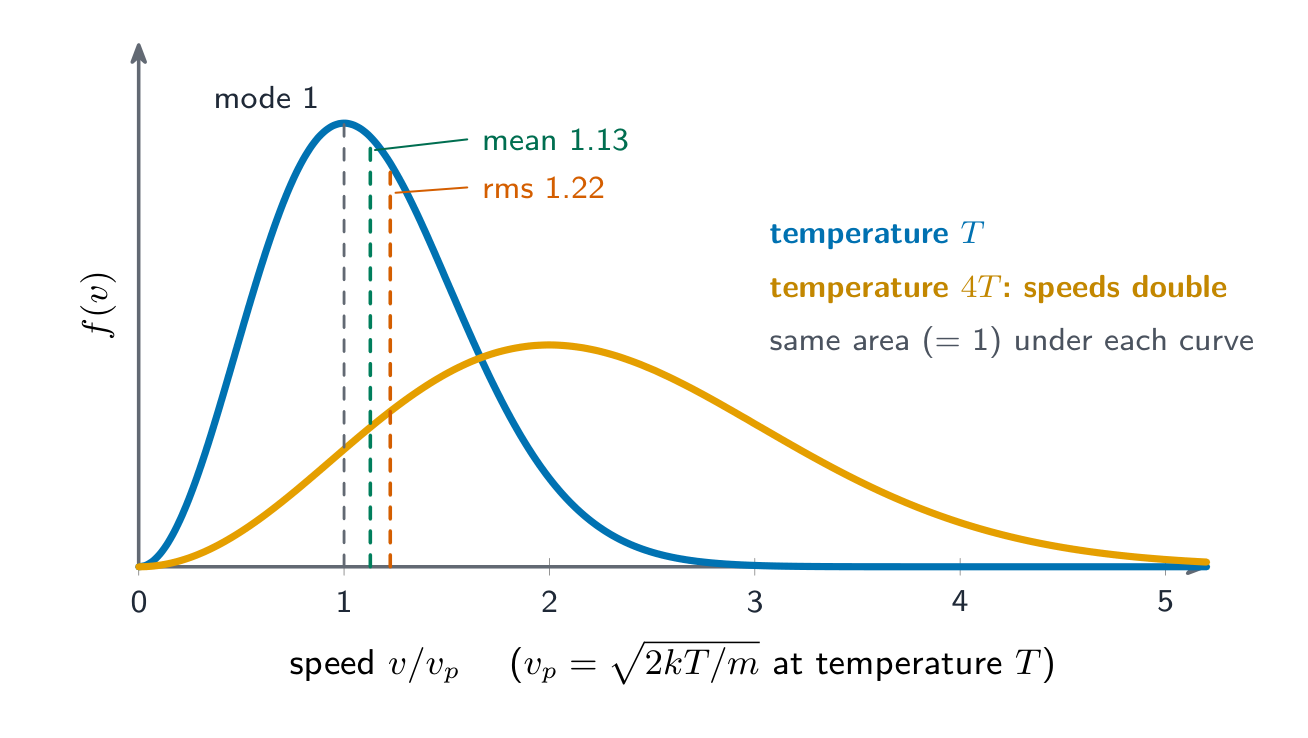
- $f(v) \propto v^2e^{-mv^2/2kT}$. Mode $\sqrt{2kT/m}$ < mean $\sqrt{8kT/\pi m}$ < rms $\sqrt{3kT/m}$.
- $f(0) = 0$ because of the $v^2$ (shell volume) factor, even though the velocity-vector density peaks at zero. The tail to high speeds makes the curve lopsided, which is why mode < mean < rms.
- Speeds scale as $\sqrt{T/m}$: four times the temperature doubles them, and the curve gets lower and wider with the same area. Remember the rms from $\tfrac12m\overline{v^2} = \tfrac32kT$; for air at 300 K it is about 500 m/s.
Zéro ou positif ?
Séparer les moyennes vectorielles des moyennes de vitesse dans un gaz isotrope.
Rapport $v_{\text{rms}}/v_{\text{mode}}$ for a Maxwell gas (three decimal places)?
Difficulté 2/5 · 140 pièces + un petit bonus lors de la première réussite aujourd'hui
For a Maxwell gas $v_{\text{rms}} = \sqrt{3kT/m}$ et $v_{\text{mode}} = \sqrt{2kT/m}$, so the ratio is $\sqrt{3/2} = 1.225$.
At the same temperature, how many times faster is the typical H₂ molecule than O₂ (masses 2 and 32)?
Difficulté 2/5 · 140 pièces + un petit bonus lors de la première réussite aujourd'hui
Typical speeds scale as $1/\sqrt{m}$: $\sqrt{32/2} = \sqrt{16} = 4$.
The rms speed of a gas is 400 m/s at 300 K. Its rms speed at 1200 K, in m/s?
Difficulté 2/5 · 140 pièces + un petit bonus lors de la première réussite aujourd'hui
$v \propto \sqrt T$: four times the temperature doubles the speed.
The mean speed of molecules in a still gas is positive even though the mean velocity is zero.
Difficulté 1/5 · 100 pièces + un petit bonus lors de la première réussite aujourd'hui
True. Velocities cancel because they have directions, but speeds are magnitudes and cannot cancel.
Exact values have zero probability
- For a continuous distribution, $P(v = v_1) = 0$; only intervals carry probability.
A speed density is flat at 0.05 per (m/s) between 10 and 30 m/s. Probability of a speed between 12 and 18 m/s?
Difficulté 2/5 · 140 pièces + un petit bonus lors de la première réussite aujourd'hui
Aire $= 0.05 \times 6 = 0.30$.
Canonical probabilities with degeneracy
- $P(\text{level } i) = \dfrac{g_ie^{-E_i/kT}}{Z}$. Equal weight per state, not per level.
- Ground $g = 1$, excited $g = 2$ at gap $kT\ln 2$: weights 1 and $2 \cdot \tfrac12 = 1$, so each level has probability $\tfrac12$ and each excited state $\tfrac14$.
- As $T \to \infty$ the Boltzmann factors approach 1 and level probabilities approach $g_i/\sum g$; as $T \to 0$ everything drops to the ground level.
Ground level $g = 1$; excited level $g = 3$ at gap $kT\ln3$. Probability of the excited level?
Difficulté 1/5 · 100 pièces + un petit bonus lors de la première réussite aujourd'hui
Weights 1 and 3 × 1/3 = 1.
Ground level $g = 1$, excited level $g = 3$. In the limit of very high temperature, probability of the excited level?
Difficulté 2/5 · 140 pièces + un petit bonus lors de la première réussite aujourd'hui
All Boltzmann factors approach 1, so probabilities follow the state count: $3/4$.
Worked GRE question: two gases, one temperature
A container holds helium ($m = 4$ u) and oxygen ($m = 32$ u) at the same temperature. The ratio of the rms speeds, $v_{\text{He}}/v_{\text{O}_2}$, is
- (A) 1
- (B) $\sqrt2$
- (C) $2\sqrt2$
- (D) 8
- (E) 64
Fast route. Same $T$ means the same mean kinetic energy, so $v \propto 1/\sqrt m$: $\sqrt{32/4} = \sqrt8 = 2\sqrt2$. Answer (C).
Traps. (A) equates speeds instead of energies. (D) forgets the square root.
Worked GRE question: a three-level system
A system has a non-degenerate ground level at energy 0 and a doubly degenerate level at energy $\varepsilon$. At temperature $T = \varepsilon/(k\ln 4)$, the probability of finding the system in the ground level is
- (A) 1/3
- (B) 1/2
- (C) 2/3
- (D) 3/4
- (E) 4/5
Fast route. $e^{-\varepsilon/kT} = e^{-\ln 4} = \tfrac14$. Weights: ground $1$, excited $2 \times \tfrac14 = \tfrac12$. $Z = \tfrac32$, so $P_0 = 1/\tfrac32 = \tfrac23$. Answer (C).
Traps. (E) drops the degeneracy ($1/(1 + \tfrac14)$). (A) counts three equally likely states, the high-temperature limit.
Common errors
- Reading $f(v)$ as a probability. Only areas $f\,dv$ are probabilities.
- Mean velocity = mean speed. Velocity averages to zero; speed does not.
- Ignoring degeneracy. Weight each level by $g_i$.
- Speeds $\propto T$. They go as $\sqrt{T/m}$.
Recap
- Normalise a density by its area before reading it.
- Mode < mean < rms; all $\propto \sqrt{T/m}$.
- Include degeneracy $g_i$ before dividing by $Z$.
- probability density: A function whose area over an interval gives the probability of that interval.
- Maxwell distribution: The probability density of molecular speeds in an ideal gas at equilibrium.
- degeneracy: The number of distinct states that share one energy level.