Travailler à travers les cultures
Introduit| English | Sens |
|---|---|
| culture/ˈkʌltʃə/ | Culture |
| cultural diversity/ˈkʌltʃərəl daɪˈvɜːsɪti/ | Diversité culturelle |
| stereotype/ˈsterɪəʊtaɪp/ | Stéréotype |
Check the meaning before assigning a cause
In a fictional meeting, Wei asks whether the group can send a draft on Friday. Ana says, “That could be difficult.” Wei records “everyone agreed”. No one has asked Ana what the difficulty is.
Culture 文化 includes shared practices, meanings and expectations. Individuals also differ, and work conditions matter. Ana's sentence could identify an obstacle or express reluctance. Her nationality alone cannot establish its meaning. Ask about the task: “What makes Friday difficult, and what can you complete by then?”
Ana dit que vendredi pourrait être difficile. Quelle action vérifie ce qu'elle signifie ?
Difficulté 1/5 · 100 pièces + un petit bonus lors de la première réussite aujourd'hui
Demander l'obstacle et le travail disponible. La nationalité ou une formule polie seule n'établit pas l'intention.
Confirm a specific decision
Silence or a polite response is not enough to establish agreement. Restate who will do what and by when, then invite correction. “Wei will send the draft on Friday at 16:00; each member will comment by Sunday 18:00. Can everyone meet those times?”
Record a confirmed answer or an unresolved point. A confirmation question reduces ambiguity but does not guarantee that everyone understood it. Allow questions, check availability and compare the later handover with the agreement.
Une réunion qui se termine sans objection n’a pas nécessairement abouti à un réel accord.
Difficulté 1/5 · 100 pièces + un petit bonus lors de la première réussite aujourd'hui
Vrai. Le silence seul ne prouve pas l'accord. Confirmer la tâche, le propriétaire et l'échéance, inviter aux corrections et consigner les points non résolus.
Écrivez une phrase qui confirme explicitement une décision de groupe, afin que personne ne parte avec une compréhension différente.
Difficulté 3/5 · 200 pièces + un petit bonus lors de la première réussite aujourd'hui
Exemple : "Donc Wei envoie le brouillon au groupe vendredi et nous commentons tous chacun dimanche — c'est ça ?"
Invite evidence from different perspectives
Cultural diversity 文化多样性 means that different cultural backgrounds are represented. It can bring different experiences and questions; it does not guarantee better decisions or tell you what a particular person knows.
A stereotype 刻板印象 applies a generalised expectation about a group to an individual. “People from her country never disagree directly” does not establish Ana's intention. Check her explanation, relevant experience and actual contribution instead of assigning a role from that claim.
Appliquer une généralisation sur un groupe à un individu est un raccourci utile en travail d'équipe.
Difficulté 1/5 · 100 pièces + un petit bonus lors de la première réussite aujourd'hui
Une généralisation de groupe n'établit pas une intention ou une capacité individuelle. Demandez au sujet du travail et vérifiez les preuves.
Design turns, then review them
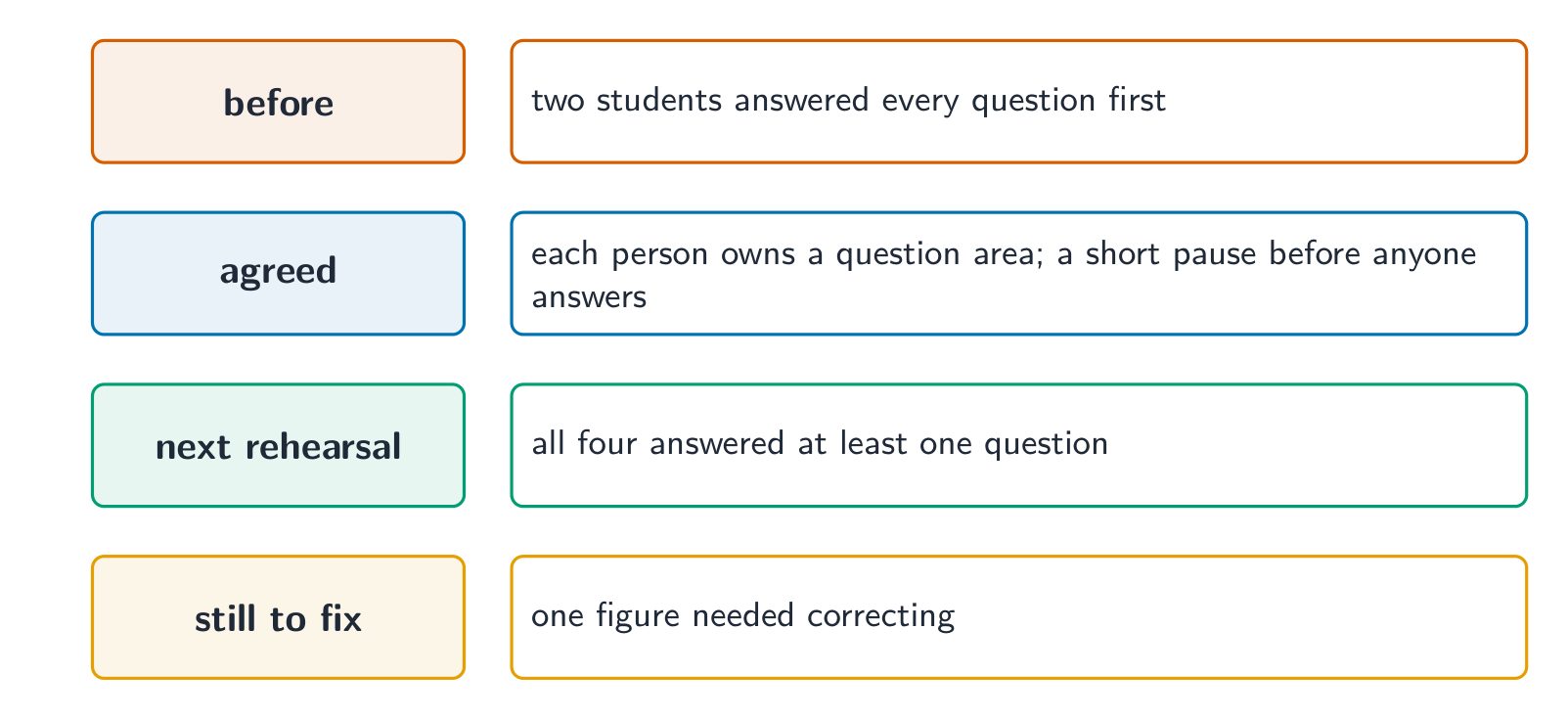
Four presenters, one trial. Two students answered every rehearsal question before the others had a turn. The quieter two said they had prepared answers but needed time to read each question. The group agreed question areas and a short pause before assigning a turn.
At the next rehearsal all four answered at least one question. The group checked answers against the report and found one figure still needed correction. More balanced turns improved participation in that trial; they did not establish that every answer was accurate or identify nationality as the cause of the earlier silence.
Deux présentateurs disent avoir besoin de temps pour lire les questions et ont été interrompus. Quel plan aborde directement ces obstacles rapportés ?
Difficulté 1/5 · 100 pièces + un petit bonus lors de la première réussite aujourd'hui
Cela addressed les obstacles rapportés. Révisez la participation et l'exactitude en répétition ; un tour convenu ne garantit pas la justesse.
Agree a shared process
Discuss how to raise a concern, confirm a deadline, ask for clarification and review contributions. Offer clear turns and written decisions; ask whether these meet the actual need. Keep the course's task and accessibility rules in view.
Do not assume that the quickest or loudest answer is correct. Compare the explanation and evidence with the task. Also avoid assuming that the quietest person must be the expert. Both claims replace a check with an impression.
Clarify the task, invite correction and record the result. Culture may help you ask respectful questions; it cannot supply a person's answer. In the rehearsal, all four spoke and one figure still needed correction. The next step is to fix and check that figure, then review another trial.