Se comprendre soi-même et les autres
Introduit| English | Sens |
|---|---|
| personality trait/ˌpɜːsəˈnælɪti treɪt/ | Trait de personnalité |
| introversion and extraversion/ˌɪntrəˈvɜːʃn ænd ˌekstrəˈvɜːʃn/ | Introversion et extraversion |
| self-awareness/self əˈweənəs/ | Conscience de soi |
| values/ˈvæljuːz/ | Valeurs |
| empathy/ˈempəθi/ | Empathie |
A quiet meeting does not explain a person
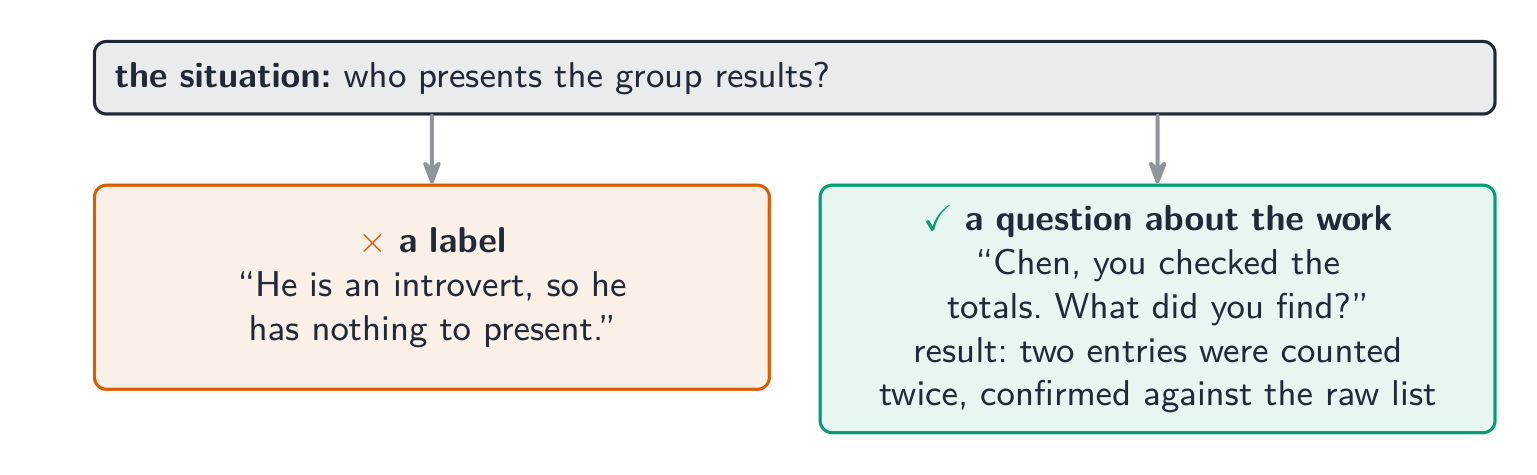
Chen brings a checked survey table to a group meeting but says nothing for twenty minutes. Wei says, “He is an introvert, so he has nothing to present.” The table is evidence of preparation. Silence alone does not establish a personality trait, lack of knowledge or unwillingness to help.
A personality trait 人格特质 describes a relatively lasting tendency in thought, feeling or behaviour. One action in one situation is not enough to establish it. Ask about the work and the conditions before deciding what support or role is needed.
Tendencies are not fixed team roles
Introversion and extraversion 内向与外向 describe broad tendencies along a range, rather than two boxes that everyone fits exactly. Introversion includes a more inward orientation; extraversion includes a more outward and social orientation. These labels do not establish someone's knowledge or presentation skill. APA definition.
Shyness and introversion are not interchangeable labels. A person may prefer quieter work and still present effectively. Another may speak readily but need to check their figures. Do not assign or remove an assessed task from a personality label alone; check the actual task rules and agreed support.
Quelle description traite convenablement de l'introversion et de l'extroversion ?
Difficulté 1/5 · 100 pièces + un petit bonus lors de la première réussite aujourd'hui
Ce sont des tendances larges, pas un diagnostic basé sur une seule rencontre. Une étiquette seule n'établit ni compétence ni raison du silence.
Describe your own evidence
Self-awareness 自我认知 means recognising your tendencies, responses and limits. Use a specific observation: “I answered after reading the question, but interrupted twice when the group talked quickly.” This supports a next action: pause, note the question and wait for the agreed turn.
Values 价值观 are things a person considers important. In a fictional planning discussion, Rui explicitly values checking every source, while Lin values finishing early. Their shared goal is a reliable report on time. Ask how to protect both aims; disagreement alone does not prove different values, intelligence or effort.
Rui dit que vérifier chaque source est primordial ; Lin dit que terminer tôt est primordial. Ils partagent l'objectif du rapport. Quelle différence est explicitement décrite ?
Difficulté 1/5 · 100 pièces + un petit bonus lors de la première réussite aujourd'hui
Les priorités déclarées diffèrent. Un désaccord seul n'établirait pas des valeurs, capacités ou efforts différents.
Ask about a contribution
A question and an observed response. Wei asks, “Chen, you checked the response totals. What did you find?” Chen explains that two entries were counted twice. The group compares the table with the raw list and confirms the duplicate entries.
The question gave Chen a specific opening. The checked response shows a useful contribution in this meeting. It does not prove why he was silent or guarantee what he will do next time. Agree turns and preparation, then review another meeting.
Un membre du groupe est resté silencieux pendant vingt minutes. Quel est le meilleur mouvement ?
Difficulté 1/5 · 100 pièces + un petit bonus lors de la première réussite aujourd'hui
Une question spécifique offre une ouverture sur le travail préparé. Vérifiez la réponse ; elle n'établit pas la raison du silence.
Écrivez une question qui ferait participer un coéquipier silencieux à une discussion sur une enquête qu'il a aidée à concevoir.
Difficulté 3/5 · 200 pièces + un petit bonus lors de la première réussite aujourd'hui
Une question sur le sondage offre une ouverture spécifique. Écoutez la réponse et vérifiez toute affirmation par rapport au travail ; ne supposez pas la raison du silence.
Understanding someone needs a check
Empathy 同理心 involves trying to understand another person's perspective. It does not mean guessing their feelings and treating the guess as fact. Ask respectfully: “Would you prefer to show the table first, or explain the two entries?” Leave room for an answer that differs from your expectation.
A group can offer preparation time, written notes and clear turns while keeping the required task in view. Follow agreed accessibility arrangements and the course rules. A personality label neither establishes an exemption nor cancels a person's support needs.
Une étiquette de personnalité seule établit qu'un élève est exempté de la présentation requise.
Difficulté 1/5 · 100 pièces + un petit bonus lors de la première réussite aujourd'hui
Vérifiez les règles de la tâche et le soutien convenu. Une étiquette de personnalité seule n'établit ni une exemption ni l'absence de besoins en soutien.
Observe → ask → check → agree a next action. Separate what happened from what you infer. Chen prepared a table, explained two duplicates and had that explanation checked. His reason for being silent remains unknown. A sensible next step is an agreed reporting turn followed by a recorded review, not a diagnosis.