Planifiez et rédigez une dissertation académique approfondie sur une option future
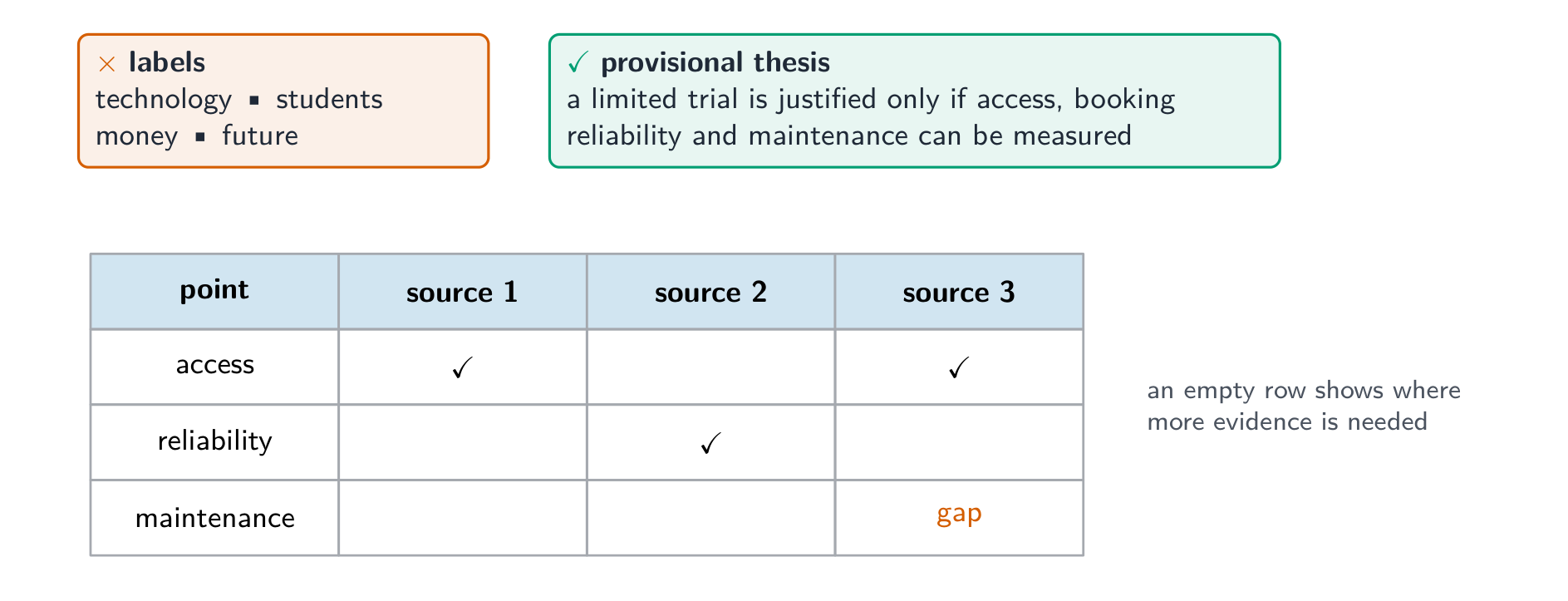
IntroduitAn essay plan needs an argument, not six topic labels
- A fictional campus is considering a shared equipment service. A plan headed “technology, students, money, future” offers topics without saying how evidence will answer the question. An extended essay needs a thesis and a connected sequence of reasoning.
- This GAC015-aligned lesson integrates research, source evaluation and synthesis. The source cards are invented planning material, not real results. You will practise the argument, then replace them with verified sources for actual research coursework.
Narrow the question and state a provisional thesis
- Use “Under what conditions should the fictional campus trial a shared equipment service?” rather than “What will the future be?” A provisional thesis might support a limited trial only if access, booking reliability and maintenance can be evaluated transparently.
- The thesis may change as you read. Keep a research log with search terms, original sources, relevant locators and rejection reasons. A useful source provides evidence for a part of the question; collecting unrelated impressive titles will not build the argument.
Fictional card U: A voluntary survey of thirty current equipment users finds twenty interested in a shared service. Non-users were not surveyed. Card B: A two-week log records six double bookings in forty requests, with no waiting-time records. Card M: A maintenance planning note identifies cleaning, repairs and replacement as recurring tasks, but provides no cost estimate. None of the cards measures the proposed service’s effect.
Quelle question donne à la dissertation une portée faisable ?
Difficulté 1/5 · 100 pièces + un petit bonus lors de la première réussite aujourd'hui
La question bornée identifie un contexte, une décision et des conditions.
Combien d'utilisateurs actuels interrogés ont exprimé de l'intérêt ?
Difficulté 2/5 · 140 pièces + un petit bonus lors de la première réussite aujourd'hui
Vingt sur trente ont exprimé de l'intérêt ; les non-utilisateurs n'ont pas été interrogés.
Create an evidence matrix and identify gaps
- Organise themes across sources: interest, access, reliability and resources. U suggests interest among surveyed current users; B identifies a booking issue; M identifies tasks. The sources do not supply whole-campus demand, a proven solution or a complete budget.
- Add a “missing evidence” column: non-user needs, abandoned requests, task time and actual costs. Do not fill the essay’s gaps with invented measurements. Your synthesis should explain how the themes constrain the same recommendation.
| Paragraph role | Evidence and reasoning | Remaining limit |
|---|---|---|
| Demand and access | U suggests interest; non-users also matter | Wider demand unknown |
| Reliability | B identifies conflicts to measure in a trial | Proposed effect unknown |
| Resources | M names recurring maintenance tasks | Costs not estimated |
| Counterargument | A limited trial can still use staff time | Need a feasible review plan |
Quels DEUX lacunes de preuves subsistent ?
Difficulté 2/5 · 140 pièces + un petit bonus lors de la première réussite aujourd'hui
Les besoins des non-utilisateurs et les coûts réels sont absents. Six doubles réservations et la taille de l'échantillon de trente personnes sont des faits fournis.
Build paragraphs that develop the thesis
- Each body paragraph needs a bounded point, attributed evidence, explanation, limitation and link to the overall question. Connect sources where their ideas interact: interest alone is not enough if reliability and maintenance remain unresolved. Do not write one isolated source summary per paragraph.
- Address a strong counterargument, such as investing scarce time in an unproven system. Explain why a limited trial with explicit review criteria may be justified, or revise your thesis if the resource gap is too large. Neither position requires pretending to know the future.
La synthèse relie ce que chaque source apporte autour de la thèse et de ses thèmes.
Difficulté 1/5 · 100 pièces + un petit bonus lors de la première réussite aujourd'hui
VRAI. La synthèse ne consiste pas en un résumé par source ; elle rassemble les sources pour construire un argumentaire cohérent.
Draft a complete practice essay, then revise the argument
- Write a 650–800-word classroom essay using explicit fictional card labels. Include an introduction, logically ordered body paragraphs, a counterargument and conclusion. The length is this lesson’s practice target, not an official GAC assessment requirement.
- The conclusion answers the focused question and restates conditions without introducing invented new evidence. Afterwards check thesis-to-paragraph links, repeated ideas, unsupported claims and fair treatment of opposing views before polishing grammar.
Audit the source trail and evaluate the next step
- For real coursework, replace the cards with in-depth verified sources, pair every citation with the required reference entry and ensure each claim matches its source. Keep your own proposals distinct from reported findings. Use a quotation only when the exact wording matters.
- Ask a partner to explain your recommendation and name its two most important conditions. If they cannot, revise the structure or wording. Finish with a research action list for the unresolved evidence, rather than claiming the essay completed an unrun trial.
A limited trial is defensible only with clear access and resource conditions. Interest among current users (U) does not establish wider demand; booking conflicts (B) identify a problem rather than prove a solution; recurring maintenance tasks (M) require a feasible plan before expansion.
A long essay does not become in-depth by repeating claims or adding invented references. Depth comes from connected reasoning, relevant evidence and serious treatment of limits.
An extended essay synthesizes evaluated sources around a focused thesis, addresses objections and ends with a conclusion proportionate to the evidence.
Quelle conclusion correspond aux cartes ?
Difficulté 1/5 · 100 pièces + un petit bonus lors de la première réussite aujourd'hui
Il maintient la proposition conditionnelle et identifie l'évaluation manquante plutôt que d'inventer des résultats.