Évaluer les preuves et l'équité dans une discussion sur une règle
IntroduitOne complaint does not describe every case
- A fictional library considers a late-return procedure. One speaker uses an anecdote; another uses a log. They may both raise useful questions, but their evidence supports different claims. Evaluate the argument rather than accepting the louder voice.
- This GAC014-aligned lesson explores reasoning about rules and fair procedures. It does not state actual law or advise on legal rights. The library and its rule are invented, and the script provides rehearsal instead of reviewed recorded audio.
Identify the claim and its supporting reason
- Ask partners to read the two roles. Make notes under proposed action, evidence and missing information. An argument has a conclusion supported by reasons; a memorable story alone does not establish how often a problem occurs.
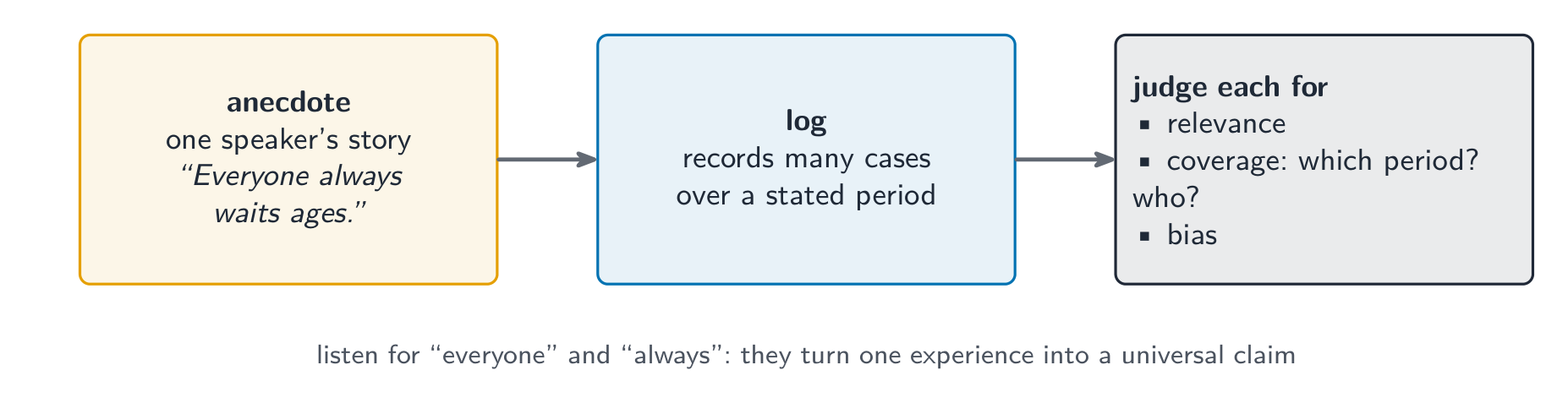
- Listen for terms such as “everyone” and “always.” They can turn one experience into a universal claim. Do not assume a staff log is complete simply because it is a table; check its time period and what it records.
Speaker A: My friend returned a book late because the return box was locked. Everyone gets unfair penalties, so the library should remove every late-return rule. Speaker B: Our fictional four-week log lists twenty late returns; five mention an unavailable return box. It does not record whether the other fifteen had different access problems. We should check access, offer a way to review individual cases and then reconsider the procedure. The log alone cannot show that every penalty was fair or unfair.
Quoi soutient l'affirmation de A concernant la boîte verrouillée ?
Difficulté 1/5 · 100 pièces + un petit bonus lors de la première réussite aujourd'hui
Fournit un seul anecdote, pas une preuve universelle ou légale.
Combien de retards signalés mentionnent une boîte indisponible ?
Difficulté 2/5 · 140 pièces + un petit bonus lors de la première réussite aujourd'hui
Cinq sur vingt le mentionnent ; les autres raisons sont partiellement décrites.
Assess relevance, coverage and bias
- A’s friend’s experience is relevant to access, but not sufficient for “everyone.” B’s log gives a bounded count, yet missing reasons remain important. A supported criticism can preserve the access problem while rejecting the universal conclusion.
- A personal stake or institutional role can influence emphasis. That possibility does not automatically make a statement false. Ask what evidence could check the claim, and compare the proposed action with the actual scope of the information.
Le registre prouve que les quinze autres n'avaient aucun problème d'accès.
Difficulté 1/5 · 100 pièces + un petit bonus lors de la première réussite aujourd'hui
Le script dit explicitement que leurs problèmes d'accus possible n'ont pas été enregistrés.
Discuss fairness as an explicit criterion
- For this invented procedure, define fairness operationally: clear instructions, reasonable access, consistent handling and an opportunity to correct errors. State these as discussion criteria, not legal entitlements established by the lesson.
- In pairs, ask whether each proposed action addresses a criterion. Removing all rules is broader than checking the return box. Reviewing individual cases responds to missing information without assuming every case must have the same outcome.
Quelles DEUX critères sont proposés pour la discussion fictive ?
Difficulté 2/5 · 140 pièces + un petit bonus lors de la première réussite aujourd'hui
La leçon propose des instructions transparentes et un examen des erreurs, pas des jugements automatiques.
Construct a measured counterargument
- Use three moves: acknowledge the valid concern, challenge the unsupported generalisation, propose an evidence-based next check. “The locked box matters, but one case cannot describe everyone; the log suggests checking access and reviewing disputed cases.”
- Rehearse a one-minute answer to “Why not trust the log completely?” Explain its four-week scope and missing information about fifteen cases. Do not invent the missing reasons or call a speaker dishonest without evidence.
Quelle réponse est le mieux soutenue ?
Difficulté 1/5 · 100 pièces + un petit bonus lors de la première réussite aujourd'hui
Elle aborde la préoccupation connue et les preuves incomplètes sans généraliser.
Reflect on your evaluation
- Name one supported claim, one unsupported claim and one unanswered question. Ask a partner to check that your spoken summary includes all three. Evaluating validity concerns whether the evidence supports the conclusion, not whether you like the speaker.
- Write a short argument about an invented classroom rule using transparent evidence and explicit criteria. Keep actual legal questions separate from this language-and-reasoning exercise; its counts and procedures are fictional.
The unavailable return box is a relevant concern. Five of twenty logged returns mention it, but the other reasons are incomplete. An access check and individual review are more directly supported than a claim about every penalty.
Neither an anecdote nor an incomplete log establishes a universal conclusion. Do not invent the missing cases.
Evaluate a rule argument by its evidence, scope, stated fairness criteria and unanswered questions.