Choisir des sources environnementales et les citer précisément
IntroduitA confident headline may not answer your question
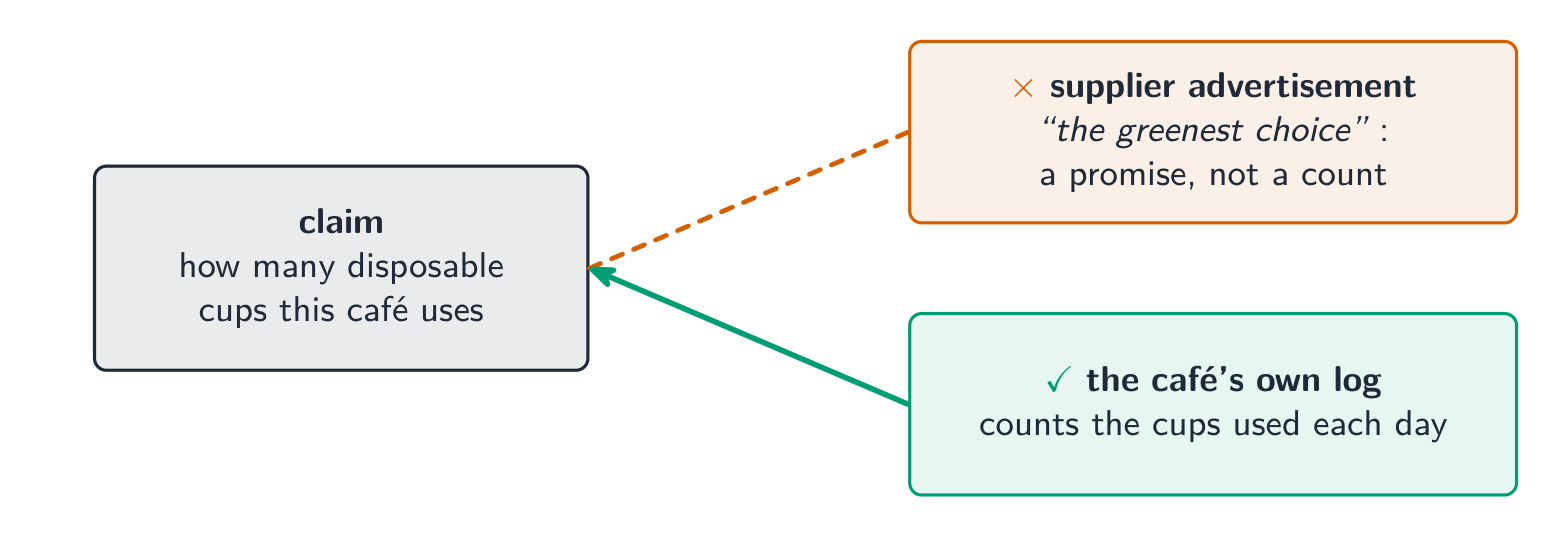
- A student wants to reduce disposable cups at a fictional café. A vendor's advertisement promises “the greenest choice,” while the café's own log counts used cups. The sources have different purposes and answer different questions.
- This GAC008-aligned lesson teaches information literacy and accurate citation. The materials below are fictional source cards, not environmental findings about real products. Evaluating sources is part of the argument, not a final decoration after writing.
Match the source to the claim
- First specify the question: “How many disposable cups did this café use, and what should it investigate before changing supplies?” A local log can support a local count. It cannot on its own compare manufacture, washing, transport or disposal impacts.
- Read the cards for authorship, purpose, method and date information. Missing information may limit how you use a source. A commercial interest does not make every statement false, but it makes independent verification of a promotional claim especially important.
Card L: Fictional café operations log, prepared by the shift supervisor for this lesson. It records 120 disposable cups on Monday and 90 on Tuesday. Customer totals and reusable-cup use were not recorded.
Card V: Fictional vendor advertisement. “Our new cup is the greenest choice.” The card supplies no comparison method, defined environmental measure or independently checkable report.
Card M: Fictional research-methods note. A comparison of cup options should define the products, number of uses and relevant production, washing, transport and disposal stages before comparing outcomes. This card supplies a method checklist, not product-specific results.
De combien de tasses la consommation enregistrée de gobelets jetables a-t-elle diminué ?
Difficulté 2/5 · 140 pièces + un petit bonus lors de la première réussite aujourd'hui
120 − 90 = 30. Aucun compte de clients n'a été enregistré.
Evaluate relevance and evidence separately
- L directly supports a 30-cup fall between the two days. Without customer totals, it cannot show a per-customer reduction; without other days, it cannot establish a lasting trend. V is relevant to a product proposal but does not support its superlative.
- M helps plan a wider comparison but gives no winner. Ask what measure “greenest” means and request a retrievable report with assumptions. Do not replace missing evidence with an invented percentage reduction or a claim that every reusable product is always preferable.
Claim audit: “Disposable use fell by 30 cups” → supported by L. “Use per customer fell” → customer totals missing. “The vendor's cup is best on every environmental measure” → no method or comparison evidence supplied by V.
Sans les totaux par client, le journal ne peut pas montrer si l’usage de gobelets jetables par client a diminué.
Difficulté 1/5 · 100 pièces + un petit bonus lors de la première réussite aujourd'hui
Vrai. L’usage absolu et l’usage par client sont deux mesures différentes ; il faut connaître le nombre de clients pour calculer le taux.
Quoi aiderait le mieux à évaluer le superlatif du vendeur ?
Difficulté 1/5 · 100 pièces + un petit bonus lors de la première réussite aujourd'hui
Une comparaison testable nécessite des résultats définis, des limites et des preuves.
Keep in-text citations and references paired
- An in-text citation identifies the source beside a borrowed idea; the reference entry lets the reader retrieve it. Follow one style required by your teaching centre. Its punctuation and rules for missing dates vary, so use the style guide rather than guessing.
- Record real author or organisation, title, date if available, publication details, locator and URL as needed. Never invent an author, page number or publication date. These cards can be acknowledged as fictional lesson cards L, V and M; they must not receive fabricated journal entries.
A link to a home page is not enough when your claim comes from a particular report. Save the report title and exact relevant location. Every cited work should have a reference entry, and every reference entry should have a genuine role in the text.
Quelles DEUX actions de référencement sont appropriées ?
Difficulté 2/5 · 140 pièces + un petit bonus lors de la première réussite aujourd'hui
Utiliser les règles de missing-information du style et préserver la récupération ; ne pas fabriquer de faits bibliographiques.
Write a recommendation with evidence gaps visible
- Combine L's observation with M's method guidance: the café could record more comparable days and customer totals, then define the wider comparison before choosing supplies. V's unsupported promise should be treated as a claim to verify, not as the conclusion.
- Write a 120-word paragraph identifying each card. Separate the observed change, the missing measurements and your proposed next action. Do not cite M as if it had measured this café, or L as if it compared complete product impacts.
Check retrieval and claim support
- For a real project, open each original source again, locate the evidence and check the reference against the required style. Where the source says “may,” keep that uncertainty. Correct references do not excuse changing what a source actually concluded.
- Ask a partner to trace two claims to their exact source locations. If they cannot, repair the citation or remove the unsupported claim. A useful recommendation tells readers what is known, what remains unknown and what evidence the next decision needs.
Choose sources for the claims they can support, preserve their limits, pair citations with retrievable references, and verify promotional comparisons before relying on them.
Quelle conclusion s'applique à trois fiches ?
Difficulté 1/5 · 100 pièces + un petit bonus lors de la première réussite aujourd'hui
Fournit une observation limitée, M une liste de contrôle méthodologique, et V une affirmation promotionnelle sans soutien.