Saisir les changements et conditions dans un avis de logement oral
IntroduitOne familiar time can be the wrong time
- A fictional residence announcement mentions both the usual kitchen time and a temporary change. A listener who catches only “nine o'clock” may miss what applies on Saturday. Prepare to distinguish the normal arrangement from the changed one.
- This original GAC007-aligned lesson provides a printed script and partner-read rehearsal. The on-screen checks test comprehension of that text. No reviewed recording is attached, so this is not a recorded listening test or a measure of your pronunciation.
Quel horaire s'applique à la cuisine ce samedi ?
Difficulté 1/5 · 100 pièces + un petit bonus lors de la première réussite aujourd'hui
La fermeture temporaire le samedi est à sept heures ; neuf heures est l'horaire normal et celui de la salle à manger.
Preview the details you need
- Before a partner reads, make four note headings: day, changed time, reason, action. You do not need to copy every word. These headings help you notice a correction and decide which detail answers the question.
- Ask your partner to read the complete script once at a natural pace while you look away from it. Then compare notes with the text. This is classroom rehearsal, not a secure one-pass assessment; do not use your reading score as a listening score.
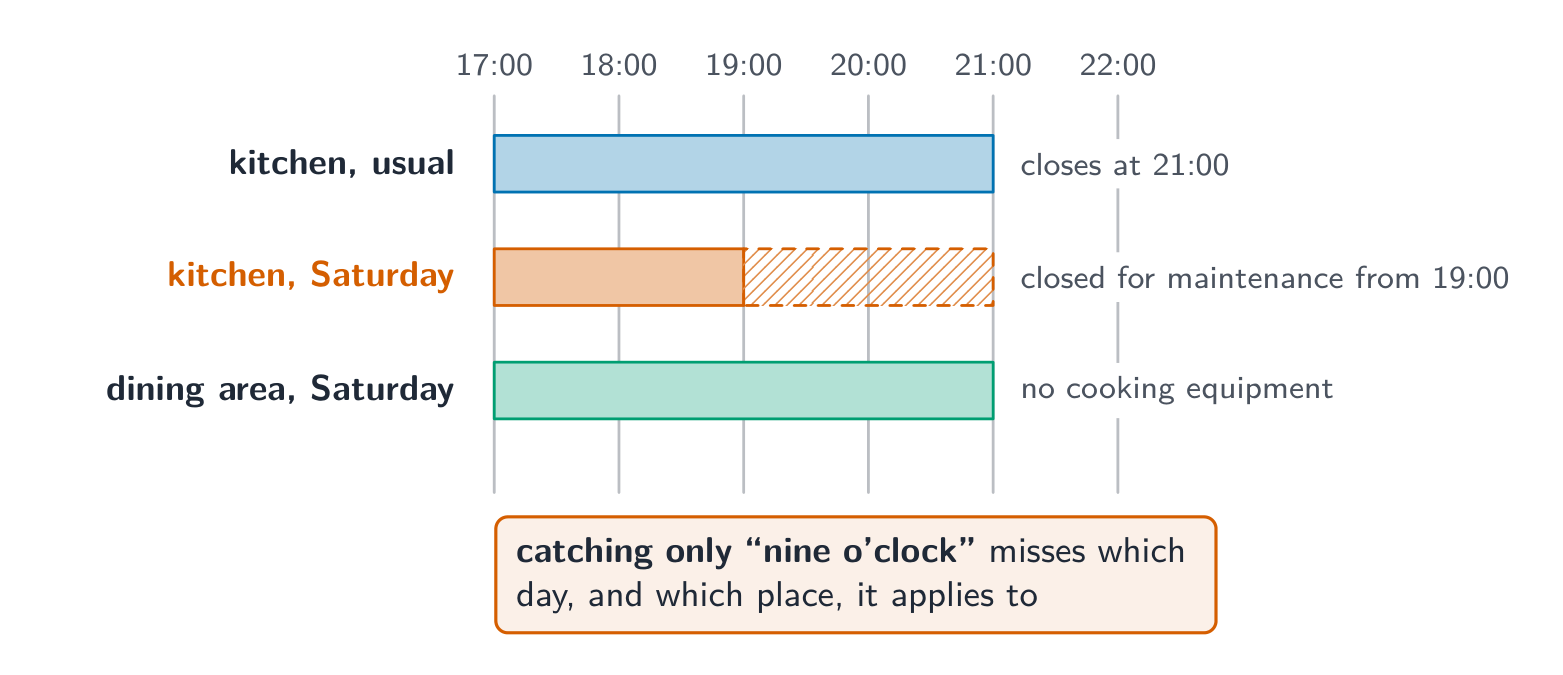
Good evening. The shared kitchen normally closes at nine, but this Saturday it will close at seven because the maintenance team needs access. Please finish cooking and clear your items before seven. The dining area will stay open until nine, although no cooking equipment will be available there. If you need to collect something from the kitchen after seven, contact the residence desk rather than entering the work area. Normal kitchen hours return on Sunday. We are not asking residents to leave the building; only kitchen access changes.
Track the contrast and the scope
- Normally… but this Saturday… contrasts the usual and temporary arrangements. Although limits what the open dining area provides. Only narrows the change to kitchen access. These signals organise the information rather than merely decorate the speech.
- Keep place and time together: kitchen closes at seven on Saturday; dining area remains open until nine; normal kitchen hours return Sunday. “Everything closes at seven” would combine details the speaker explicitly separates.
Notes: Sat kitchen 7, not usual 9 → maintenance; finish + clear before 7; dining to 9, no cooking; late collection → desk; normal Sun.
Quelles DEUX informations sont confirmées par le script ?
Difficulté 2/5 · 140 pièces + un petit bonus lors de la première réussite aujourd'hui
L'avis maintient la salle à manger ouverte mais exclut le matériel de cuisson. Les horaires normaux de la cuisine reprennent dimanche, et les résidents n'ont pas besoin de partir.
Check an inference before repeating it
- The notice says equipment will not be available in the dining area. It does not say residents must leave the building or that every meal is cancelled. An inference is a conclusion you draw; it must stay within what the information supports.
- A partner says, “So we can cook in the dining area until nine.” Reply with the relevant condition: “The room stays open, but the notice says no cooking equipment will be available.” Correct the detail without criticising the person's attention.
Do not replace a missing detail with a guess that sounds practical. If you did not catch the collection procedure, ask for it again or check the notice before advising someone else.
Le locuteur dit que la salle à manger reste ouverte jusqu'à neuf heures mais ne dispose pas d'équipements de cuisson.
Difficulté 1/5 · 100 pièces + un petit bonus lors de la première réussite aujourd'hui
VRAI. Le locuteur exclut explicitement les équipements de cuisson bien que la pièce reste ouverte, donc les résidents ne devraient pas supposer qu'ils peuvent y cuisiner.
Ask for clarification politely
- Use a specific question: “Did you say normal kitchen hours return on Sunday?” or “Who should we contact to collect an item after seven?” A question naming the uncertainty is easier to answer than “I didn't understand anything.”
- To check understanding, paraphrase: “So Saturday's change is for the kitchen, while the dining area remains open?” Your partner confirms or corrects it using the script. Listen to the whole reply rather than assuming yes after its first word.
Quelle question clarifie le mieux une collecte d'objets après sept heures ?
Difficulté 1/5 · 100 pièces + un petit bonus lors de la première réussite aujourd'hui
La question nomme l'incertitude exacte et évite des prémisses que l'avis ne soutient pas.
Give a concise spoken update
- Prepare a 30-second message for a resident: changed place and time, reason, required action and exception. Keep the kitchen and dining area distinct. Do not add an invented alternative cooking facility or turn an access change into an evacuation instruction.
- A partner checks the four main details and asks one clarification question. Revise whichever detail they misunderstood, then rehearse again without reading every sentence. Accurate selection matters more than repeating the script word for word.
For a changed arrangement, connect the time to its place, notice contrast and scope signals, and clarify a missing detail before passing it on.
Ordonnez les points principaux dans une mise à jour utile pour les résidents.
Difficulté 3/5 · 200 pièces + un petit bonus lors de la première réussite aujourd'hui
Commencez par l'arrangement modifié, puis expliquez l'action et les limites de l'exception.