Reported speech · Discours rapporté
Telling people what others said
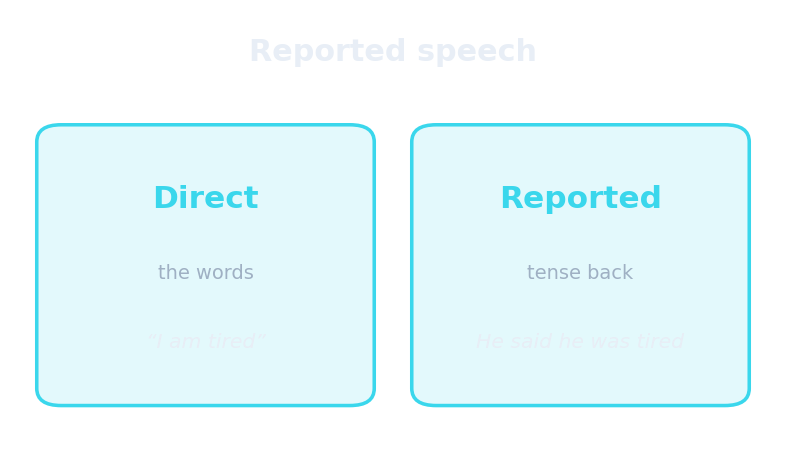
- Reported speech tells what someone said — without quotation marks.
- Direct: "I am tired," he said.
- Reported: He said he was tired.
He said he was early. The clock reported a different story.
Raconter ce que les autres ont dit
- Le discours rapporté dit ce que quelqu'un a dit — sans guillemets.
- Direct : « Je suis fatigué », a-t-il dit.
- Indirect : Il a dit qu'il était fatigué.
Il a dit qu'il était en avance. L'horloge racontait une autre histoire.
say and tell
- say (that) … — no listener: She said she was busy.
- tell someone (that) … — with a listener: She told me she was busy.
- that can be left out.
say et tell
- say (that) … — sans auditeur : Elle a dit qu'elle était occupée.
- tell someone (that) … — avec un auditeur : Elle m'a dit qu'elle était occupée.
- that peut être omis.
Complete with say or tell: He ___ me that he was busy. · Complétez avec say ou tell : Il ___ que c'était occupé.
“tell” takes a listener (me): “He told me …”. “say” does not. · « tell » prend un auditeur (me) : « He told me … ». « say » ne le fait pas.
Tense backshift
- When the reporting verb is past (said, told), the tense moves back one step.
- am / is → was; are → were; will → would; can → could.
- present perfect / past simple → past perfect.
Retrait de temps (backshift)
- Lorsque le verbe introducteur est au passé (said, told), le temps recule d'une case.
- am / is → was ; are → were ; will → would ; can → could.
- Present perfect / past simple → past perfect.
Direct → reported speech · Discours direct → discours rapporté
Shift the tense back, change the pronoun, and adjust time words. · Reculez le temps, changez les pronoms et ajustez les mots de temps.
Report this: She said, “I will help you.” · Rapportez ceci : Elle a dit, « Je t'aiderai. »
After “said”, will moves back to would: “She said she would help me.” · Après « said », will recule vers would : « She said she would help me. »
Translate into English: 他说他累了。 · Traduisez en anglais : 他说他累了。
Backshift after “said”: is → was: “He said he was tired.” · Recul après « said » : is → was : « He said he was tired. »
Pronouns and time words change
- I → he / she, you → me, my → his / her.
- now → then, today → that day, tomorrow → the next day.
Les pronoms et mots de temps changent
- I → il / elle, you → moi, my → son / sa.
- now → alors, today → ce jour-là, tomorrow → le lendemain.
In reported speech, does “tomorrow” often change to “the next day”? · Dans le discours rapporté, « tomorrow » change-t-il souvent en « the next day » ?
Yes — time words shift too: tomorrow → the next day, now → then. · Oui — les mots de temps changent aussi : tomorrow → the next day, now → then.
Common mistakes
- ❌ He said me that he was busy. → ✓ He told me… / He said… — tell takes a person, say doesn't.
- ❌ She asked me where did I live. → ✓ …where I lived. — statement order, no did.
- ❌ He said he will come tomorrow. → ✓ …he would come the next day.
Erreurs courantes
- ❌ He said me that he was busy. → ✓ Il m'a dit… / Il a dit… — tell prend une personne, say non.
- ❌ She asked me where did I live. → ✓ … où j'habitais. — ordre statement, pas de did.
- ❌ He said he will come tomorrow. → ✓ … il viendrait le lendemain.
Match the direct speech to its reported form. · Reliez le discours direct à sa forme rapportée.
Backshift: am → was, will → would, can → could. · Recul : am → was, will → would, can → could.
Report the question: “Are you busy?” · Rapportez la question : « Are you busy? »
Yes/no questions report with if / whether + statement order. · Les questions oui/non se rapportent avec if / whether + ordre statement.
- say (no listener) / tell + someone.
- Past reporting verb → backshift (is → was, will → would).
- Pronouns and time words change too (tomorrow → the next day).
- say (sans auditeur) / tell + quelqu'un.
- Verbe introducteur au passé → retrait de temps (is → was, will → would).
- Les pronoms et mots de temps changent aussi (tomorrow → le lendemain).
Think of something a friend said. Report it in one sentence using “said” or “told” (with backshift). · Pensez à ce qu'un ami vous a dit. Rapportez-le en une phrase en utilisant « said » ou « told » (avec recul).
Example: “My friend told me she had passed the exam.” · Exemple : « My friend told me she had passed the exam. »