this, that, these, those
Pointing at things
- We use this, that, these, those to point at things.
- Near or far? One thing or many?
- This pen is mine. Those cars are fast.
This is my pen. That is your pen. Please do not take this one.
Pointer vers des choses
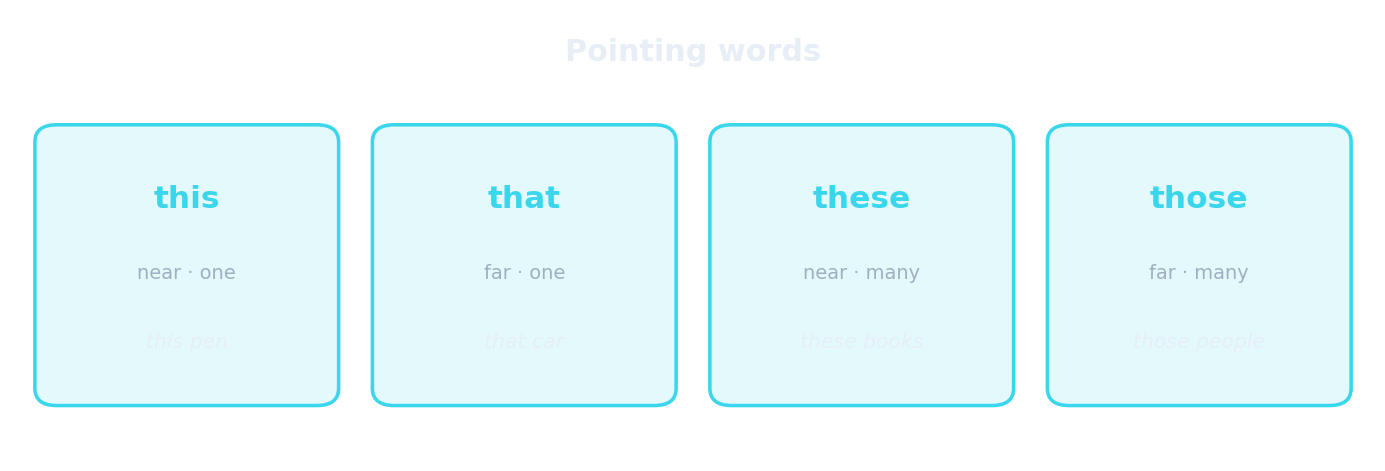
- Nous utilisons this, that, these, those pour pointer vers des choses.
- Proche ou loin ? Une chose ou plusieurs ?
- Ce stylo est à moi. Ces voitures sont rapides.
Ceci est mon stylo. Cela est ton stylo. S'il te plaît, ne prends pas celui-ci.
this and that (one thing)
- this = one thing near me.
- that = one thing far from me.
- This is my phone. That is your car.
this et that (une chose)
- this = une chose près de moi.
- that = une chose loin de moi.
- Ceci est mon téléphone. Cela est ta voiture.
You are holding a pen. Which is best? · Vous tenez un stylo. Lequel est le meilleur ?
Something near you → this: “This is a pen.” · Quelque chose près de vous → this: “This is a pen.”
these and those (many things)
- these = things near me. those = things far away.
- These are my books. Those are her friends.
- They need a plural noun: these books.
these et those (plusieurs choses)
- these = choses près de moi. those = choses loin.
- Ce sont mes livres. Ce sont ses amis.
- Ils nécessitent un nom pluriel : these books.
this, that, these or those? · this, that, these ou those ?
Near or far? One or many? That picks the word. · Proche ou loin ? Un ou plusieurs ? Cela sélectionne le mot.
Complete (far + plural): ___ are my shoes over there. · Complétez (loin + pluriel) : ___ are my shoes over there.
Far + plural → those: “Those are my shoes.” · Loin + pluriel → those: “Those are my shoes.”
Is this correct? “These book are new.” · Est-ce correct ? “These book are new.”
“these” needs a plural noun: “These books are new.” · “these” nécessite un nom pluriel : “These books are new.”
Translate into English: 那些是我的书。 · Traduisez en anglais : 那些是我的书。
Far + plural → those + are + plural noun: “Those are my books.” · Loin + pluriel → those + are + nom pluriel : “Those are my books.”
with nouns
- They can come before a noun too: this book, those people.
- I like this song. Look at those birds.
avec des noms
- Ils peuvent aussi aller avant un nom : this book, those people.
- J'aime cette chanson. Regarde ces oiseaux.
Common mistakes
- ❌ these book → ✓ these books — a plural noun after these / those.
- ❌ This books are mine. → ✓ These books are mine.
- On the phone, say: ✓ This is Tom. (not I am Tom)
Erreurs courantes
- ❌ these book → ✓ these books — un nom pluriel après these / those.
- ❌ This books are mine. → ✓ Ces livres sont à moi.
- Au téléphone, dites : ✓ Ceci est Tom. (pas Je suis Tom)
Match the situation to the right word. · Associez la situation au bon mot.
Near → this / these. Far → that / those. One → this / that. Many → these / those. · Proche → this / these. Loin → that / those. Un → this / that. Plusieurs → these / those.
On the phone: “Hello, ___ is Anna.” · Au téléphone : “Hello, ___ is Anna.”
English says “This is Anna” on the phone. · En anglais, on dit “This is Anna” au téléphone.
- Near: this (one) / these (many).
- Far: that (one) / those (many).
- these / those + a plural noun.
- Près : this (un) / these (plusieurs).
- Loin : that (un) / those (plusieurs).
- these / those + un nom pluriel.
Look around the room. Write one sentence using “this”, “that”, “these” or “those”. · Regardez autour de la pièce. Écrivez une phrase utilisant “this”, “that”, “these” ou “those”.
Example: “These are my pens.” or “That is a window.” · Exemple : “These are my pens.” ou “That is a window.”