Trading blocs and the WTO
Introduit| English | Sens |
|---|---|
| customs union/ˈkʌstəmz ˈjuːnɪən/ | union douanière |
| World Trade Organization/wɜːld treɪd ˌɔːɡənaɪˈzeɪʃn/ | Organisation mondiale du commerce |
The world's largest trading bloc, 2022
- On 1 January 2022 the Regional Comprehensive Economic Partnership (RCEP) came into force. Its 15 members, including China, Japan, South Korea, Australia and the ASEAN countries, produce about 30% of the world's output. Over time it removes tariffs on about 90% of goods traded between them.
- Countries often agree trade rules in groups.
Types of trading bloc
- A free trade area removes tariffs between members; each member keeps its own tariffs on outsiders.
- A customs union 关税同盟 also sets one common tariff on goods from outside, as the European Union does.
Members remove tariffs between themselves and set one common tariff on outsiders. This is
Difficulté 1/5 · 100 pièces + un petit bonus lors de la première réussite aujourd'hui
Common external tariff.
Trade creation and diversion
- Trade creation: members now buy from a cheaper partner instead of making goods at higher cost themselves.
- Trade diversion: members switch from a cheaper outside supplier to a dearer member, because only outsiders pay the tariff.
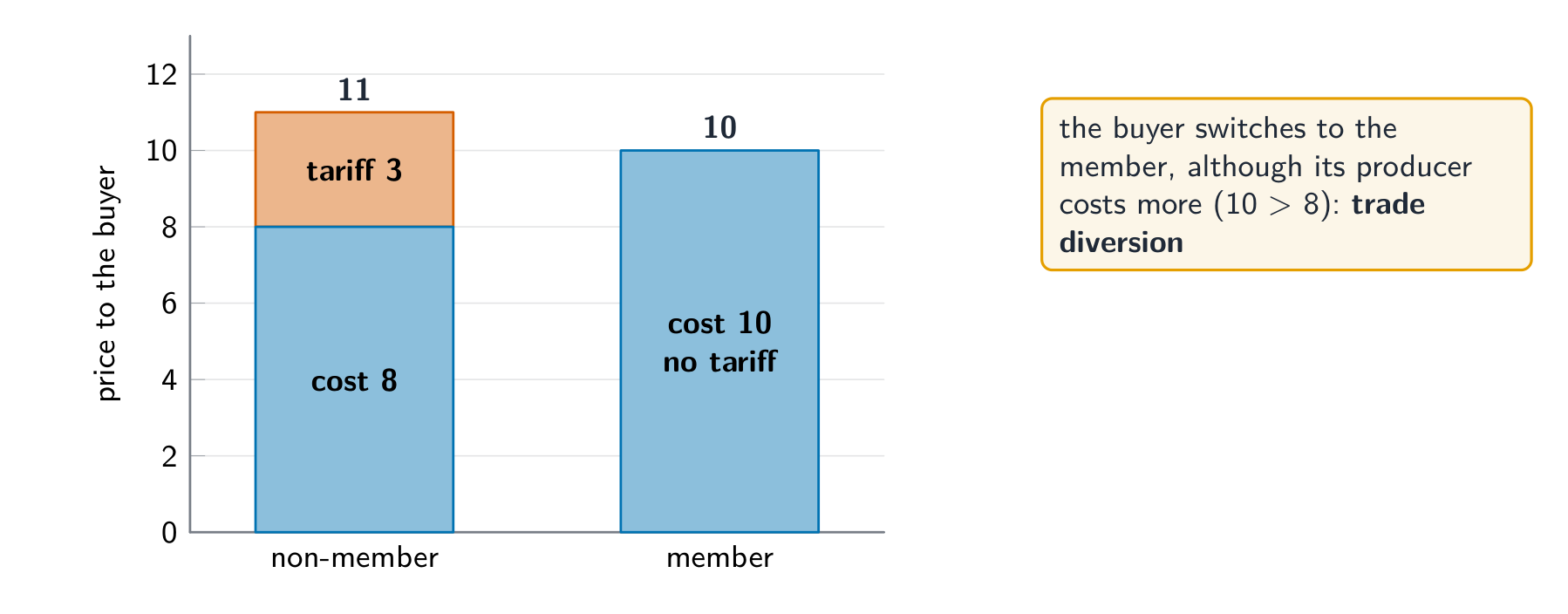
Worked example: trade diversion
Country H can import a good from outsider O at 10 dollars, or from partner P at 12. H's tariff on outsiders is 3 dollars; partners pay none.
- From O: $10 + 3 = 13$ dollars. From P: 12 dollars.
- Choice: H buys from P, the dearer producer.
- Cost: the world's cheapest supplier loses the sale, and H's government loses 3 dollars of tariff revenue on each unit.
An outsider sells at 20 dollars and a partner at 23. The tariff on outsiders is 5 dollars. What does the importer pay if it buys from the outsider?
Difficulté 2/5 · 140 pièces + un petit bonus lors de la première réussite aujourd'hui
20 + 5.
With those prices, where does the importer buy?
Difficulté 1/5 · 100 pièces + un petit bonus lors de la première réussite aujourd'hui
The partner is cheaper after the tariff.
The World Trade Organization
- The World Trade Organization 世界贸易组织 (WTO), set up in 1995, writes rules for trade between its 160-plus members and settles trade disputes.
- Members agree to treat each other equally and to cut barriers over time.
What does the WTO do?
Difficulté 2/5 · 140 pièces + un petit bonus lors de la première réussite aujourd'hui
Exchange rates are not its role.
Blocs: good or bad?
- Members gain bigger markets, economies of scale and more competition.
- Outsiders may lose sales, and trade diversion can mean buying from dearer producers.
Firms in a trading bloc can gain economies of scale from a bigger market.
Difficulté 1/5 · 100 pièces + un petit bonus lors de la première réussite aujourd'hui
More sales across members.
A trading bloc does not always buy from the cheapest producer. With a tariff only on outsiders, a dearer partner can win, as P does here. That is trade diversion.
A trading bloc always buys from the world's cheapest producer.
Difficulté 1/5 · 100 pièces + un petit bonus lors de la première réussite aujourd'hui
Trade diversion.
Free trade areas remove internal tariffs; customs unions add a common external tariff. Blocs create trade but can divert it to dearer members. The WTO sets global trade rules and settles disputes.
Explain one benefit and one cost of RCEP for its members.
Trading blocs.