Reading trade patterns without stereotypes
Introduit| English | Sens |
|---|---|
| export composition/ˈekspɔːt ˌkɒmpəˈzɪʃn/ | composition des exportations |
| diversification/daɪˌvɜːsɪfɪˈkeɪʃn/ | diversification |
When oil prices fell, 2014–16
- In June 2014 oil sold for over 100 dollars a barrel; by January 2016 it was below 30. Oil was about 90% of Nigeria's export earnings, and the country fell into recession in 2016. Norway, also a big oil exporter, had other industries and a large savings fund, and suffered far less.
- What a country exports matters as much as how much.
Export composition
- Export composition 出口构成 is the mix of goods and services a country sells abroad.
- Primary exports: raw materials and food. Manufactures: cars, phones, machines. Services: tourism, finance, software.
Match each export to its type.
Difficulté 2/5 · 140 pièces + un petit bonus lors de la première réussite aujourd'hui
Raw, made or service.
Measuring dependence
- Share of primary exports $= \dfrac{\text{primary exports}}{\text{total exports}} \times 100$.
- A high share means export earnings depend on a few commodity prices.
A country exports 80 billion, of which 48 billion are primary goods. What is the primary share, in per cent?
Difficulté 2/5 · 140 pièces + un petit bonus lors de la première réussite aujourd'hui
48 ÷ 80 × 100.
Worked example: two economies
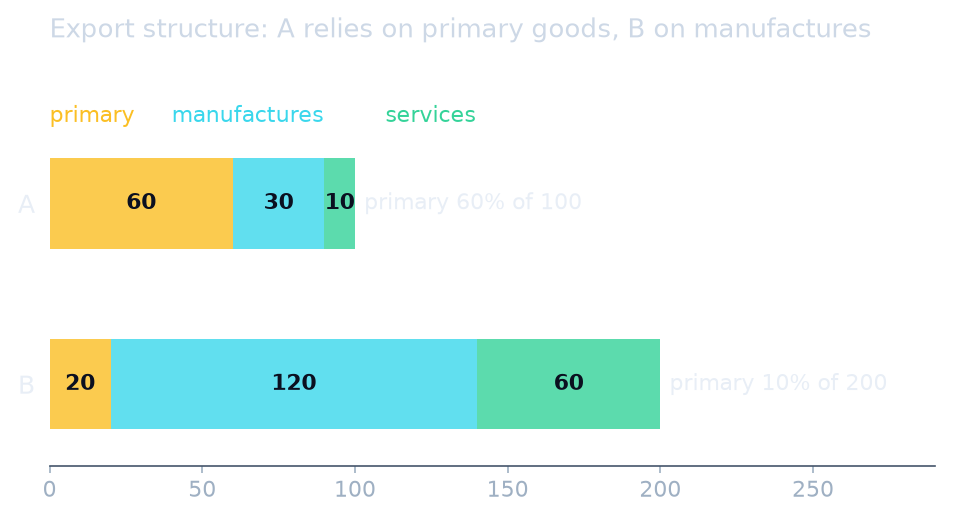
Economy A exports 100 billion, of which 60 billion are primary goods. Economy B exports 200 billion, of which 20 billion are primary.
- A: $\dfrac{60}{100} = 60\%$. B: $\dfrac{20}{200} = 10\%$.
- Later: A's primary exports rise to 66 billion and its total to 120. Share $= \dfrac{66}{120} = 55\%$.
- Meaning: A's primary exports grew, yet its dependence fell, because other exports grew faster.
How dependent is each economy on primary exports?
A exports 60 of its 100 in primary goods (60%); B exports 20 of 200 (10%). If A's primary exports rise to 66 while its total reaches 120, its share falls to 55%.
Later, its primary exports are 54 billion and its total 120 billion. What is the new share, in per cent?
Difficulté 2/5 · 140 pièces + un petit bonus lors de la première réussite aujourd'hui
54 ÷ 120 × 100.
Diversification
- Diversification 多样化 means widening the range of goods and services a country produces and exports.
- It makes export earnings more stable when one price falls. Chile has used copper earnings to build fruit, wine and salmon exports.
Why might a country diversify its exports?
Difficulté 2/5 · 140 pièces + un petit bonus lors de la première réussite aujourd'hui
Diversification reduces dependence.
Reading the data fairly
- A high primary share does not mean a country is poor: Australia and Norway export many raw materials and are rich.
- Look at the trend, the size of exports, and how earnings are used — not just one percentage.
A high share of primary exports always means a country is poor.
Difficulté 1/5 · 100 pièces + un petit bonus lors de la première réussite aujourd'hui
Norway and Australia are rich.
Do not judge a country by its export mix alone. A falling primary share can come from faster growth elsewhere, not from smaller primary exports. And raw-material exporters can be rich or poor.
If a country's primary share falls, its primary exports must have fallen.
Difficulté 1/5 · 100 pièces + un petit bonus lors de la première réussite aujourd'hui
Other exports may have grown faster.
Export composition shows what a country sells abroad. Heavy dependence on a few commodities makes earnings unstable. Diversification spreads the risk. Read shares together with totals and trends, not as stereotypes.
Explain why Nigeria was hit harder than Norway by the oil-price fall of 2014–16, using export composition.
Export composition.