Reading the economic cycle
Introduit| English | Sens |
|---|---|
| recession/rɪˈseʃn/ | récession |
| recovery/rɪˈkʌvəri/ | reprise économique |
The 2008–09 recession
- After the global financial crisis of 2008, Britain's real GDP fell for five quarters in a row, by about 6% in total. It took about five years to get back to its old peak. Economies do not grow smoothly.
- Output moves up and down in the economic cycle.
The four phases
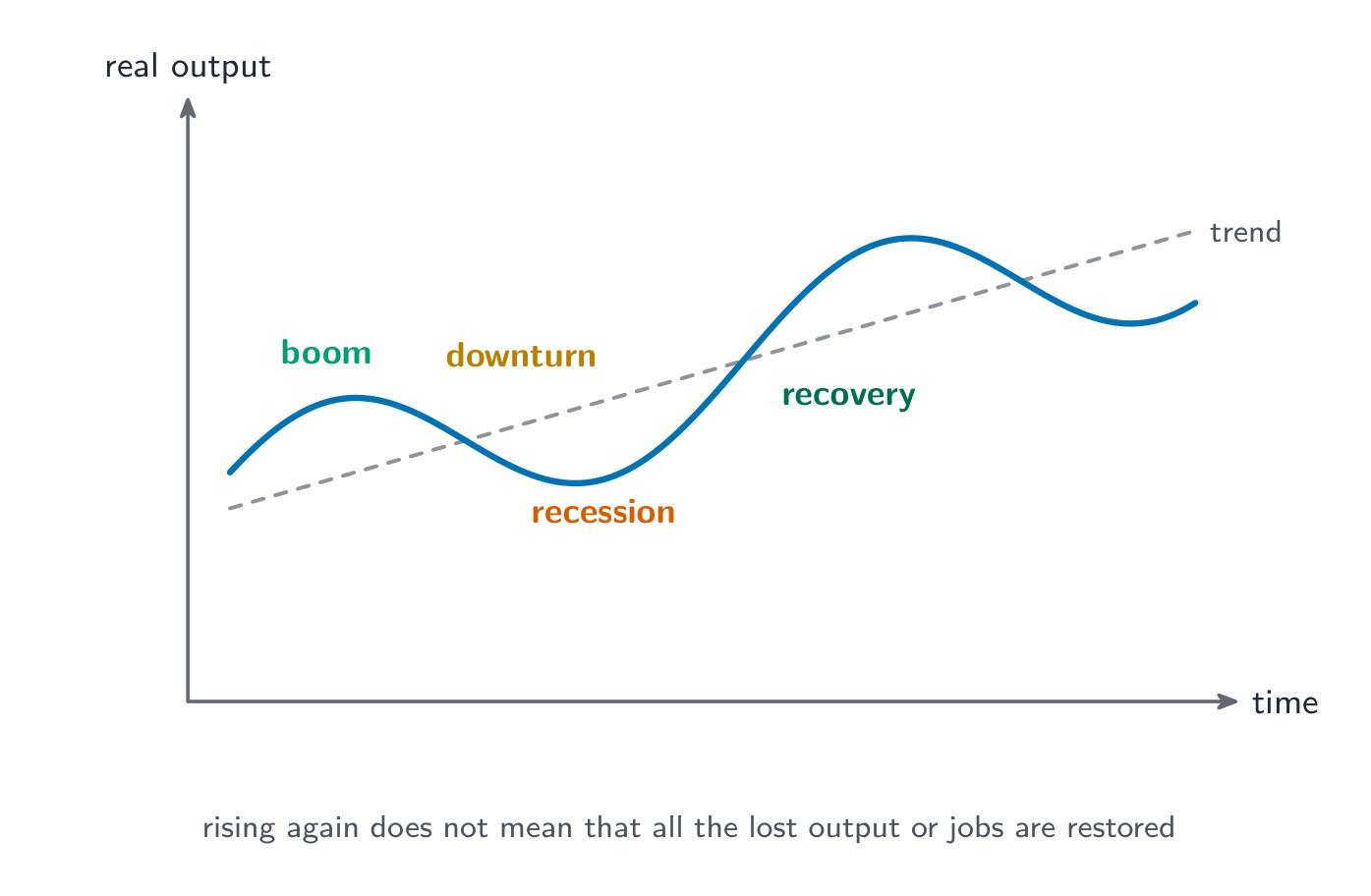
- Boom: fast growth, low unemployment, rising inflation. Downturn: growth slows.
- Recession 经济衰退: real GDP falls — commonly, for two quarters in a row. Recovery 经济复苏: output grows again.
Match each phase to its description.
Difficulté 2/5 · 140 pièces + un petit bonus lors de la première réussite aujourd'hui
The cycle.
Reading the cycle
- Each quarter's growth rate compares output with the quarter before.
- A fall in the growth rate is not a recession; output must actually fall.
Worked example: five quarters
A real-output index for five quarters: 100, 104, 102, 99, 101.
- Growth rates: $+4\%$, then $\dfrac{-2}{104} \approx -1.92\%$, then $\dfrac{-3}{102} \approx -2.94\%$, then $\dfrac{2}{99} \approx +2.02\%$.
- Recession: two falls in a row (quarters 3 and 4).
- Recovery: output grows to 101 — but that is still below the 104 peak.
Two falls make a recession
A real-output index moves 100, 104, 102, 99, 101: growth +4%, then about −1.92% and −2.94% (two falls: a recession on the common indicator), then about +2.02%. Output recovers, but 101 is still below the 104 peak.
Real output falls from 200 to 196. What is the growth rate, in per cent?
Difficulté 2/5 · 140 pièces + un petit bonus lors de la première réussite aujourd'hui
−4 ÷ 200 × 100.
Quarterly growth rates: +1%, +0.5%, +0.2%, +0.1%. Is this a recession?
Difficulté 1/5 · 100 pièces + un petit bonus lors de la première réussite aujourd'hui
Output must fall.
Effects of a recession
- Firms sell less, so they cut jobs: unemployment rises. Tax revenue falls and benefit spending rises.
- Some firms close; those selling inferior goods may do better.
Which are likely in a recession?
Difficulté 2/5 · 140 pièces + un petit bonus lors de la première réussite aujourd'hui
Demand is weak.
Responses
- Governments can raise spending or cut taxes; central banks can cut interest rates.
- In a boom, they may do the opposite to stop inflation rising too fast.
Cutting interest rates is one response to a recession.
Difficulté 1/5 · 100 pièces + un petit bonus lors de la première réussite aujourd'hui
It encourages borrowing and spending.
Recovery does not mean back to normal. At 101 the economy is growing again, but output is still below its 104 peak. A recovery can take years to make up the lost ground.
Once output starts growing, the economy is back to its previous peak.
Difficulté 1/5 · 100 pièces + un petit bonus lors de la première réussite aujourd'hui
It may still be below the peak.
The cycle runs boom, downturn, recession, recovery. A recession is a fall in real GDP, commonly two quarters in a row. Recessions raise unemployment and cut tax revenue; governments respond with fiscal and monetary policy.
Explain how a recession affects unemployment and government finances, using the 2008–09 example.
Cycle effects.