Government objectives and policies
Introduit| English | Sens |
|---|---|
| inflation/ɪnˈfleɪʃn/ | l'inflation |
| fiscal policy/ˈfɪskl ˈpɒlɪsi/ | politique budgétaire |
A growth target of "around 5%"
- Each March, China's government announces targets for the year: in 2024, economic growth of around 5%, consumer price inflation of around 3%, and over 12 million new urban jobs. Governments aim at several goals at once.
- Each goal is measured, and each has its own tools.
The main objectives
- Economic growth, low unemployment, low and stable inflation 通货膨胀, and a sustainable balance of payments.
- Also: fair distribution of income and protecting the environment.
Which are macroeconomic objectives of governments?
Difficulté 2/5 · 140 pièces + un petit bonus lors de la première réussite aujourd'hui
Rising prices are not an aim.
Real and nominal growth
- Nominal GDP is measured at current prices, so it rises when prices rise. Real GDP removes price rises.
- Real growth $\approx$ nominal growth $-$ inflation.
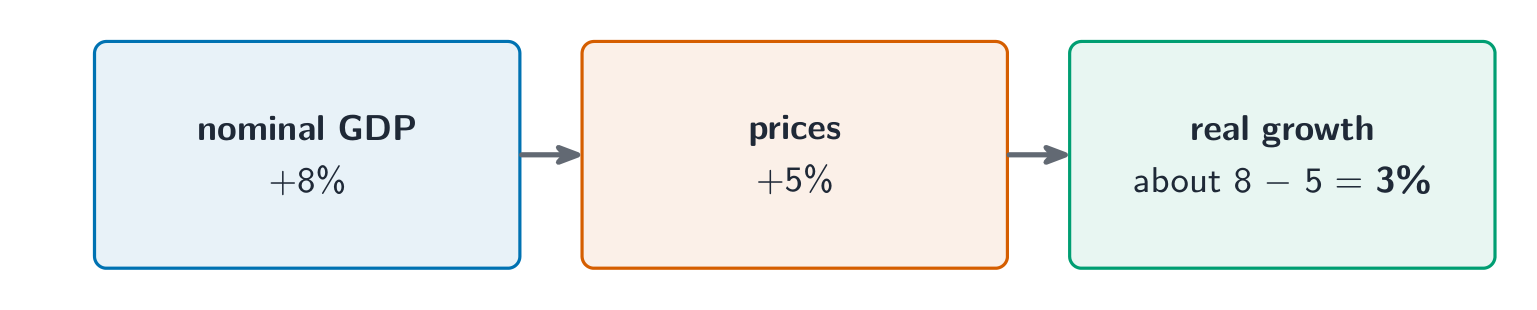
Worked example: removing price rises
Nominal GDP rises from 100 to 108 billion yuan. Prices rose 3%.
- Nominal growth: 8%.
- Real output: $\dfrac{108}{1.03} \approx 104.9$ billion at old prices.
- Real growth: about 4.9% — roughly $8 - 3 = 5\%$. Only this part is more goods and services.
Nominal GDP grows 7% and inflation is 2%. What is real growth, approximately, in per cent?
Difficulté 2/5 · 140 pièces + un petit bonus lors de la première réussite aujourd'hui
7 − 2.
Nominal GDP rises from 200 to 220 billion, and prices rise 10%. What is real GDP in the second year, at old prices, in billions?
Difficulté 2/5 · 140 pièces + un petit bonus lors de la première réussite aujourd'hui
220 ÷ 1.1 — no real growth.
Fiscal policy
- Fiscal policy 财政政策 uses government spending and taxes to influence the economy.
- Higher spending or lower taxes boost demand; the opposite slows it.
Increasing government spending is an example of fiscal policy.
Difficulté 1/5 · 100 pièces + un petit bonus lors de la première réussite aujourd'hui
Spending and tax.
Other tools
- Monetary policy: interest rates set by the central bank.
- Supply-side policies: training, infrastructure and deregulation that raise productive capacity.
Match each tool to its type of policy.
Difficulté 2/5 · 140 pièces + un petit bonus lors de la première réussite aujourd'hui
Three groups of tools.
A rise in nominal GDP is not all growth. If prices rose 3%, 3 of the 8 percentage points are higher prices, not more output. Always check real figures.
An 8% rise in nominal GDP always means 8% more goods and services.
Difficulté 1/5 · 100 pièces + un petit bonus lors de la première réussite aujourd'hui
Part may be inflation.
Governments aim for growth, low unemployment, low inflation, a sustainable balance of payments, fair distribution and a cleaner environment. Fiscal, monetary and supply-side policies are the tools. Real growth removes inflation from nominal growth.
Explain why a government might set targets for both growth and inflation, and why they can be hard to hit together.
Objectives.