Indices, surds and standard form · Higher
Introduit| English | Sens |
|---|---|
| index/ˈɪndeks/ | indice |
| surd/sɜːd/ | An expression involving a root that cannot be simplified to a rational number. |
Weighing the Earth
- In 1798 Henry Cavendish measured the force between lead balls and worked out the Earth's density. Today its mass is given as $5.97 \times 10^{24}$ kg.
- Numbers like this need standard form and the index laws, including fractional powers.
The index laws
- $a^m \times a^n = a^{m+n}$, $a^m \div a^n = a^{m-n}$, $(a^m)^n = a^{mn}$, $a^0 = 1$, $a^{-n} = \dfrac{1}{a^n}$.
- Example: $\left(\dfrac{2}{3}\right)^{-2} = \left(\dfrac{3}{2}\right)^2 = \dfrac{9}{4}$.
Evaluate $\left(\dfrac{1}{2}\right)^{-3}$.
Difficulté 2/5 · 140 pièces + un petit bonus lors de la première réussite aujourd'hui
Reciprocal $2^3 = 8$.
The laws with letters. Simplify $\dfrac{(2x^3)^4}{4x^5}$.
- The power applies to both parts of the bracket: $(2x^3)^4=2^4x^{12}=16x^{12}$.
- Divide numbers, then subtract indices: $\dfrac{16x^{12}}{4x^5}=4x^{7}$.
Simplify $(3y^2)^3$.
Difficulté 1/5 · 100 pièces + un petit bonus lors de la première réussite aujourd'hui
3³ = 27 and (y²)³ = y⁶.
Fractional indices
- $a^{\frac{1}{n}} = \sqrt[n]{a}$, so $27^{\frac{1}{3}} = 3$.
- $a^{\frac{m}{n}} = \left(\sqrt[n]{a}\right)^m$: take the root first, then the power. $16^{\frac{3}{4}} = \left(16^{\frac{1}{4}}\right)^3 = 2^3 = 8$.
Indices, surds and standard form
For the same positive base, multiplication adds indices and division subtracts them
Compare the model with the worked case and explain one change.
Evaluate $125^{\frac{2}{3}}$.
Difficulté 2/5 · 140 pièces + un petit bonus lors de la première réussite aujourd'hui
$\sqrt[3]{125} = 5$, then $5^2 = 25$.
Worked example: a negative fractional index
Evaluate $8^{-\frac{2}{3}}$.
- Negative: take the reciprocal, $\dfrac{1}{8^{\frac{2}{3}}}$.
- Root, then power: $\sqrt[3]{8} = 2$, and $2^2 = 4$.
- Answer: $\dfrac{1}{4}$. Doing the root first keeps the numbers small.
Evaluate $9^{-\frac{3}{2}}$.
Difficulté 1/5 · 100 pièces + un petit bonus lors de la première réussite aujourd'hui
$\sqrt{9} = 3$, $3^3 = 27$, reciprocal $\dfrac{1}{27}$.
Surds
- A surd 根式 is an irrational root left exact: $\sqrt{72} = \sqrt{36 \times 2} = 6\sqrt{2}$.
- Multiply and expand like algebra, using $\sqrt{a}\times\sqrt{a}=a$: $(3+\sqrt2)(1-\sqrt2)=3-3\sqrt2+\sqrt2-2=1-2\sqrt2$. Rationalise a simple denominator: $\dfrac{1}{\sqrt{2}} = \dfrac{\sqrt{2}}{2}$.
Simplify $\sqrt{48}$.
Difficulté 1/5 · 100 pièces + un petit bonus lors de la première réussite aujourd'hui
$48 = 16 \times 3$; $2\sqrt{12}$ is not fully simplified.
Rationalise with the conjugate (Higher). Write $\dfrac{3}{2+\sqrt3}$ with a whole-number denominator.
- Multiply top and bottom by $2-\sqrt3$, the denominator with the sign changed.
- The bottom becomes $(2+\sqrt3)(2-\sqrt3)=4-3=1$, so the answer is $3(2-\sqrt3)=6-3\sqrt3$.
Rationalise the denominator of $\dfrac{4}{3-\sqrt5}$.
Difficulté 1/5 · 100 pièces + un petit bonus lors de la première réussite aujourd'hui
Multiply by (3 + √5): the bottom is 9 − 5 = 4, so 4(3 + √5)/4 = 3 + √5.
Standard form calculations
- Add by matching powers: $3 \times 10^4 + 2 \times 10^3 = 3 \times 10^4 + 0.2 \times 10^4 = 3.2 \times 10^4$.
- Earth to Moon mass: $\dfrac{5.97 \times 10^{24}}{7.35 \times 10^{22}} \approx 0.812 \times 10^2$, which in standard form is $8.12\times10^1$. The Earth is about 81 times heavier.
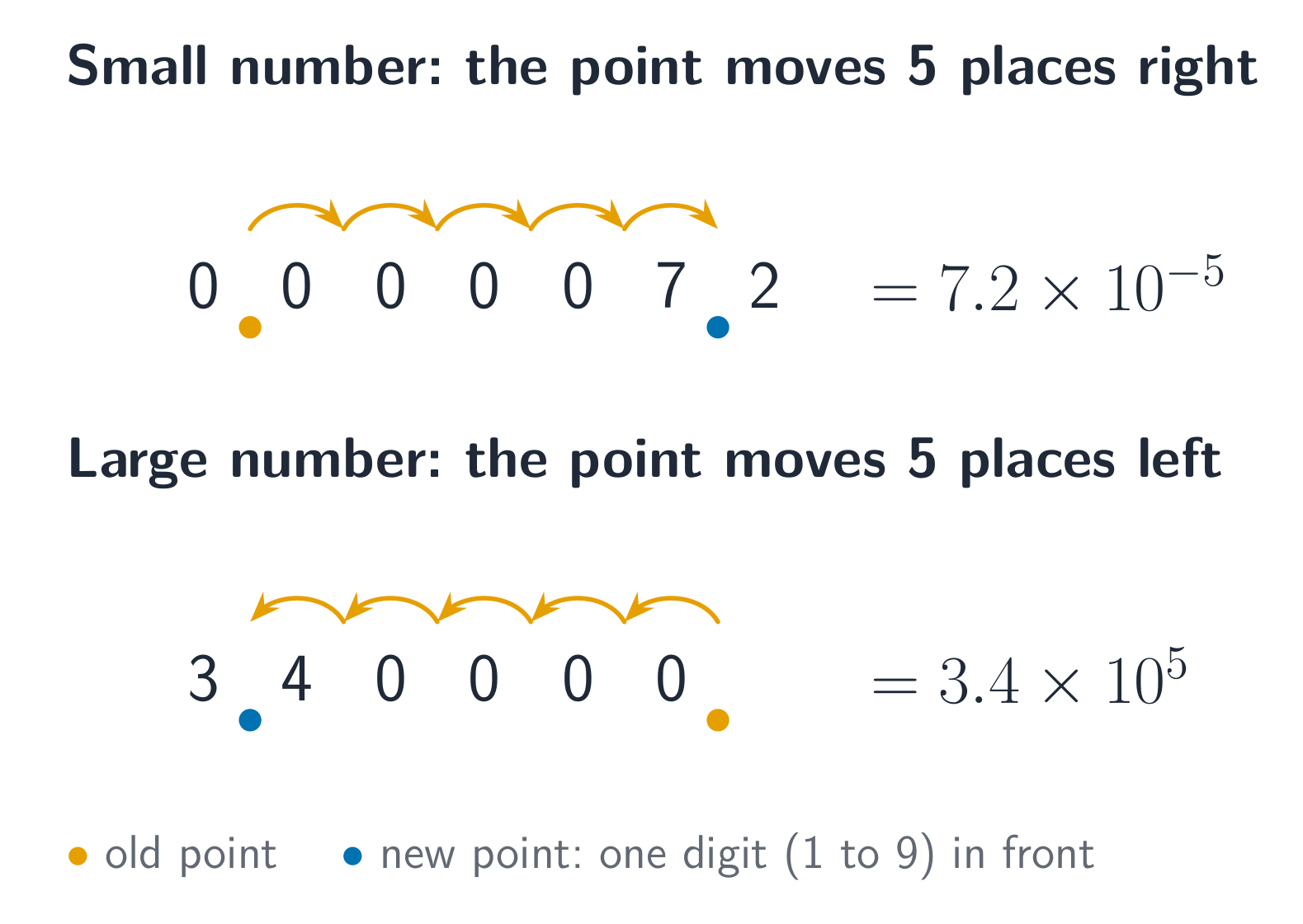
Work out $5 \times 10^6 + 4 \times 10^5$ in standard form.
Difficulté 1/5 · 100 pièces + un petit bonus lors de la première réussite aujourd'hui
$4 \times 10^5 = 0.4 \times 10^6$.
Multiply, then tidy up. Work out $(4\times10^3)\times(6\times10^5)$ in standard form.
- Multiply the numbers and add the powers: $24\times10^{8}$.
- 24 is not between 1 and 10, so write $24=2.4\times10^1$. The answer is $2.4\times10^{9}$.
Work out $(5\times10^4)\times(8\times10^{-7})$ in standard form.
Difficulté 1/5 · 100 pièces + un petit bonus lors de la première réussite aujourd'hui
5 × 8 = 40 and 10⁴ × 10⁻⁷ = 10⁻³, so 40 × 10⁻³ = 4 × 10⁻².
$16^{\frac{3}{4}}$ is not $16 \times \frac{3}{4}$. A fractional index means a root and a power, not multiplication: the answer is 8, not 12.
$64^{\frac{1}{2}} = 32$.
Difficulté 1/5 · 100 pièces + un petit bonus lors de la première réussite aujourd'hui
C'est $\sqrt{64} = 8$.
The index laws hold for all indices. $a^{-n}$ is a reciprocal and $a^{\frac{m}{n}}$ is the $n$th root raised to the power $m$. Simplify surds with square factors, and match powers before adding in standard form.
Solve $2^{x} = 8^{\frac{4}{3}}$, showing each step.
Same base, compare indices.