- Order and calculate with positives, negatives, decimals and fractions; the four operations with formal written methods.
- Primes, factors, HCF/LCM by prime decomposition; indices, roots, surd 无理数s (H) and standard form 标准形式.
- Fractions ↔ decimals ↔ percentages as operators; rounding, estimation and bounds (H).
-
1
Number
1.1
Number: the foundations everything else stands on
Vocabulary TrainEnglish standard form/ˈstændəd fɔːm/ surd/sɜːd/ 1.1
Arithmetic, factors, multiples and primes (N1–N5)
Syllabus
Arithmetic, factors, multiples and primes (AQA 8463-style N1-N5 rules for 8300).
- Order integers, decimals and fractions; use the six inequality and equality symbols.
- Apply the four operations with formal written methods to integers, decimals, fractions and mixed numbers, in context including household finance.
- Use inverse operations and the priority of operations (BIDMAS).
- Use primes, factors, multiples, HCF and LCM via prime factorisation; (H) systematic listing and the product rule for counting.
Source: Cambridge International syllabus
Ordering and symbols: order positive and negative integers, decimals and fractions on a number line; use =, ≠, <, >, ≤, ≥.
The four operations (N2): formal written methods for integers, decimals, proper and improper fractions and mixed numbers, all signs — set in context including household finance: profit, loss, cost price, selling price, debit, credit, balance, income tax, VAT, interest rate.
Inverse operations and priority (N3): cancellation to simplify; BIDMAS 运算顺序 — brackets, indices/powers, roots, division/multiplication, addition/subtraction.
Primes and structure (N4): prime numbers, factors, multiples, common factors, common multiples, HCF, LCM; prime factorisation 质因数分解 in index form (product notation; unique factorisation). Worked pattern:
- 200 = 2³ × 5²
- HCF = product of the lowest powers of common primes; LCM = product of the highest powers of all primes.
(N5) systematic listing and the product rule for counting (H).
Vocabulary TrainEnglish prime factorisation/praɪm ˌfæktəraɪˈzeɪʃn/ BIDMAS 1.3
Indices, surds, standard form and bounds (N7–N9, N14–N16)
Syllabus
Indices, surds, standard form and bounds (AQA 8300 rules N7-N9, N14-N16).
- Use index laws with integer and (H) fractional indices; calculate with roots.
- (H) Simplify surds and rationalise denominators.
- Calculate with standard form A x 10^n and interpret calculator displays.
- Estimate answers by rounding to one significant figure; round to dp and sf.
- (H) Write error intervals in inequality notation and apply upper and lower bounds through calculations.
Source: Cambridge International syllabus
Indices (N7): laws — a^m × a^n = a^(m+n), a^m ÷ a^n = a^(m-n), (a^m)^n = a^(mn), a^(-n) = 1/a^n, a^(1/2) = √a; (H) fractional indices a^(m/n) = the n-th root of a^m.
Surds (N8, H): √12 = √(4 × 3) = 2√3 — simplify; rationalise denominators (multiply by the conjugate: 1/(3+√2) × (3−√2)/(3−√2) = (3−√2)/7).
Standard form (N9): A × 10ⁿ, 1 ≤ A < 10, n an integer — add/subtract (match powers), multiply/divide (multiply the As, add the ns); interpret calculator displays.
Estimation (N14): round each value to 1 significant figure, compute, decide over- or under-estimate; check calculations by approximation.
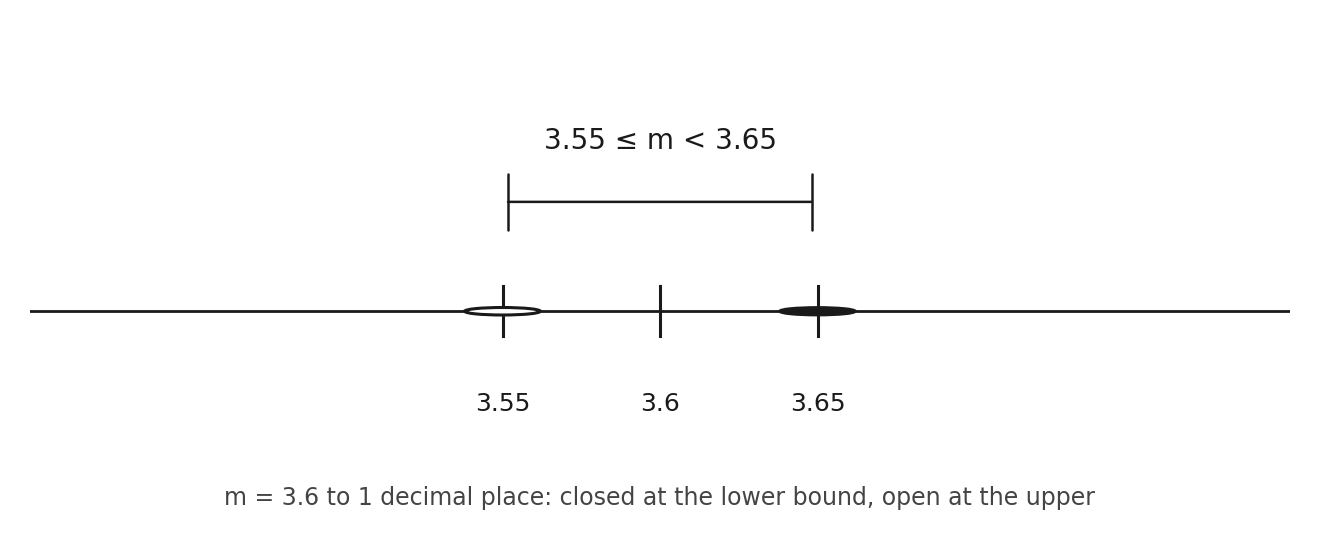
Rounding and error intervals 误差区间 (N15): to decimal places and significant figures (know not to round mid-calculation); (H) inequality notation for error intervals — 3.6 kg to 1 d.p. means 3.55 ≤ m < 3.65; truncation gives 3.6 ≤ m < 3.7.
Bounds (N16, H): upper bound 上界 of a length 9 m to the nearest metre is 9.5; in calculations, UB of × and + uses UBs, ÷ uses UB ÷ LB; give the answer to an appropriate degree of accuracy (often the bound width decides).
Vocabulary TrainEnglish error interval upper bound/ˈʌpə baʊnd/ lower bound/ˈləʊə baʊnd/ 1.2
Fractions, decimals and percentages (N10–N13, R9 links)
Syllabus
Fractions, decimals and percentages (AQA 8300 rules N10-N13).
- Convert between terminating decimals and fractions; (H) recurring decimals to fractions.
- Interpret fractions and percentages as operators, using multipliers including reverse percentages.
- Use standard units of mass, length, time and money with decimal quantities.
Source: Cambridge International syllabus
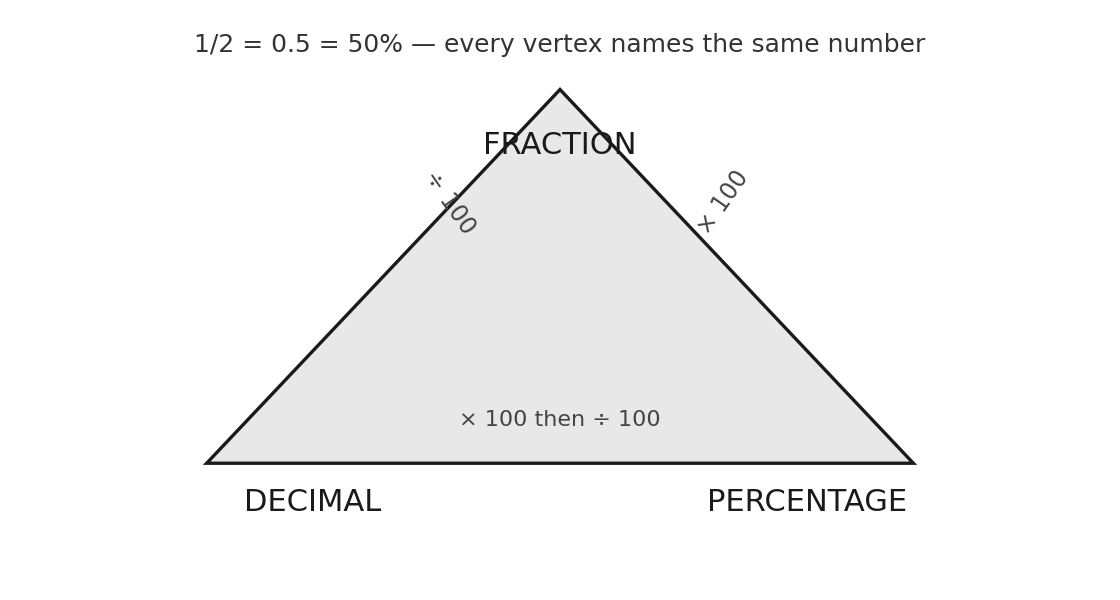
Conversions (N10): 3.5 = 7/2, 0.375 = 3/8; (H) recurring decimal 循环小数s ↔ fractions: 0.6̄ = 6/9 = 2/3; 0.4̄5̄ (pair) → 45/99 = 5/11. Method: x = 0.6̄, 10x = 6.6̄, 9x = 6.
Fractions as operators (N12): "3/5 of 40" = 40 × 3/5 = 24; percentage as multiplier 乘数 — increase by 15% = × 1.15; decrease by 20% = × 0.8; reverse percentage: find the original before the change by dividing by the multiplier.
Units (N13): metric conversions for length, area, volume, capacity; compound measures (speed, density, pressure) link to topic 3.
Vocabulary TrainEnglish recurring decimal/rɪˈkɜːrɪŋ ˈdesɪml/ multiplier/ˌmʌltɪˈplaɪə/ 1.2
Checklist before you call this topic done
- Four operations on fractions/mixed numbers and negatives without a calculator; BIDMAS traps.
- Prime decomposition → HCF/LCM; product rule for counting (H).
- Index laws including negative and fractional; simplify and rationalise surds (H).
- Standard form arithmetic; rounding and error intervals; upper/lower bounds through a formula (H).
- FDP conversions including recurring decimals (H); percentage multipliers and reverse percentages.
-
2
Algebra
-
2.1 Notation, expressions, substitution, expanding and factorising (A1–A4)
Learning program coming soon
-
2.2 Equations, inequalities, formulae and rearranging (A5–A7)
Learning program coming soon
-
2.3 Sequences, including nth term (A24–A25)
Learning program coming soon
-
2.4 Graphs: linear, quadratic, reciprocal, real contexts (A8–A16)
Learning program coming soon
-
2.5 Quadratics and simultaneous equations - HT (A17–A23)
Learning program coming soon
-
-
3
Ratio, proportion and rates of change
-
3.1 Ratio and proportion (R1–R5)
Learning program coming soon
-
3.2 Percentage change, growth and decay (R9–R16)
Learning program coming soon
-
3.3 Compound measures and rates of change (R6–R8, R13–R14)
Learning program coming soon
-
-
4
Geometry and measures
-
4.1 Angles, parallel lines and polygons (G1–G3)
Learning program coming soon
-
4.2 Perimeter, area and volume, including circles (G14–G17, G19)
Learning program coming soon
-
4.3 Pythagoras, trigonometry and their graphs (G6, G20–G24)
Learning program coming soon
-
4.4 Transformations, constructions, loci and vectors (G7–G10, G25)
Learning program coming soon
-
4.5 Properties and congruence and similarity (G4–G5, G18)
Learning program coming soon
-
-
5
Probability
-
5.1 Probability basics and tables (P1–P6)
Learning program coming soon
-
5.2 Tree diagrams and sets - HT (P7–P9)
Learning program coming soon
-
-
6
Statistics
-
6.1 Sampling, averages and spread (S1–S4)
Learning program coming soon
-
6.2 Charts, tables, time series and scatter (S5–S8)
Learning program coming soon
-