Land use and peat: habitat and carbon consequences
Introduit| English | Sens |
|---|---|
| Peat/piːt/ | Soil made of plant material that did not fully decay, which stores carbon. |
| habitat fragmentation/ˈhæbɪtæt ˌfræɡmənˈteɪʃn/ | fragmentation des habitats |
Bogs that store carbon
- Peatlands cover only about 3% of the world's land, but they store about twice as much carbon as all the world's forests.
- Peat 泥炭 forms over thousands of years from plants that never fully decay in waterlogged, acidic bogs.
Land use
- Humans reduce the land available for other animals and plants by building, quarrying, farming and dumping waste.
- Habitats are lost, or split into small pieces: habitat fragmentation 生境破碎化.
Which human land uses reduce habitat?
Difficulté 2/5 · 140 pièces + un petit bonus lors de la première réussite aujourd'hui
Restoration increases habitat.
Peat extraction
- Peat bogs are drained and dug up to make garden compost.
- This destroys the bog habitat and the species that live there.
Why peat does not decay
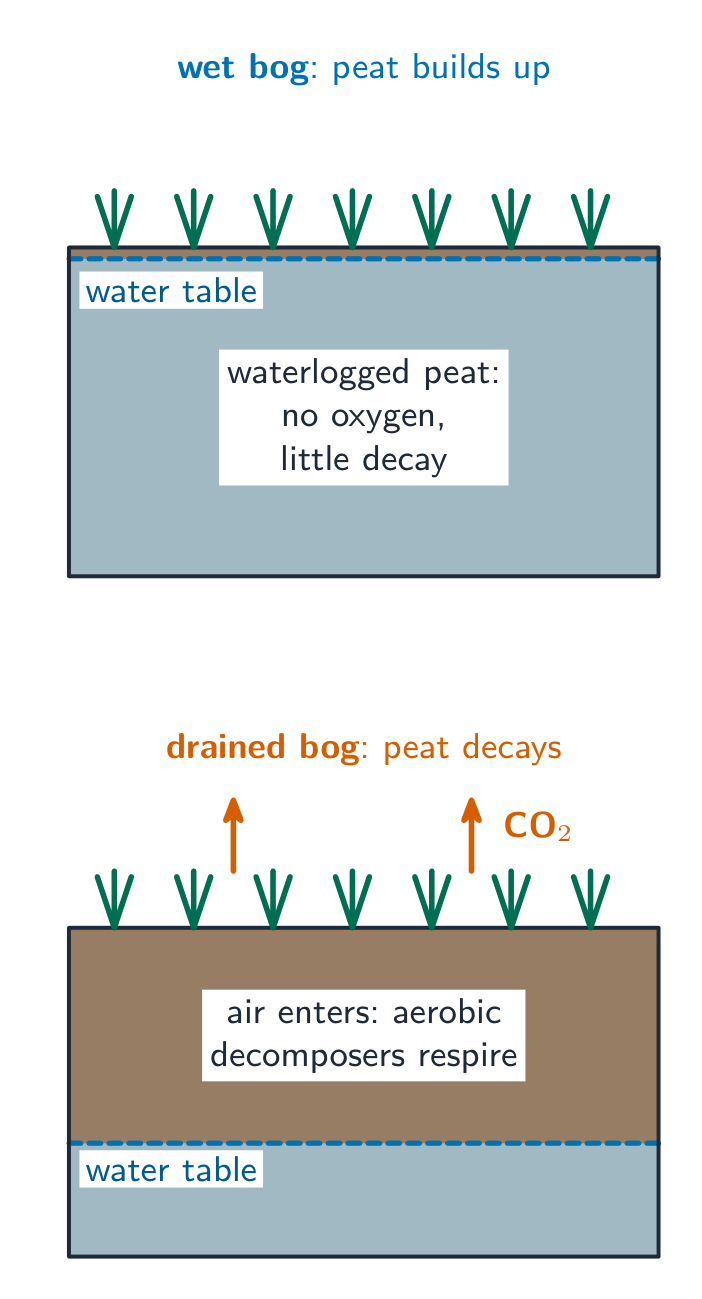
- In a bog the soil is full of water, so there is almost no oxygen. Decomposers (bacteria and fungi) need oxygen to respire aerobically, so dead plants break down very slowly. The bog is also acidic, which slows decay further.
- So dead plant material builds up as peat, and the carbon in it stays locked away instead of returning to the air as CO₂.
Peat habitat lost to land use
Peat habitat falls from 80 to 60 hectares: 20 hectares lost, 25% of the starting area, with its stored carbon at risk.
Why does dead plant material build up as peat in a wet bog?
Difficulté 1/5 · 100 pièces + un petit bonus lors de la première réussite aujourd'hui
Without oxygen, decay is very slow, so the carbon stays locked in the peat. Draining the bog lets air in and decay starts.
Worked example: peat lost
A bog falls from 80 to 60 hectares after drainage.
- Lost $= 80 - 60 = 20$ hectares.
- Percentage lost $= \dfrac{20}{80} \times 100 = 25\%$.
- Carbon: the drained peat starts to decay, releasing CO₂ that had been stored for thousands of years.
A bog falls from 120 to 90 hectares. What percentage is lost?
Difficulté 2/5 · 140 pièces + un petit bonus lors de la première réussite aujourd'hui
30 ÷ 120 × 100 = 25%.
The carbon problem
- When peat is drained, aerobic decomposers can break it down, releasing CO₂. Burning peat as fuel releases it even faster.
- More CO₂ in the air adds to global warming.
Why does draining a peat bog release CO₂?
Difficulté 1/5 · 100 pièces + un petit bonus lors de la première réussite aujourd'hui
Oxygen lets decay start.
Alternatives
- Peat-free compost (made from bark, coir or green waste) is now widely sold.
- Restoring bogs by blocking drains lets peat form again.
What can gardeners use instead of peat compost?
Difficulté 1/5 · 100 pièces + un petit bonus lors de la première réussite aujourd'hui
It protects bogs.
Exam-style question
Question (4 marks): Many gardeners buy compost made from peat. Explain why using peat compost increases the amount of carbon dioxide in the atmosphere.
Model answer
- To dig peat, the bog is drained, so oxygen (air) can get into the peat. ✓
- Microorganisms (decomposers) can now break the peat down. ✓
- They respire and release carbon dioxide. ✓
- This carbon had been stored in the peat for thousands of years; the peat also stops removing CO₂, because its plants are destroyed. ✓
Where marks are lost: "the peat releases CO₂" without saying that microorganisms respire; confusing CO₂ release with the loss of habitat (both are true, but only one answers this question).
Peat is not a renewable resource on a human timescale. It grows only about 1 mm a year. A bog dug in a few years took thousands of years to form.
Peat grows back quickly after it is dug.
Difficulté 1/5 · 100 pièces + un petit bonus lors de la première réussite aujourd'hui
About 1 mm a year.
Building, quarrying, farming and waste reduce habitat. Draining and digging peat bogs destroys habitat and releases stored carbon as CO₂. Peat-free compost and bog restoration help conserve peatlands.
Explain two reasons why peat bogs should be conserved.
Two reasons.