Biodiversity: count species, explain resilience
Introduit| English | Sens |
|---|---|
| Biodiversity/ˌbaɪəʊdaɪˈvɜːsɪti/ | The variety of life, including genetic diversity, species diversity and ecosystem diversity. |
| Species richness/ˈspiːsiːz ˈrɪtʃnəs/ | The number of different species in an area. |
A rainforest in a football pitch
- A single hectare of Amazon rainforest can contain over 400 tree species. A hectare of British woodland may have fewer than 10.
- Biodiversity 生物多样性 is the variety of all the different species of organisms on Earth, or within an ecosystem.
What is biodiversity?
Difficulté 1/5 · 100 pièces + un petit bonus lors de la première réussite aujourd'hui
Variety, not quantity.
Why it makes an ecosystem stable
- With many species, each animal usually has several foods, and each plant has several pollinators. If one species is lost, the others can switch to another.
- So high biodiversity makes an ecosystem more stable: it reduces the dependence of one species on another for food, shelter and the upkeep of the physical environment.
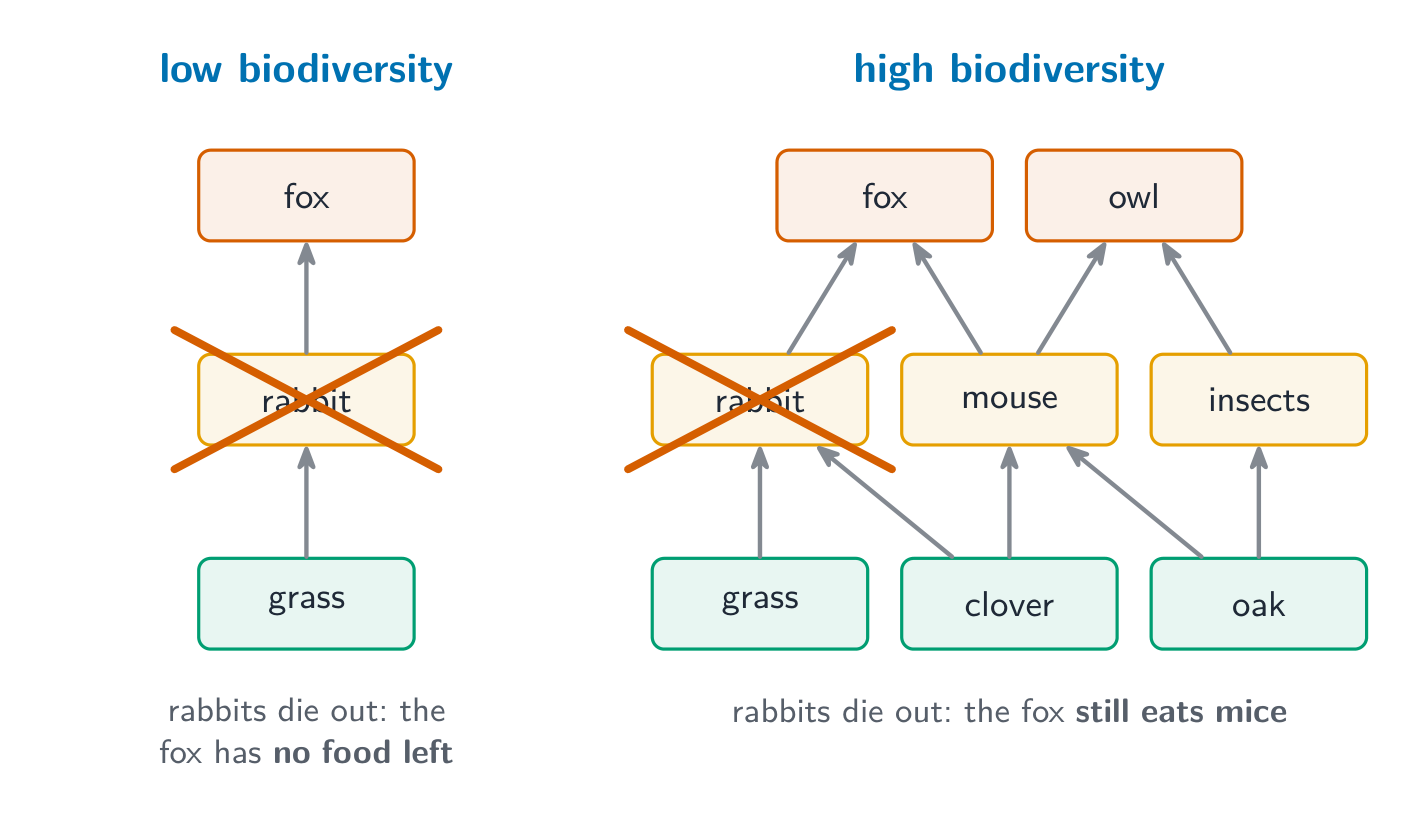
Why does high biodiversity make an ecosystem more stable?
Difficulté 1/5 · 100 pièces + un petit bonus lors de la première réussite aujourd'hui
Many links spread the risk.
In the richer web, the rabbits die out. Why does the fox survive?
Difficulté 1/5 · 100 pièces + un petit bonus lors de la première réussite aujourd'hui
More species means more links, so losing one is not fatal.
Why humans need it
- The future of the human species on Earth depends on keeping a good level of biodiversity. We rely on other species for food, medicines, timber and fibres.
- Living things also keep the environment working for us: plants make oxygen and hold soil in place, about three-quarters of the main food crop types benefit from insect pollination, and wetlands clean water.
Which do humans get from biodiversity?
Difficulté 2/5 · 140 pièces + un petit bonus lors de la première réussite aujourd'hui
Fossil fuels took millions of years to form.
Species richness
- Species richness 物种丰富度 counts how many different species are present.
- It is not the same as the number of individuals.
Fewer individuals but more species
Site A has 80 individuals across 4 species; site B has 60 across 7. B has the greater recorded species richness, by 7 − 4 = 3 species, despite having fewer individuals.
Worked example: two sites
Site A has 80 individuals of 4 species. Site B has 60 individuals of 7 species.
- A: more individuals.
- B: richness $7 - 4 = 3$ species higher.
- Conclusion: B has greater biodiversity, even though it has fewer individuals.
A pond has 12 species and a stream has 5. How many more species does the pond have?
Difficulté 2/5 · 140 pièces + un petit bonus lors de la première réussite aujourd'hui
12 − 5 = 7.
Site X: 500 organisms of 2 species. Site Y: 100 organisms of 9 species. Which has the higher species richness?
Difficulté 1/5 · 100 pièces + un petit bonus lors de la première réussite aujourd'hui
Count species, not individuals.
Humans reduce it
| Human activity | How it reduces biodiversity |
|---|---|
| more people use more land | building, farming and quarrying destroy habitats |
| waste and pollution | sewage and fertiliser in rivers, acid rain and toxic chemicals kill plants and animals |
| deforestation | removes the habitat and food of many species; replaced by one crop |
| peat bog removal | destroys a rare habitat and releases CO₂ |
| global warming | species cannot move or adapt fast enough |
- Since 1970, wildlife populations monitored worldwide have fallen by an average of about 70%. Many of these changes are happening faster than ever before, because the human population and the resources each person uses are both growing.
How does each activity reduce biodiversity?
Difficulté 2/5 · 140 pièces + un petit bonus lors de la première réussite aujourd'hui
Each one removes habitat, kills organisms, or changes conditions.
Exam-style question
Question (4 marks): Large areas of tropical forest are cleared to grow one crop, oil palm. Explain why this reduces biodiversity, and why this matters.
Model answer
- The forest is the habitat (food and shelter) of many species, which are lost when it is cleared. ✓
- The plantation has only one plant species, so it supports very few animal species. ✓
- With fewer species, the ecosystem is less stable: species that remain depend on fewer food sources, so a disease or change can wipe them out. ✓
- Humans lose possible resources, such as new medicines and foods, and the forest's role in taking in CO₂. ✓
Where marks are lost: "animals die" without saying why (habitat, food); or treating fewer trees as the same as fewer species.
More organisms does not mean more biodiversity. A field of wheat has millions of plants but almost no biodiversity. What counts is the number of different species.
A large wheat field has high biodiversity because it has many plants.
Difficulté 1/5 · 100 pièces + un petit bonus lors de la première réussite aujourd'hui
It has very few species.
Biodiversity is the variety of species in an area. High biodiversity makes ecosystems stable, because species depend less on any one other species, and supports human needs for food, medicine and a working environment. Species richness counts species, not individuals. Human activity is reducing biodiversity.
Explain why humans should protect biodiversity.
Two reasons.