Carbon cycles through living and non-living stores
Introduit| English | Sens |
|---|---|
| carbon cycle/ˈkɑːbən ˈsaɪkl/ | cycle du carbone |
| Decomposers/ˌdiːkəmˈpəʊzəz/ | Organisms that break down dead organic matter and waste, recycling nutrients. |
The breathing Earth
- Measurements at Mauna Loa in Hawaii since 1958 show CO₂ in the air rising and falling every year. It dips in the northern summer, when plants grow, and rises in winter.
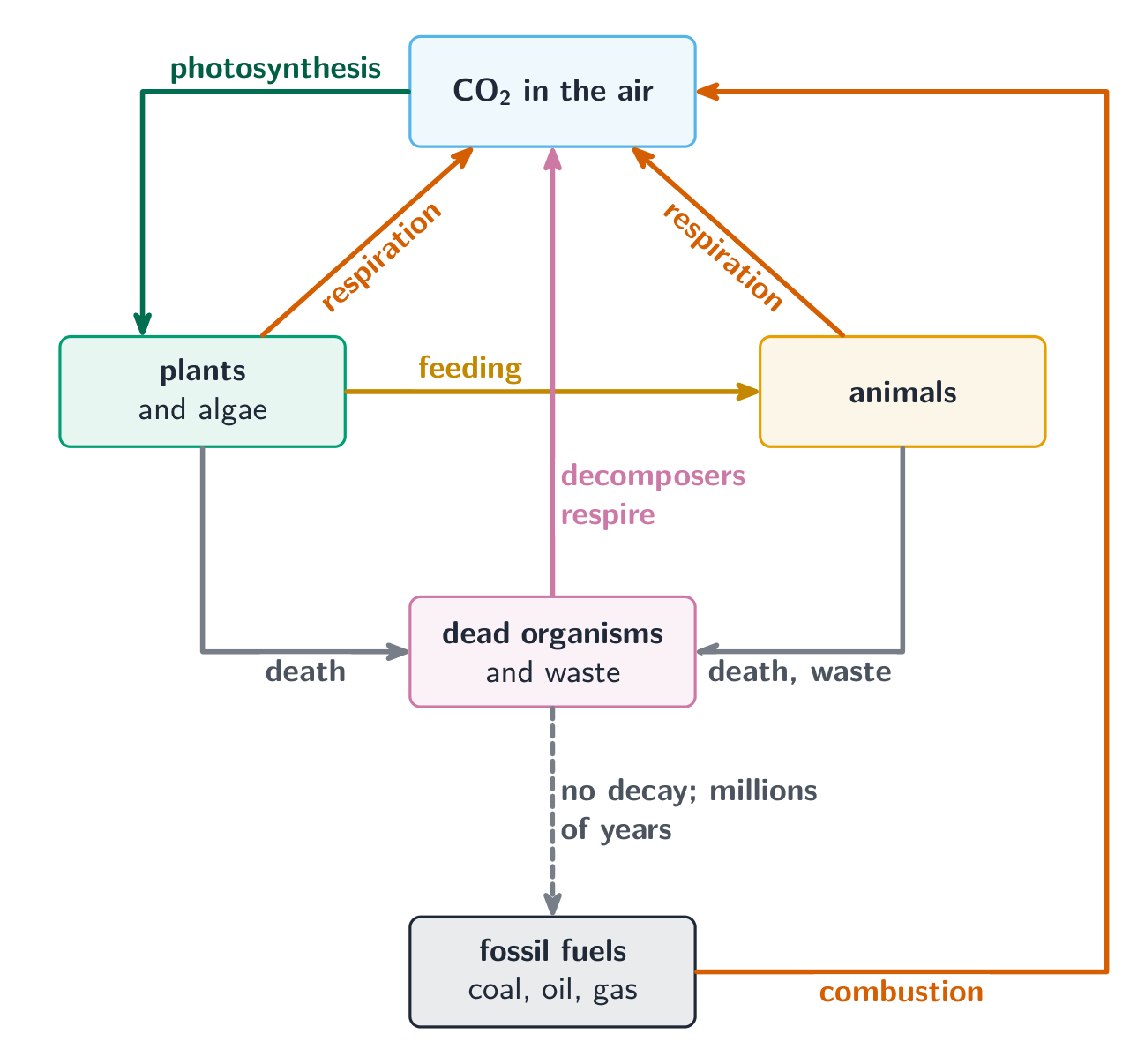
- Carbon moves constantly between the air, living things and the ground: the carbon cycle 碳循环. The cycle returns carbon to the air as CO₂, ready for plants to use again in photosynthesis.
Why does CO₂ in the air dip each northern summer?
Difficulté 1/5 · 100 pièces + un petit bonus lors de la première réussite aujourd'hui
Plants take in more CO₂ than they release while they grow.
Carbon out of the air
- Photosynthesis by plants and algae takes CO₂ from the air and builds it into glucose, and then into other carbon compounds such as starch, cellulose and proteins.
- Animals get carbon by eating plants or other animals. The carbon compounds are digested and built into the animal's own body.
Carbon back to the air
- Respiration by plants, animals and microorganisms releases CO₂.
- Decomposers 分解者 (bacteria and fungi) feed on dead organisms and waste, and release CO₂ as they respire. Combustion of wood and fossil fuels also releases CO₂.
Does each process remove CO₂ from the air or return it?
Difficulté 2/5 · 140 pièces + un petit bonus lors de la première réussite aujourd'hui
Only photosynthesis removes CO₂.
How do decomposers return carbon to the air?
Difficulté 1/5 · 100 pièces + un petit bonus lors de la première réussite aujourd'hui
Respiration releases CO₂.
The whole cycle
- Follow one carbon atom: CO₂ in the air → photosynthesis → a grass leaf → feeding → a rabbit → death → decomposers → respiration → CO₂ in the air again.
- Every arrow back to the air is either respiration (by living things, including decomposers) or combustion.
Balance the plant carbon store
Plants gain 50 carbon units by photosynthesis, pass 18 to animals by feeding and release 12 by respiration: the plant store changes by 50 − 18 − 12 = +20 units.
Put the journey of one carbon atom in order.
Difficulté 3/5 · 200 pièces + un petit bonus lors de la première réussite aujourd'hui
Photosynthesis, feeding, death, decomposition.
Fossil fuels: a store that is being emptied
- Coal, oil and gas formed over millions of years from organisms that died where decay could not happen (no oxygen). Their carbon was locked away.
- Burning them releases that carbon as CO₂ far faster than it was stored. At Mauna Loa, CO₂ has risen from about 315 parts per million in 1958 to over 420 today.
Why did dead organisms become fossil fuels instead of decaying?
Difficulté 1/5 · 100 pièces + un petit bonus lors de la première réussite aujourd'hui
Without the conditions decomposers need, the carbon stayed locked in the dead material.
Worked example: a plant store
In a model year, plants take in 50 carbon units by photosynthesis, lose 18 to animals by feeding and release 12 by respiration.
- Change in the plant store $= 50 - 18 - 12 = +20$ units.
- Meaning: the plants grew, locking up 20 units of carbon.
- When they die, decomposers return that carbon to the air.
Plants take in 60 units, pass 20 to animals and respire 15. What is the change in the plant store?
Difficulté 2/5 · 140 pièces + un petit bonus lors de la première réussite aujourd'hui
60 − 20 − 15 = 25.
Why decomposers matter
- Decay returns carbon to the air as CO₂ and mineral ions to the soil.
- Without decomposers, carbon would stay locked in dead material, and plants would run short of CO₂ and minerals.
Exam-style question
Question (4 marks): Describe how a carbon atom in the CO₂ of the air could become part of a rabbit, and then return to the air.
Model answer
- A plant (grass) takes in the CO₂ by photosynthesis and makes glucose and other carbon compounds. ✓
- The rabbit eats the grass and digests it; the carbon is used to build the rabbit's body. ✓
- The rabbit dies (or produces waste), and decomposers (bacteria and fungi) feed on it. ✓
- The decomposers respire and release the carbon as CO₂ (or the rabbit releases CO₂ in its own respiration). ✓
Where marks are lost: "the rabbit breathes in CO₂" (animals do not take in carbon from the air); "the rabbit decomposes" with no mention of microorganisms respiring.
Plants do not only take in CO₂. They respire all the time, releasing CO₂. They take in more than they give out only when photosynthesis is faster than respiration.
Plants never release CO₂.
Difficulté 1/5 · 100 pièces + un petit bonus lors de la première réussite aujourd'hui
They respire all the time.
Photosynthesis removes CO₂ from the air; feeding passes carbon along food chains; respiration (including by decomposers) and combustion return CO₂ to the air. Fossil fuels are carbon locked away where decay could not happen; burning them is raising CO₂ in the air. Decomposers recycle carbon and mineral ions from dead material.
Peat bogs are wet and short of oxygen, so dead plants in them decay very slowly. Explain how draining a peat bog and using the peat changes the amount of CO₂ in the air. (3 marks)
Link the condition to decay, then to CO₂.