Biotic factors: changing living relationships
Introduit| English | Sens |
|---|---|
| biotic factors | Living factors that affect organisms, such as food, predators and disease. |
| pathogens/ˈpæθədʒnz/ | Disease-causing agents, such as certain bacteria, viruses, fungi or parasites. |
Red squirrels in retreat
- Grey squirrels were brought to Britain from America in the 1870s. They outcompete native red squirrels for food and carry a virus that kills reds. Red squirrels have now vanished from most of England.
- The greys are a living factor in the reds' environment. Living factors like these are biotic factors 生物因子.
Biotic or abiotic?
| Biotic (living) | Abiotic (non-living) |
|---|---|
| availability of food | light intensity, temperature |
| new predators arriving | moisture levels, soil pH and minerals |
| new pathogens 病原体 | wind intensity and direction |
| competition between species | carbon dioxide (plants), oxygen (water animals) |
- Test: is the factor caused by another organism? If yes, it is biotic.
Biotic or abiotic?
Difficulté 2/5 · 140 pièces + un petit bonus lors de la première réussite aujourd'hui
Is it caused by another organism? Then it is biotic.
The four biotic factors
- Food: more food means more individuals survive and breed; a food shortage means more die. New predators: prey that has never met them often has no defence, so its numbers fall.
- New pathogens: if no individuals are resistant, many die. Competition: if another species is better at getting food, space or mates, a population can fall until there are too few to breed.
Prey numbers after a predator arrives
The prey count falls from 80 to 60: a decrease of 20, or 20 ÷ 80 × 100 = 25%.
Competition
- Animals compete for food, mates and territory. Plants compete for light, space, water and mineral ions from the soil.
- Grey squirrels digest acorns before they are ripe, so they eat them first and reds find less food. When two species need the same resource, the better competitor often takes over.
What do plants compete for?
Difficulté 2/5 · 140 pièces + un petit bonus lors de la première réussite aujourd'hui
Plants also compete for space; animals compete for mates.
Why have grey squirrels replaced red squirrels in much of England?
Difficulté 2/5 · 140 pièces + un petit bonus lors de la première réussite aujourd'hui
Fighting is rare; competition and disease do the damage.
Disease spreads through a community
- Ash dieback is a fungal disease first found in Britain in 2012. It may kill most of Britain's ash trees.
- Nearly 1000 species use ash trees, and about 45 live on nothing else. Losing one species changes the whole community, and not every change is a fall.
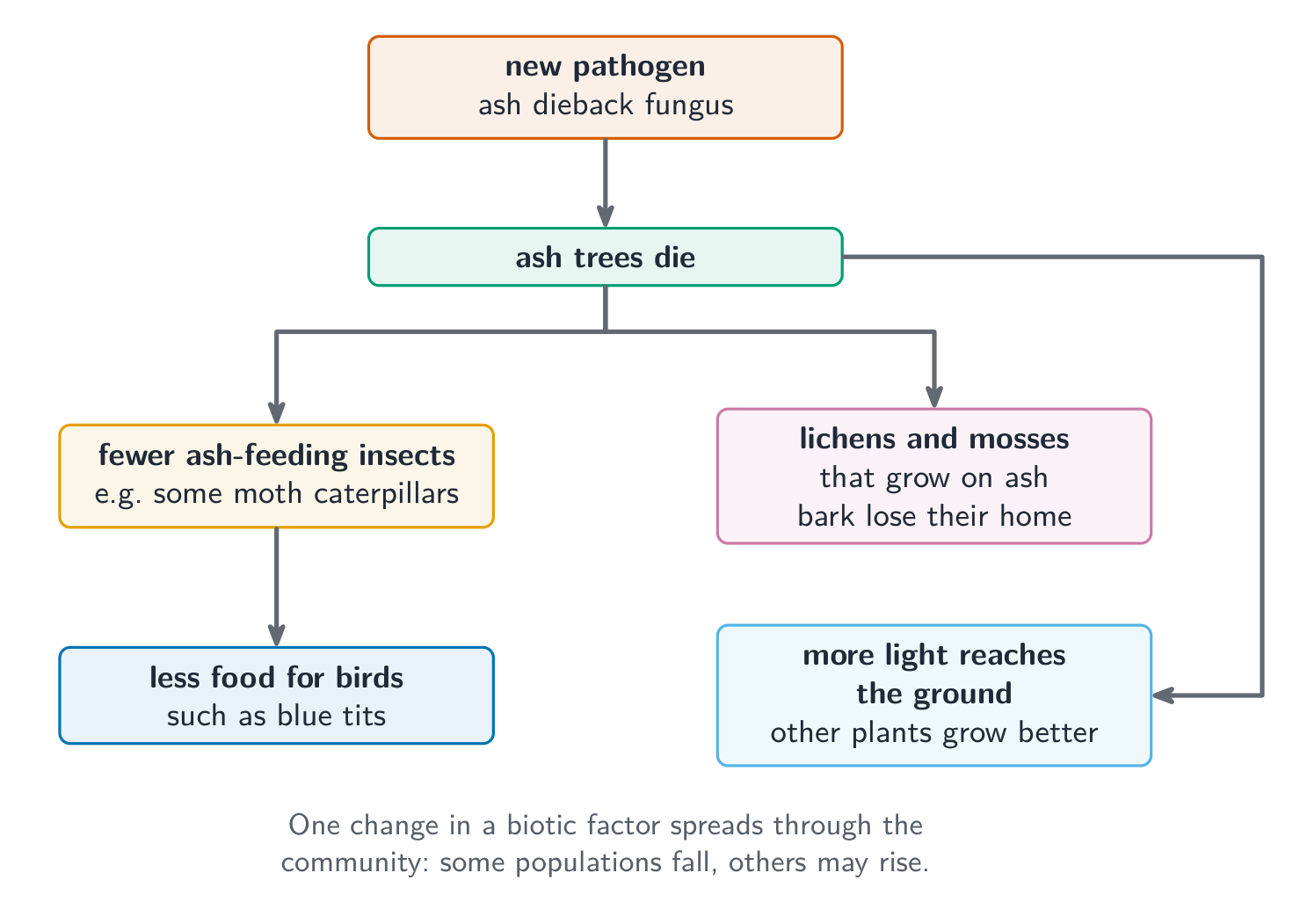
Ash dieback kills most ash trees in a wood. Which population is most likely to increase?
Difficulté 1/5 · 100 pièces + un petit bonus lors de la première réussite aujourd'hui
The dead trees no longer shade the ground, so other plants get more light for photosynthesis.
Worked example: a new predator
After a new predator arrives on an island, a prey species falls from 80 to 60 in one year.
- Fall $= 80 - 60 = 20$.
- Percentage fall $= \dfrac{20}{80} \times 100 = 25\%$.
- If it continues, the prey may become too rare to find mates.
A population falls from 120 to 90. What is the percentage fall?
Difficulté 2/5 · 140 pièces + un petit bonus lors de la première réussite aujourd'hui
30 ÷ 120 × 100 = 25%.
Exam-style question
Question (3 marks): In a wood, blue tits feed their young mainly on moth caterpillars. Many of the caterpillars feed on ash leaves. Ash dieback kills most of the ash trees in the wood. Explain the effect on the blue tit population.
Model answer
- Fewer ash trees means fewer ash leaves, so there are fewer caterpillars. ✓
- The blue tits have less food for their young. ✓
- So fewer young survive, and the blue tit population falls. ✓
Extra credit thinking: the fall may be small if blue tits switch to caterpillars on other trees, such as oak. Answers that follow the chain one link at a time score; "the blue tits die because the trees die" skips the links and scores little.
Competition does not mean fighting. Grey and red squirrels rarely fight. The greys win by eating the same food more efficiently, leaving less for the reds.
Competition between species always involves fighting.
Difficulté 1/5 · 100 pièces + un petit bonus lors de la première réussite aujourd'hui
Usually it is for resources such as food or light.
Biotic factors are living influences on a community: availability of food, new predators, new pathogens, and competition (one species outcompeting another until there are too few to breed). To explain the effect of a change, follow the feeding links one at a time, and remember that some populations may rise.
In a food web, foxes eat rabbits and voles; owls also eat voles; rabbits and voles eat grass. A disease kills most of the rabbits. Explain the effects on the foxes, the voles and the owls. (4 marks)
Follow each feeding link one step at a time.