Wallace and the separation of populations
Introduit| English | Sens |
|---|---|
| speciation/ˌspiːʃɪˈeɪʃn/ | spéciation |
| selection pressures | pressions de sélection |
The Wallace Line
- Alfred Russel Wallace spent eight years collecting animals in the islands of South-East Asia. He found that animals on Bali and Lombok — just 35 km apart — were strikingly different. The boundary is now called the Wallace Line.
- In 1858 he sent Darwin a paper with the same idea of natural selection, so both published together.
Wallace's contributions
- He independently proposed evolution by natural selection, which pushed Darwin to publish On the Origin of Species in 1859. He gathered evidence from around the world.
- He is best known for two ideas: warning colours (bright animals such as poison frogs are avoided by predators that have learned they taste bad), and speciation 物种形成, how new species form.
What did Wallace contribute?
Difficulté 2/5 · 140 pièces + un petit bonus lors de la première réussite aujourd'hui
DNA came much later.
Why do brightly coloured poison frogs survive better than dull ones?
Difficulté 1/5 · 100 pièces + un petit bonus lors de la première réussite aujourd'hui
This is warning colouration, which Wallace studied.
How a new species forms
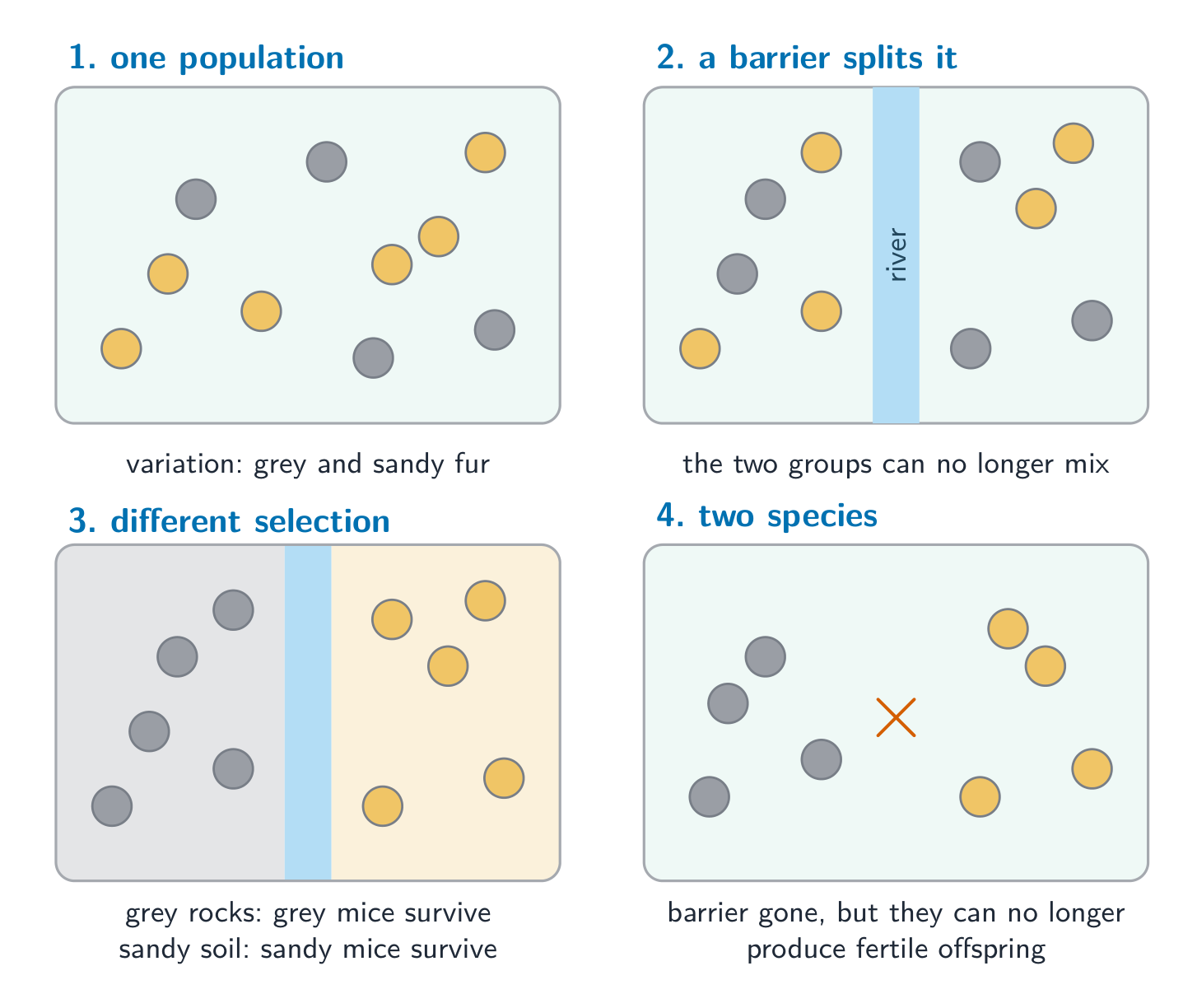
- A population is split by a barrier: a mountain range, a river, the sea. The two groups can no longer interbreed, so their genes stop mixing.
- Each group has variation. The groups face different selection pressures 选择压力 (food, climate, predators), so in each one, the individuals best suited to their side survive, breed and pass on their alleles.
Worked example: a variant spreading
On one island, a beak variant rises from 10% to 35% of the population.
- Change $= 35 - 10 = 25$ percentage points.
- Relative increase $= \dfrac{25}{10} \times 100 = 250\%$ — not 25%.
- Over many generations, such changes add up until the island group is very different.
Percentage points, not percent
The advantageous variant rises from 10% to 35% of the population: an increase of 25 percentage points, which is a 250% relative increase, not 25%.
A variant rises from 20% to 50% of a population. What is the relative increase?
Difficulté 2/5 · 140 pièces + un petit bonus lors de la première réussite aujourd'hui
30 ÷ 20 × 100 = 150%.
A new species
- Differences build up over many generations.
- When the two groups can no longer interbreed to produce fertile offspring, they are separate species.
Order the steps of speciation.
Difficulté 3/5 · 200 pièces + un petit bonus lors de la première réussite aujourd'hui
Isolation then selection.
How do you know two populations are separate species?
Difficulté 1/5 · 100 pièces + un petit bonus lors de la première réussite aujourd'hui
Fertile offspring is the test.
Exam-style question
Question (4 marks): A population of lizards lived on one island. A storm carried some of them to a second island, where the plants are much tougher to eat. Explain how the lizards on the second island could become a new species.
Model answer
- The two populations are isolated, so they cannot interbreed. ✓
- There is variation in each population, for example in jaw strength, caused by different alleles (from mutation). ✓
- On the second island, lizards with stronger jaws are more likely to survive and breed, so they pass on their alleles; this is natural selection. ✓
- Over many generations, the populations become so different that they can no longer interbreed to produce fertile offspring: a new species. ✓
Where marks are lost: "the lizards developed stronger jaws because they needed to" (individuals do not change to fit; selection acts on variation that is already there); or missing the fertile-offspring test.
Which statement about the lizards is correct?
Difficulté 1/5 · 100 pièces + un petit bonus lors de la première réussite aujourd'hui
Selection acts on variation that is already there.
Being different does not make a new species. Dog breeds look very different but can still interbreed and have fertile puppies, so they are one species. The test is fertile offspring.
A Great Dane and a chihuahua are different species because they look so different.
Difficulté 1/5 · 100 pièces + un petit bonus lors de la première réussite aujourd'hui
They can produce fertile puppies.
Wallace independently proposed natural selection and is known for his work on warning colours and speciation. Speciation happens when populations are isolated and face different selection pressures, until they can no longer interbreed to produce fertile offspring.
Explain how two species of finch could form on two separate islands.
Speciation steps.