Graphs of Polar Functions · Graphes de fonctions polaires
| English | Français |
|---|---|
| polar function/ˈpəʊlə ˈfʌŋkʃn/ | fonction polaire |
| rose/rəʊz/ | rose |
| cardioid/ˈkɑːdɪəʊɪd/ | cardioïde |
| polar coordinates/ˈpəʊlə kəʊˈɔːdɪnəts/ | coordonnées polaires |
Curves that bloom
- In rectangular graphs, $y$ depends on $x$. In polar graphs, the radius depends on the angle.
- As the angle sweeps around, the radius grows and shrinks, tracing surprising shapes.
- Flowers, hearts, and spirals all appear from simple polar rules.
- These curves are hard to write with $x$ and $y$, but easy with $r$ and $\theta$.
Courbes qui s'épanouissent
- Dans les graphiques rectangulaires, $y$ dépend de $x$. Dans les graphiques polaires, le rayon dépend de l'angle.
- À mesure que l'angle balaye le plan, le rayon grandit et diminue, traçant des formes surprenantes.
- Fleurs, cœurs et spirales apparaissent tous à partir de règles polaires simples.
- Ces courbes sont difficiles à écrire avec $x$ et $y$, mais faciles avec $r$ et $\theta$.
What a polar function is
- A polar function 极坐标函数 has the form $r = f(\theta)$: a radius for each angle.
- To plot it, sweep $\theta$ around and mark the point at distance $r$ in that direction.
- Where $r$ is large the curve reaches far out; where $r = 0$ it touches the origin.
- The whole graph is built one angle at a time.
Ce qu'est une fonction polaire
- Une fonction polaire 极坐标函数 a la forme $r = f(\theta)$ : un rayon pour chaque angle.
- Pour la tracer, balayez $\theta$ autour et marquez le point à la distance $r$ dans cette direction.
- Où $r$ est grand, la courbe s'étend loin ; où $r = 0$ elle touche l'origine.
- Tout le graphique est construit un angle à la fois.
A polar function $r = f(\theta)$ gives, for each angle, the… · Une fonction polaire $r = f(\theta)$ donne, pour chaque angle, le…
A polar function outputs a radius for each input angle; plotting $(f(\theta), \theta)$ traces the curve. · Une fonction polaire produit un rayon pour chaque angle d'entrée ; tracer $(f(\theta), \theta)$ dessine la courbe.
The simple polar equation $r = 3$ (constant) is a circle. · L'équation polaire simple $r = 3$ (constante) est un cercle.
A constant radius at every angle traces a circle of that radius around the origin. · Un rayon constant à chaque angle trace un cercle de ce rayon autour de l'origine.
Roses and other shapes
- $r = a\sin(k\theta)$ or $a\cos(k\theta)$ traces a rose 玫瑰线 — a flower of petals.
- With $k$ odd there are $k$ petals; with $k$ even there are $2k$.
- $r = a(1 + \sin\theta)$ traces a heart-shaped cardioid 心形线.
- A constant $r = a$ is simply a circle of radius $a$.
Roses et autres formes
- $r = a\sin(k\theta)$ ou $a\cos(k\theta)$ trace une rose 玫瑰线 — une fleur de pétales.
- Avec $k$ impair il y a $k$ pétales ; avec $k$ pair il y a $2k$.
- $r = a(1 + \sin\theta)$ trace un cardioïde 心形line en forme de cœur.
- Un $r = a$ constant est simplement un cercle de rayon $a$.
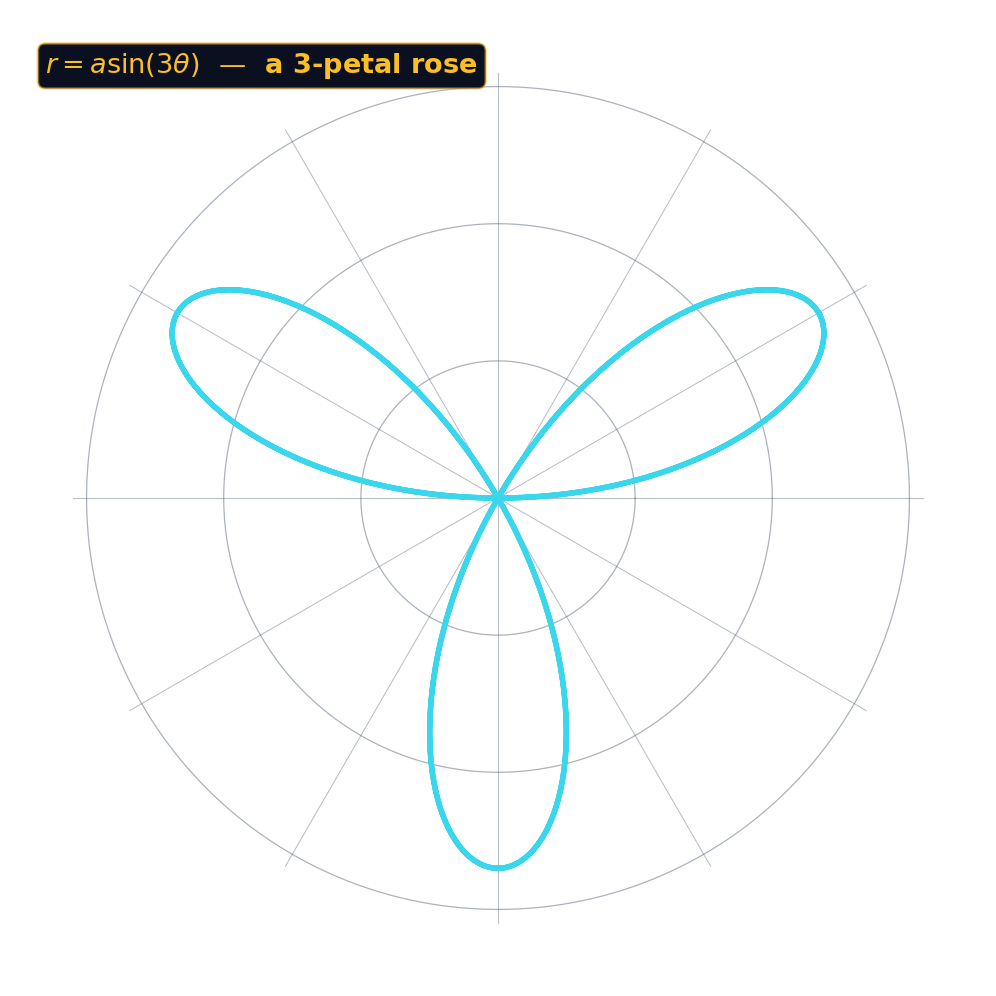
Draw a polar curve petal by petal · Dessiner une courbe polaire pétales par pétales
A polar function sets r for each angle theta. Sweep theta around and the radius traces a rose, circle, or spiral. · Une fonction polaire définit r pour chaque angle theta. Balayer theta autour et le rayon trace une rose, un cercle ou une spirale.
The curve $r = a\sin(3\theta)$ is a rose with how many petals? · La courbe $r = a\sin(3\theta)$ est une rose avec combien de pétales ?
For · Pour $r = a\sin(k\theta)$ with $k$ odd, the rose has exactly $k$ petals — here $3$. · Pour $r = a\sin(k\theta)$ avec $k$ impair, la rose a exactement $k$ pétales — ici $3$.
The heart-shaped polar curve $r = 1 + \sin\theta$ is called a ____. · La courbe polaire en forme de cœur $r = 1 + \sin\theta$ s'appelle ____.
A cardioid ("heart-shaped") is a classic polar curve of the form $r = a(1 + \sin\theta)$. · Un cardioïde («en forme de cœur») est une courbe polaire classique de la forme $r = a(1 + \sin\theta)$.
Select all · tout true statements about polar graphs. · Sélectionnez tous les énoncés vrais sur les graphes polaires.
Polar graphs include circles, roses, cardioids, and spirals — rarely straight lines. The other three are correct. · Les graphes polaires incluent des cercles, des roses, des cardioïdes et des spirales — rarement des lignes droites. Les trois autres sont correctes.
Plotting point by point
- Make a table: choose angles, compute $r$ at each, and mark the points.
- Watch for where $r = 0$ (the curve passes through the origin) and where $r$ peaks.
- Join the points smoothly in order of increasing $\theta$.
- The pattern usually repeats after one full turn (or half, for even roses).
Tracer point par point
- Faites un tableau : choisissez des angles, calculez $r$ à chacun, et marquez les points.
- Surveillez où $r = 0$ (la courbe passe par l'origine) et où $r$ atteint son maximum.
- Reliez les points doucement dans l'ordre croissant de $\theta$.
- Le motif se répète généralement après un tour complet (ou demi-tour pour les roses paires).
Symmetry helps
- Many polar curves are symmetric about an axis, which halves the plotting work.
- A $\sin$ curve is often symmetric about the vertical axis; a $\cos$ curve about the horizontal.
- Spotting the symmetry lets you sketch one part and mirror the rest.
- Converting back to polar coordinates 极坐标 confirms exactly where each feature sits.
La symétrie aide
- Beaucoup de courbes polaires sont symétriques par rapport à un axe, ce qui divise par deux le travail de tracé.
- Une courbe $\sin$ est souvent symétrique par rapport à l'axe vertical ; une courbe $\cos$ par rapport à l'axe horizontal.
- Repérer la symétrie permet de dessiner une partie et de miroiter le reste.
- Revenir aux coordonnées polaires 极坐标 confirme exactement où chaque caractéristique se trouve.
Do not read a polar graph like a rectangular one. A "loop" back to the origin means $r$ passed through $0$, not that the function is undefined. And a single point can be reached at several different angles, so the same curve may be traced more than once.
Ne lisez pas un graphe polaire comme un graphe rectangulaire. Une "boucle" vers l'origine signifie que $r$ est passé par $0$, et non que la fonction est indéfinie. Et un point unique peut être atteint à plusieurs angles différents, donc la même courbe peut être tracée plus d'une fois.
Sketch $r = 2\cos\theta$ over $0 \le \theta \le \pi$.
- At $\theta = 0$: $r = 2$ (a point $2$ units right).
- At $\theta = \tfrac{\pi}{2}$: $r = 0$ (the origin).
- The points trace a circle of diameter $2$ sitting to the right of the origin.
Esquissez $r = 2\cos\theta$ sur $0 \le \theta \le \pi$.
- À $\theta = 0$ : $r = 2$ (un point $2$ unités à droite).
- À $\theta = \tfrac{\pi}{2}$ : $r = 0$ (l'origine).
- Les points tracent un cercle de diamètre $2$ placé à droite de l'origine.
A polar function $r = f(\theta)$ gives a radius for each angle. Sweeping $\theta$ traces circles, roses ($r = a\sin k\theta$), cardioids ($r = a(1+\sin\theta)$), and spirals. Plot point by point using polar coordinates, and use symmetry to speed up the sketch.
Une fonction polaire $r = f(\theta)$ donne un rayon pour chaque angle. Balayer $\theta$ trace des cercles, des roses ($r = a\sin k\theta$), des cardioïdes ($r = a(1+\sin\theta)$) et des spirales. Tracez point par point en utilisant des coordonnées polaires, et utilisez la symétrie pour accélérer l'esquisse.