Defining Simple Harmonic Motion
Introduit| English | Sens |
|---|---|
| restoring force/rɪˈstɔːrɪŋ fɔːs/ | force de rappel |
| simple harmonic motion/ˈsɪmpl hɑːˈmɒnɪk ˈməʊʃn/ | mouvement harmonique simple |
The back-and-forth that nature loves
- A mass on a spring bobs up and down, over and over.
- A guitar string, a swing, a tuning fork — all repeat the same dance.
- Pull them aside and something always tugs them back.
- One linear restoring-force rule describes simple harmonic motion; other repeating motions can follow different rules.
The restoring rule
- For a constant mass with no damping or driving, simple harmonic motion 简谐运动 happens when the net restoring force 回复力 is proportional to displacement:
- The minus sign means the force always points back toward equilibrium.
- A bigger pull the farther you go — that is the signature of SHM.
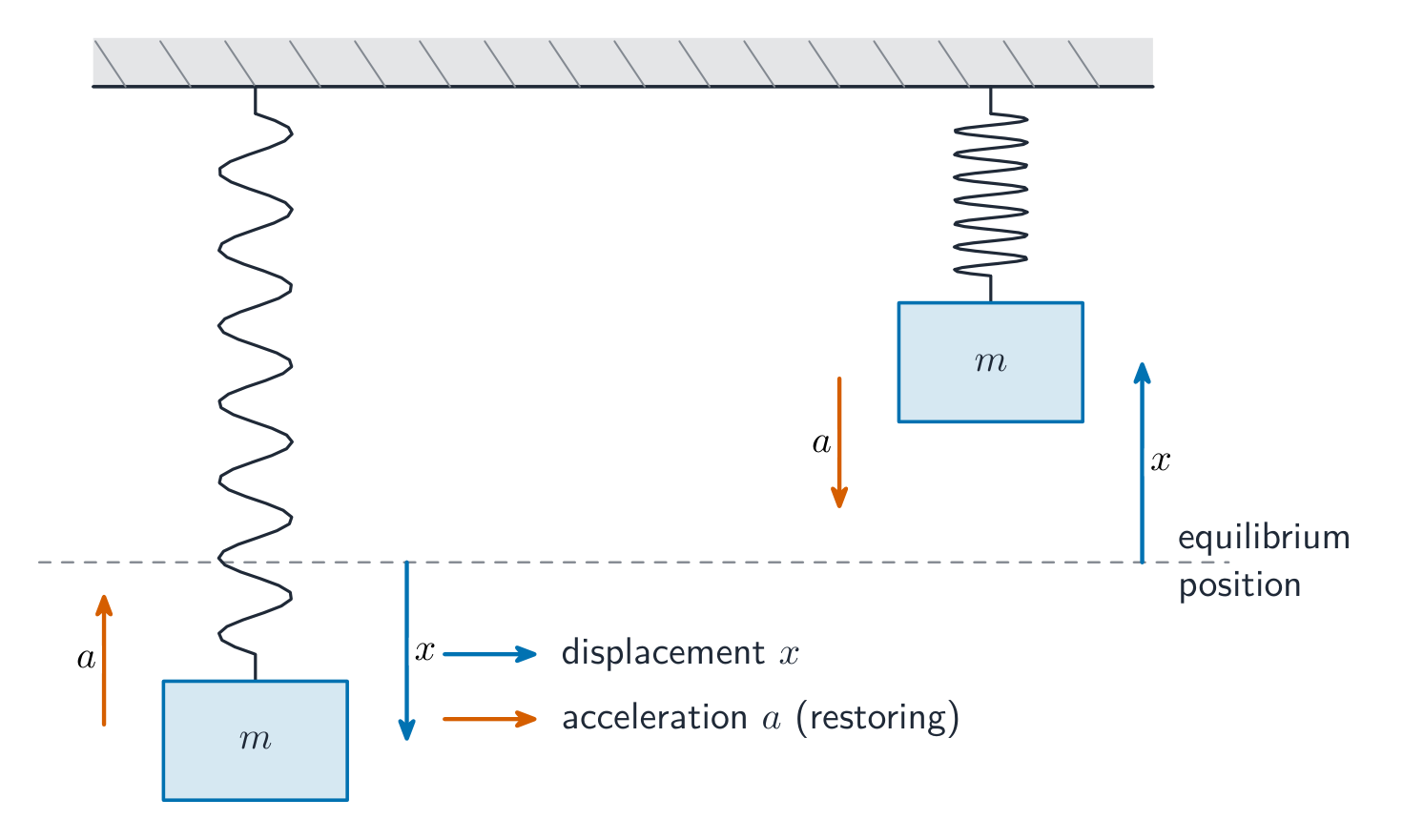
In SHM the acceleration always points back towards equilibrium, opposite the displacement
A spring with $k = 20\ \text{N/m}$ is stretched $x = 0.15\ \text{m}$. The magnitude of the restoring force (in N)?
Difficulté 2/5 · 140 pièces + un petit bonus lors de la première réussite aujourd'hui
$|F| = kx = 20 \times 0.15 = 3\ \text{N}$.
A motion is simple harmonic when the restoring force is...
Difficulté 1/5 · 100 pièces + un petit bonus lors de la première réussite aujourd'hui
$F = -kx$ -- proportional to $x$ and pointing back toward equilibrium.
The minus sign in $F = -kx$ means the force always points back toward equilibrium.
Difficulté 1/5 · 100 pièces + un petit bonus lors de la première réussite aujourd'hui
The force opposes the displacement, restoring the mass toward $x = 0$.
Acceleration points home
- Dividing by mass, the acceleration obeys:
- Acceleration is proportional to displacement but opposite in direction.
- The constant $\omega^2 = k/m$ sets how quickly it oscillates.
For SHM with $\omega^2 = 25\ \text{rad}^2/\text{s}^2$ at displacement $x = 0.2\ \text{m}$, the acceleration magnitude (in m/s²)?
Difficulté 2/5 · 140 pièces + un petit bonus lors de la première réussite aujourd'hui
$|a| = \omega^2 x = 25 \times 0.2 = 5\ \text{m/s}^2$.
The usual suspects
- A mass on a spring: $F = -kx$ directly.
- A pendulum at small angles: gravity gives a near-linear pull back.
- Any system with a linear restoring force wobbles as SHM.
The restoring force of SHM
Simple harmonic motion needs a restoring force proportional to the displacement and pointing back to the centre.
A $0.5\ \text{kg}$ mass on a spring with $k = 8\ \text{N/m}$ is pulled $0.1\ \text{m}$ and released.
- Restoring force at release: $F = -kx = -8 \times 0.1 = -0.8\ \text{N}$.
- Acceleration: $\omega^2 = k/m = 16$, so $a = -\omega^2 x = -16 \times 0.1 = -1.6\ \text{m/s}^2$.
In SHM, where is the magnitude of acceleration largest?
Difficulté 1/5 · 100 pièces + un petit bonus lors de la première réussite aujourd'hui
The acceleration magnitude is omega squared times the absolute displacement, so it is largest at either extreme and zero at equilibrium.
A pendulum swings as simple harmonic motion only for small angles.
Difficulté 1/5 · 100 pièces + un petit bonus lors de la première réussite aujourd'hui
Only at small angles is the restoring pull proportional to displacement.
A pendulum is only SHM for small angles (roughly under $15^\circ$); at large angles the pull-back is no longer proportional to displacement. The minus sign is essential — without it the force would push the mass away and nothing would oscillate. And acceleration is largest at the extremes (biggest $x$) and zero at equilibrium, the opposite of speed.
Simple harmonic motion is the smooth repeat you get when the restoring force is proportional to displacement and points back home: $F = -kx$, so $a = -\omega^2 x$ with $\omega^2 = k/m$. A spring shows it exactly; a small-angle pendulum shows it approximately. Acceleration peaks at the extremes and vanishes at equilibrium.
Write from the data: find the restoring force
- A spring has k = 50 N/m and is stretched 0.10 m.
- Find the size of the restoring force.
A spring with k = 50 N/m is stretched by 0.10 m. What is the magnitude of the restoring force, and which way does it point?
50 times 0.10 is 5.
An ideal spring with k = 50 N/m is stretched 0.10 m. What is the magnitude and direction of its restoring force?
Difficulté 1/5 · 100 pièces + un petit bonus lors de la première réussite aujourd'hui
k times x is 50 times 0.10.