Electric Potential
Introduit| English | Sens |
|---|---|
| volt/vəʊlt/ | volt |
Voltage is like "electric height"
- A ball rolls downhill from high ground to low; a positive charge, left alone, moves from high potential to low. A map of electric potential is like a contour map of a hill.
- Electric potential 电势 tells you how much electric potential energy each coulomb of charge would have at a point. Unlike the field, it is a scalar, so adding up potentials is just adding numbers.
Potential and potential difference
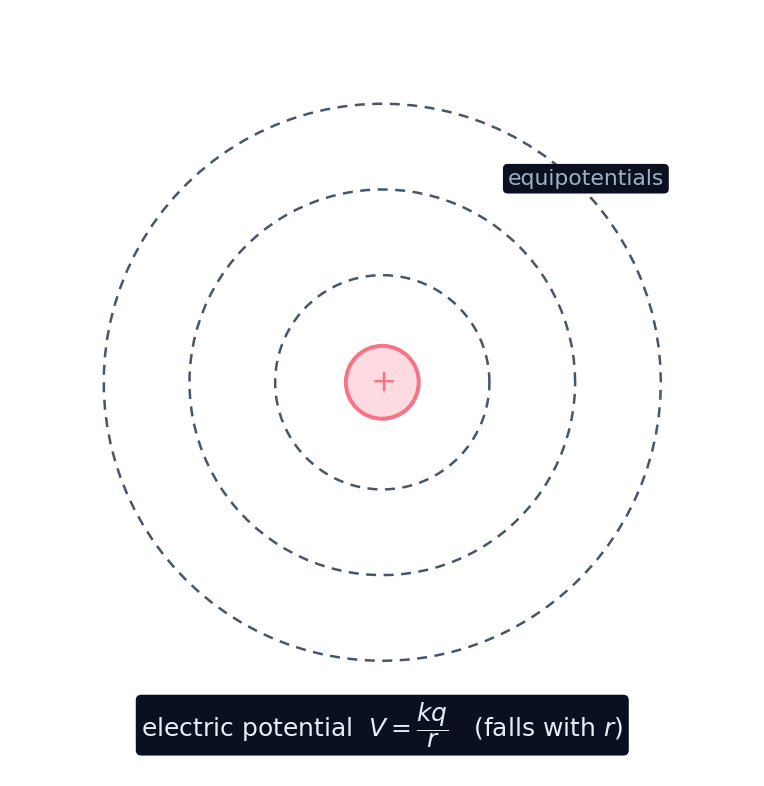
- Electric potential $V$ is the electric potential energy per unit charge at a point: $V = U/q$, in volts ($1\ \text{V} = 1\ \text{J/C}$). For a point charge, $V = kq/r$: positive near a positive charge, negative near a negative charge.
- The potential difference $\Delta V$ between two points is the change in potential energy per unit charge when a test charge moves between them: $\Delta U = q\Delta V$. A battery creates a potential difference by chemical processes that separate positive and negative charges.
A $+2\ \text{C}$ charge moves slowly to a point $6\ \text{V}$ higher in potential. How much external work is required, in $\text{J}$?
Difficulté 2/5 · 140 pièces + un petit bonus lors de la première réussite aujourd'hui
For slow motion, $W_{\text{ext}} = \Delta U = q\Delta V = 2 \times 6 = 12\ \text{J}$. Electric work is $-12\ \text{J}$.
One volt equals one joule per ____.
Difficulté 1/5 · 100 pièces + un petit bonus lors de la première réussite aujourd'hui
$1\ \text{V} = 1\ \tfrac{\text{J}}{\text{C}}$ — energy per unit charge.
Select tout true statements about electric potential.
Difficulté 2/5 · 140 pièces + un petit bonus lors de la première réussite aujourd'hui
Potential is a scalar in volts, and its difference drives current. Only the field has a direction.
A charge of magnitude 3 C moves between points with potential difference magnitude 8 V. What is the magnitude of the energy transfer?
Difficulté 1/5 · 100 pièces + un petit bonus lors de la première réussite aujourd'hui
Charge times potential difference is 24 J. Other options — 12 J (the lesson transfer); 8 J (the voltage used as the energy).
Superposition: just add the numbers
- The potential from several point charges is the sum of the potentials from each one, with signs: $V = \sum kq_i/r_i$. There are no components, because potential is a scalar.
- Potential can be zero at a point where the electric field is not zero, and the field can be zero where the potential is not.
+2.0 nC at $x=0$ and −1.0 nC at $x=0.30$ m. Find $V$ at the midpoint, $x=0.15$ m. ($k = 9.0\times10^9\ \text{N·m}^2/\text{C}^2$)
Electric potential is a vector with a direction at each point.
Difficulté 1/5 · 100 pièces + un petit bonus lors de la première réussite aujourd'hui
False. Electric potential is a scalar measured in volts; it is the electric field that has a direction.
Which correctly distinguishes potential from field?
Difficulté 1/5 · 100 pièces + un petit bonus lors de la première réussite aujourd'hui
Potentiel $V = U/q$ (scalar, volts); field $E = F/q$ (vector, N/C).
Charges of +3.0 nC and −3.0 nC are 0.20 m apart. What is the electric potential at the midpoint between them, in volts?
Difficulté 2/5 · 140 pièces + un petit bonus lors de la première réussite aujourd'hui
Each charge is 0.10 m away: $k(3.0\times10^{-9})/0.10 = 270$ V and $-270$ V. Sum: 0 V. (The field there is not zero: both fields point toward the negative charge.)
Equipotentials and the field
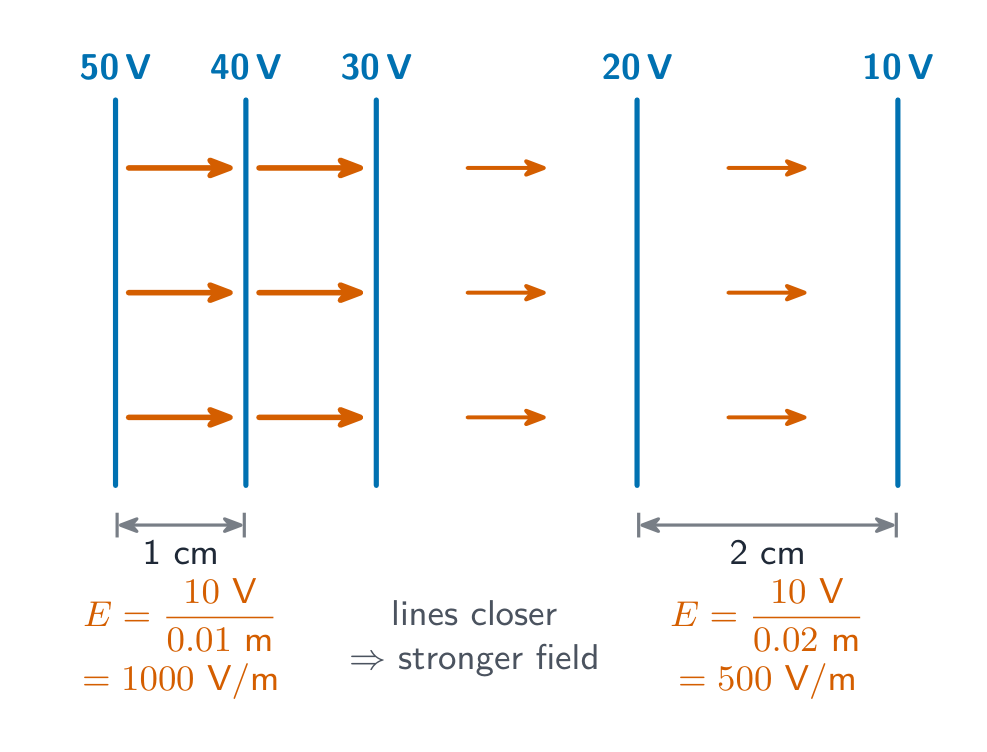
- Equipotential lines 等势线 join points at the same potential. The field is always perpendicular to them and points from high to low potential. No work is done moving a charge along an equipotential.
- The average field between two points is the potential difference divided by the distance: $E = \dfrac{|\Delta V|}{\Delta r}$, so 1 V/m = 1 N/C. Closer equipotential lines mean a stronger field.
Field and potential together
See how the field lines relate to the potential that falls off around a charge.
How much work is needed to move a charge along an equipotential surface?
Difficulté 1/5 · 100 pièces + un petit bonus lors de la première réussite aujourd'hui
Points on an equipotential are at the same potential, so no work is needed to move between them.
Two equipotential lines, at 120 V and 80 V, are 0.050 m apart. What is the size of the average electric field between them, in V/m?
Difficulté 2/5 · 140 pièces + un petit bonus lors de la première réussite aujourd'hui
$E = |\Delta V|/\Delta r = 40/0.050 = 800$ V/m.
On an equipotential map, which way does the electric field point?
Difficulté 1/5 · 100 pièces + un petit bonus lors de la première réussite aujourd'hui
The field is perpendicular to equipotentials and points from high to low potential.
Conductors in contact
- When two conductors touch, electrons flow between them until both surfaces are at the same potential. Then there is no potential difference, so charge stops flowing.
- This is why a wire in a circuit (with negligible resistance) has the same potential all along its length.
When a charged metal sphere touches an uncharged metal sphere, charge flows until both spheres have the same charge.
Difficulté 1/5 · 100 pièces + un petit bonus lors de la première réussite aujourd'hui
Charge flows until both are at the same potential. They have equal charge only if the spheres are the same size.
Worked FRQ answer
Use the two charges in the superposition example: +2.0 nC at $x=0$, −1.0 nC at $x=0.30$ m.
(A) Find the point between the charges where $V = 0$. At distance $x$ from the positive charge, the two potentials cancel; $k$ and $10^{-9}$ cancel too:
(B) Is the electric field also zero at that point? Justify. No. Between the charges, the field of the positive charge points away from it (to the right), and the field of the negative charge points toward it (also to the right). The two fields add, so $E \neq 0$.
(C) A proton is released from rest at $x = 0.15$ m. In which direction does it move, and does its potential energy increase or decrease? It moves to the right, toward lower potential, and its potential energy decreases ($\Delta U = q\Delta V < 0$ for a positive charge moving to lower $V$).
- Why it scores: (A) uses signed scalar addition; (B) compares field directions, the step that shows $V=0$ does not imply $E=0$; (C) links the motion to high → low potential for a positive charge.
- Potential is a scalar, the field is a vector. Add potentials as signed numbers; add fields as vectors.
- $V = 0$ does not mean $E = 0$, and $E = 0$ does not mean $V = 0$.
- Negative charges move toward higher potential, the opposite of positive charges, but they too lose potential energy.
Electric potential $V = U/q$ (volts) is potential energy per unit charge; for point charges, $V = \sum kq_i/r_i$ by scalar superposition. $\Delta U = q\Delta V$. The field is perpendicular to equipotentials, points to lower $V$, and has average size $E = |\Delta V|/\Delta r$. Conductors in contact reach the same potential.