Condensateurs
Introduit| English | Sens |
|---|---|
| capacitor/kəˈpæsɪtə/ | condensateur |
| farad/ˈfæræd/ | farad |
Charge slowly, release at once
- A camera flash charges for a few seconds, then lights for about a thousandth of a second. A heart defibrillator does the same with hundreds of joules. Both store energy in a capacitor 电容器 and release it very quickly.
- AP Physics 2 studies one kind: the parallel-plate capacitor: two parallel conducting plates, separated by a gap, holding equal and opposite charges $+Q$ and $-Q$.
Capacitance: charge per volt
- Capacitance 电容 relates the charge on each plate to the potential difference between the plates: $C=\dfrac{Q}{\Delta V}$. Unit: the farad 法拉, $1\ \text{F}=1$ C/V. Real capacitors are usually microfarads (μF) or picofarads (pF).
- $C$ depends only on the capacitor itself (its shape and the material between the plates), not on $Q$ or $\Delta V$. Double the voltage and $Q$ doubles; $C$ stays the same.
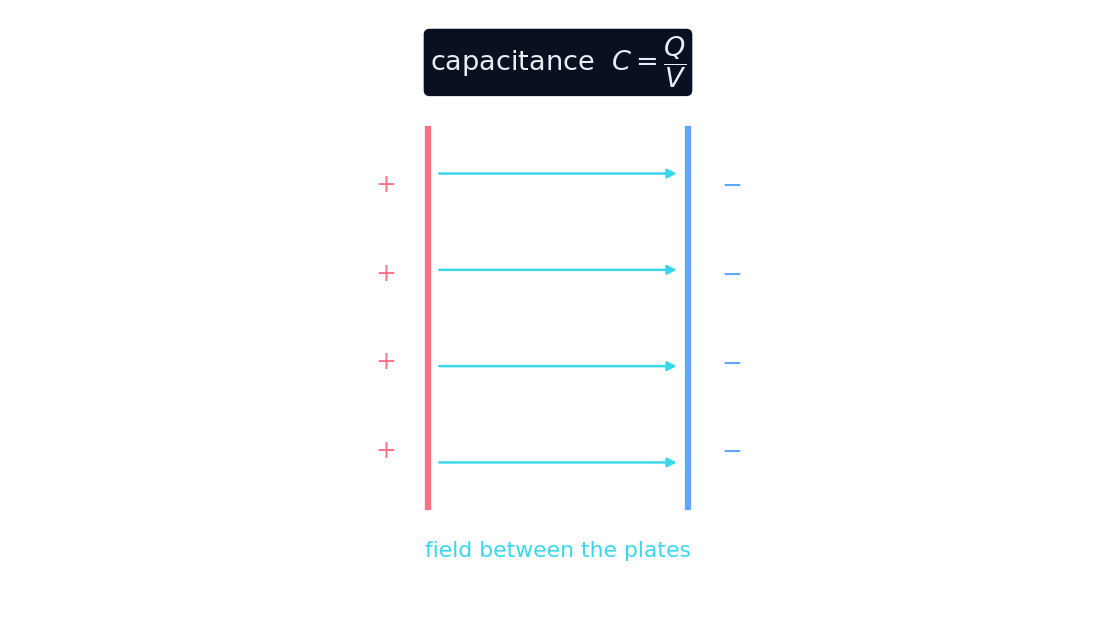
Charge up a capacitor
Watch charge build on the plates as the capacitor charges, then discharge.
A $2\ \text{F}$ capacitor is charged to $3\ \text{V}$. How much charge does it store, in $\text{C}$?
Difficulté 2/5 · 140 pièces + un petit bonus lors de la première réussite aujourd'hui
$Q = CV = 2 \times 3 = 6\ \text{C}$.
Capacitance is defined as:
Difficulté 1/5 · 100 pièces + un petit bonus lors de la première réussite aujourd'hui
$C = Q/V$ — charge stored per volt.
A capacitor's capacitance changes when you raise the voltage across it.
Difficulté 1/5 · 100 pièces + un petit bonus lors de la première réussite aujourd'hui
Capacitance is fixed by geometry; raising $V$ stores more $Q$ but keeps $C = Q/V$ the same.
Capacitance is measured in ____.
Difficulté 1/5 · 100 pièces + un petit bonus lors de la première réussite aujourd'hui
$1\ \text{F} = 1\ \tfrac{\text{C}}{\text{V}}$.
What sets the capacitance
- $\varepsilon_0=8.85\times10^{-12}\ \text{C}^2/(\text{N}\cdot\text{m}^2)$. $C$ is proportional to the plate area $A$ and inversely proportional to the separation $d$. $\kappa$ is the dielectric constant 介电常数 of the material between the plates ($\kappa=1$ for vacuum, about 1 for air).
- A dielectric 电介质 becomes polarized: it sets up a field opposite to the field from the plates. The net field and $\Delta V$ fall for the same $Q$, so $C=Q/\Delta V$ increases by a factor $\kappa$.
Plates of area $0.010\ \text{m}^2$, $1.0$ mm apart, in air: $C=\dfrac{(8.85\times10^{-12})(0.010)}{0.0010}=8.9\times10^{-11}$ F $=89$ pF.
Select tout changes that increase a capacitor's capacitance.
Difficulté 2/5 · 140 pièces + un petit bonus lors de la première réussite aujourd'hui
Bigger area, smaller gap and a dielectric all raise $C$. Voltage does not change $C$.
A charged capacitor is disconnected from its battery. A dielectric with $\kappa=3$ is slid between the plates. What happens to the potential difference?
Difficulté 1/5 · 100 pièces + un petit bonus lors de la première réussite aujourd'hui
Disconnected, so $Q$ is fixed. $C$ becomes $3C$, and $\Delta V=Q/C$ becomes one third. The dielectric's opposing field lowers the net field.
An air capacitor has plates of area $0.020\ \text{m}^2$ separated by 0.50 mm. Find its capacitance in picofarads (pF). Use $\varepsilon_0=8.85\times10^{-12}$.
Difficulté 2/5 · 140 pièces + un petit bonus lors de la première réussite aujourd'hui
$C=(8.85\times10^{-12})(0.020)/(0.00050)=3.54\times10^{-10}$ F $=354$ pF.
A uniform field between the plates
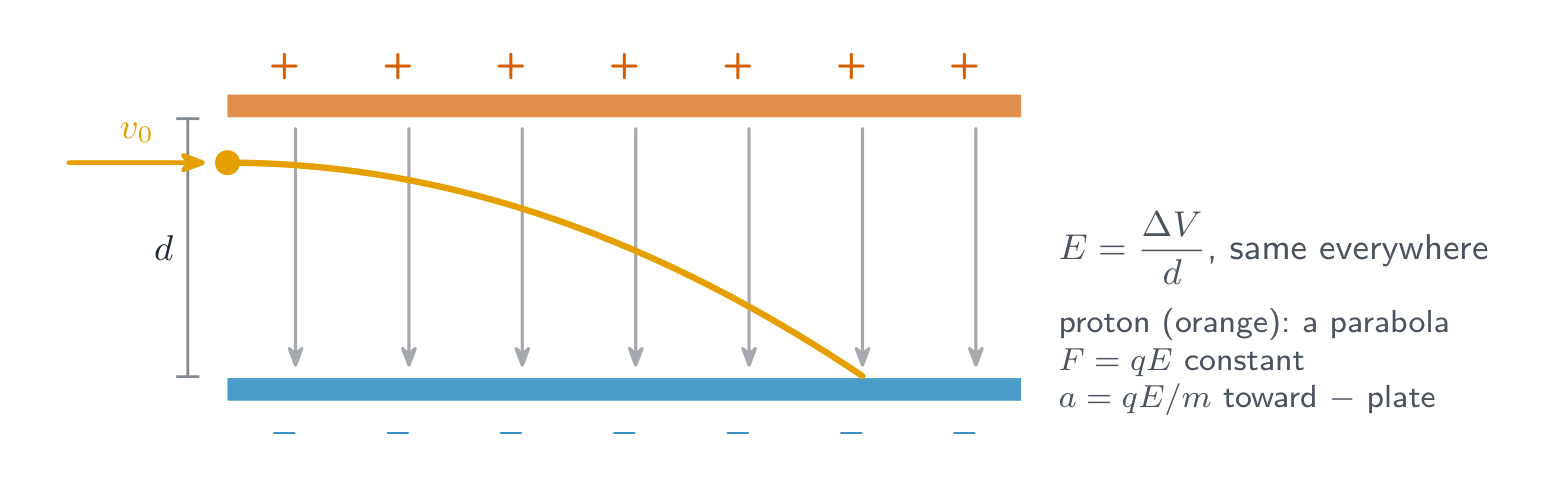
- Between the plates (away from the edges), the electric field is constant in size and direction: $E=\dfrac{\Delta V}{d}$, pointing from the + plate to the − plate.
- So a charged particle there feels a constant force $qE$ and has constant acceleration $a=qE/m$. It moves like a projectile in gravity: constant velocity along the plates, steady acceleration across them, a parabolic path.
Two parallel plates 2.0 mm apart have a potential difference of 50 V. What is the electric field between them, in V/m?
Difficulté 2/5 · 140 pièces + un petit bonus lors de la première réussite aujourd'hui
$E=\Delta V/d=50/0.0020=2.5\times10^4$ V/m.
Energy stored
- Charging a capacitor takes work: each extra charge must be pushed onto a plate against the charge already there. That work is stored as electric potential energy:
- Why $\tfrac12$? The voltage rises from 0 to $\Delta V$ while charging, so the average voltage the charge was moved through is $\tfrac12\Delta V$.
The same $2\ \text{F}$ capacitor at $3\ \text{V}$ stores how much energy, in $\text{J}$?
Difficulté 2/5 · 140 pièces + un petit bonus lors de la première réussite aujourd'hui
$U = \tfrac12 CV^2 = \tfrac12 (2)(9) = 9\ \text{J}$.
Worked FRQ: pulling the plates apart
An air capacitor is charged by a 12 V battery, then disconnected. The plates are then pulled apart from $d$ to $2d$.
(A) What happens to $Q$, $C$, $\Delta V$ and $U$? Disconnected, so the charge has nowhere to go: $Q$ stays the same. $C\propto1/d$, so $C$ halves. $\Delta V=Q/C$, so $\Delta V$ doubles to 24 V. $U=\tfrac12Q\Delta V$, so $U$ doubles.
(B) Where does the extra energy come from? The plates attract each other, so pulling them apart takes positive work by the external force. That work becomes the extra stored energy.
(C) What changes if the battery stays connected? Now $\Delta V$ stays 12 V. $C$ still halves, so $Q=C\Delta V$ halves and $U=\tfrac12C(\Delta V)^2$ halves.
- Why it scores: first state which quantity is fixed (isolated → $Q$; connected → $\Delta V$), then reason through $C=\kappa\varepsilon_0A/d$, $Q=C\Delta V$ and $U$.
A capacitor stays connected to a battery while its plate separation is halved. By what factor does its stored energy change?
Difficulté 1/5 · 100 pièces + un petit bonus lors de la première réussite aujourd'hui
Connected, so $\Delta V$ is fixed. Halving $d$ doubles $C$, and $U=\tfrac12C(\Delta V)^2$ doubles.
- Changing $\Delta V$ does not change $C$. Only geometry and the dielectric do.
- Disconnected → $Q$ constant; connected → $\Delta V$ constant. Decide this first.
- $E=\Delta V/d$ only between parallel plates, away from the edges, where the field is uniform.
A parallel-plate capacitor holds $+Q$ and $-Q$ on two plates. $C=Q/\Delta V=\kappa\varepsilon_0A/d$: set only by area, separation and dielectric. A dielectric's opposing field raises $C$. Between the plates the field is uniform, $E=\Delta V/d$, so charged particles move like projectiles. Stored energy $U_C=\tfrac12Q\Delta V=\tfrac12C(\Delta V)^2$ equals the work done to separate the charge.