Pression
Introduit| English | Sens |
|---|---|
| pressure/ˈpreʃə/ | pression |
| pascal/ˈpæskl/ | pascal |
Snowshoes float you; stilettos sink in
- Step onto soft snow in boots and you sink; strap on snowshoes and you walk on top.
- Same weight, spread over a bigger area — so the pressure 压强 is much smaller.
- Pressure is force spread over area, and it rules everything about fluids.
- Deep in the ocean it crushes; under a sharp blade it cuts.
Defining pressure
- Pressure is force per unit area: $P = \dfrac{F}{A}$.
- Its unit is the pascal 帕斯卡 ($1\ \text{Pa} = 1\ \tfrac{\text{N}}{\text{m}^2}$).
- The same force over a smaller area gives a larger pressure — hence sharp knives and needles.
- Spread the force out (snowshoes, wide tyres) and the pressure drops.
A force of $200\ \text{N}$ presses on an area of $0.5\ \text{m}^2$. What is the pressure, in $\text{Pa}$?
Difficulté 2/5 · 140 pièces + un petit bonus lors de la première réussite aujourd'hui
$P = F/A = 200/0.5 = 400\ \text{Pa}$.
The same force on a plus petite area produces:
Difficulté 1/5 · 100 pièces + un petit bonus lors de la première réussite aujourd'hui
$P = F/A$: a smaller area gives a larger pressure — why knives and needles are sharp.
Pressure is measured in ____ (the SI unit).
Difficulté 1/5 · 100 pièces + un petit bonus lors de la première réussite aujourd'hui
$1\ \text{Pa} = 1\ \tfrac{\text{N}}{\text{m}^2}$.
Pressure in a fluid grows with depth
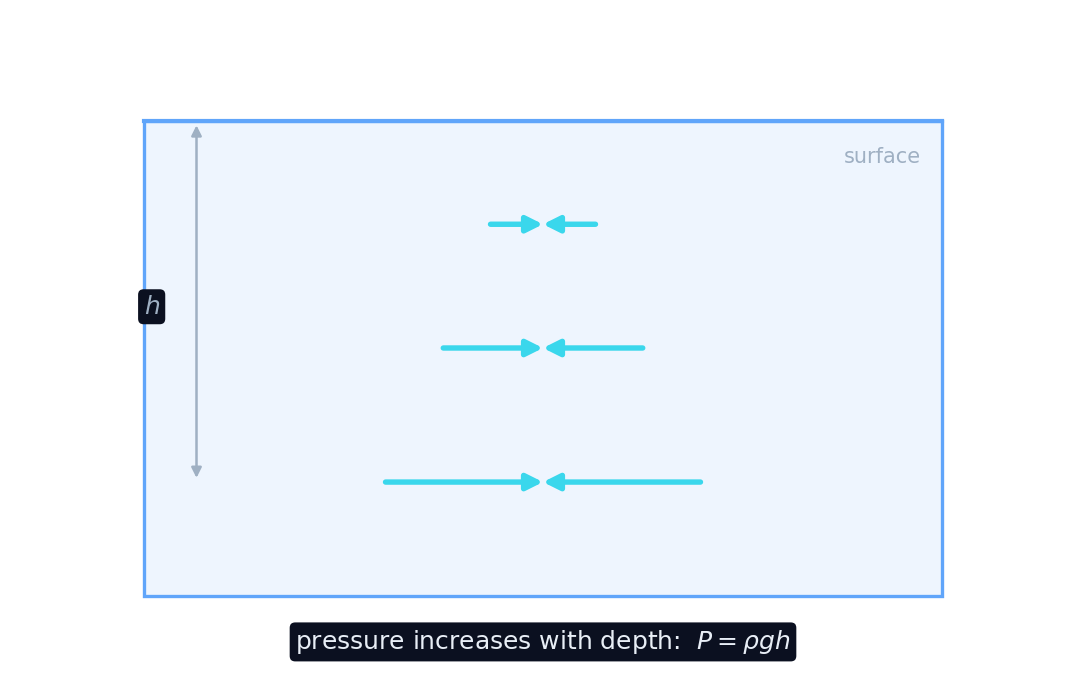
- In a static fluid of constant density, the pressure increase from the surface is $P-P_{surface}=\rho gh$. For an open surface, this is gauge pressure; absolute pressure is $P=P_{atm}+\rho gh$.
- Deeper down, more fluid weighs on you, so the pressure is greater.
- It depends on depth $h$ and density $\rho$ — not on the container's shape.
- This is why dam walls are built thick at the bottom, where pressure is highest.
Find the gauge pressure due to water at depth 2 m below an open surface, where density is 1000 kg per cubic metre and g = 10 m/s squared. Answer in Pa.
Difficulté 2/5 · 140 pièces + un petit bonus lors de la première réussite aujourd'hui
$P = \rho g h = 1000 \times 10 \times 2 = 20\,000\ \text{Pa}$.
Fluid pressure pushes every way
- At any point in a fluid, the pressure pushes equally in all directions.
- It acts on every surface it touches, always perpendicular to that surface.
- This is why a submarine is squeezed from all sides, not just the top.
- The all-directions rule is what makes hydraulics and buoyancy work.
Pression avec la profondeur
In a fluid, the pressure rises steadily with depth below the surface.
Neglecting capillary effects, a narrow tube and a wide lake have the same pressure at equal depth if fluid density, g and surface pressure match.
Difficulté 1/5 · 100 pièces + un petit bonus lors de la première réussite aujourd'hui
For a static fluid, $P=P_{surface}+\rho gh$. With the same surface pressure, density, g and depth, the pressures match regardless of container shape.
Select tout true statements about fluid pressure.
Difficulté 2/5 · 140 pièces + un petit bonus lors de la première réussite aujourd'hui
Fluid pressure grows with depth and density and pushes all ways — but does not depend on the container's shape.
Fluid pressure depends on depth, not on the amount of fluid or the container's shape. A tube and a lake with the same fluid, depth, g and surface pressure have the same bottom pressure (neglecting capillary effects). And pressure pushes in all directions, not just downward.
Find the gauge pressure due to water $2\ \text{m}$ below the surface ($\rho = 1000\ \tfrac{\text{kg}}{\text{m}^3}$, $g = 10\ \tfrac{\text{m}}{\text{s}^2}$).
- $P = \rho g h = 1000 \times 10 \times 2 = 20\,000\ \text{Pa}$.
That is the extra pressure from the water alone, on top of the air pressure above.
Pressure is force per unit area, $P = \dfrac{F}{A}$ (in pascals). A smaller area gives more pressure. In a static fluid, pressure above the surface pressure grows with depth as $P-P_{surface} = \rho g h$ — set by depth and density, not the container's shape — and pushes equally in all directions.
Write from the data: find the pressure
- A force of 90 N presses on an area of 0.30 m squared.
- Find the pressure.
A force of 90 N presses evenly on an area of 0.30 m squared. What is the pressure, in pascals?
For an evenly distributed perpendicular force, $P=F/A=(90\ \text{N})/(0.30\ \text{m}^2)=300\ \text{Pa}$. Since $1\ \text{Pa}=1\ \tfrac{\text{N}}{\text{m}^2}$, the units agree.
A force of 90 N presses evenly on an area of 0.30 m squared. What is the pressure, in pascals?
Difficulté 1/5 · 100 pièces + un petit bonus lors de la première réussite aujourd'hui
For an evenly distributed perpendicular force, $P=F/A=(90\ \text{N})/(0.30\ \text{m}^2)=300\ \text{Pa}$. Since $1\ \text{Pa}=1\ \tfrac{\text{N}}{\text{m}^2}$, the units agree.