Socially Efficient and Inefficient Outcomes
Introduit| English | Sens |
|---|---|
| marginal social benefit/ˈmɑːdʒɪnl ˈsəʊʃl ˈbenɪfɪt/ | bénéfice social marginal |
| marginal social cost/ˈmɑːdʒɪnl ˈsəʊʃl kɒst/ | coût social marginal |
| socially efficient/ˈsəʊʃəli ɪˈfɪʃənt/ | efficience sociale |
| total surplus/ˈtəʊtl ˈsɜːpləs/ | Excédent total |
| market failure/ˈmɑːkɪt ˈfeɪlɪə/ | défaillance du marché |
| deadweight loss/ˈdedweɪt lɒs/ | Perte sèche |
| market power/ˈmɑːkɪt ˈpaʊə/ | pouvoir de marché |
When does a market get it right?
- A free market usually lands on an efficient outcome — but not always.
- To judge it, we ask a society-wide question about the last unit made.
- Is that unit worth more to society than it costs society?
- Answering that tells us when a market succeeds, and when it fails.
Efficiency is MSB = MSC
- Marginal social benefit 边际社会收益 (MSB) is the value of one more unit to everyone.
- Marginal social cost 边际社会成本 (MSC) is the cost of one more unit to everyone.
- A market is socially efficient 社会有效 when $MSB = MSC$ — where total surplus 总剩余 is largest.
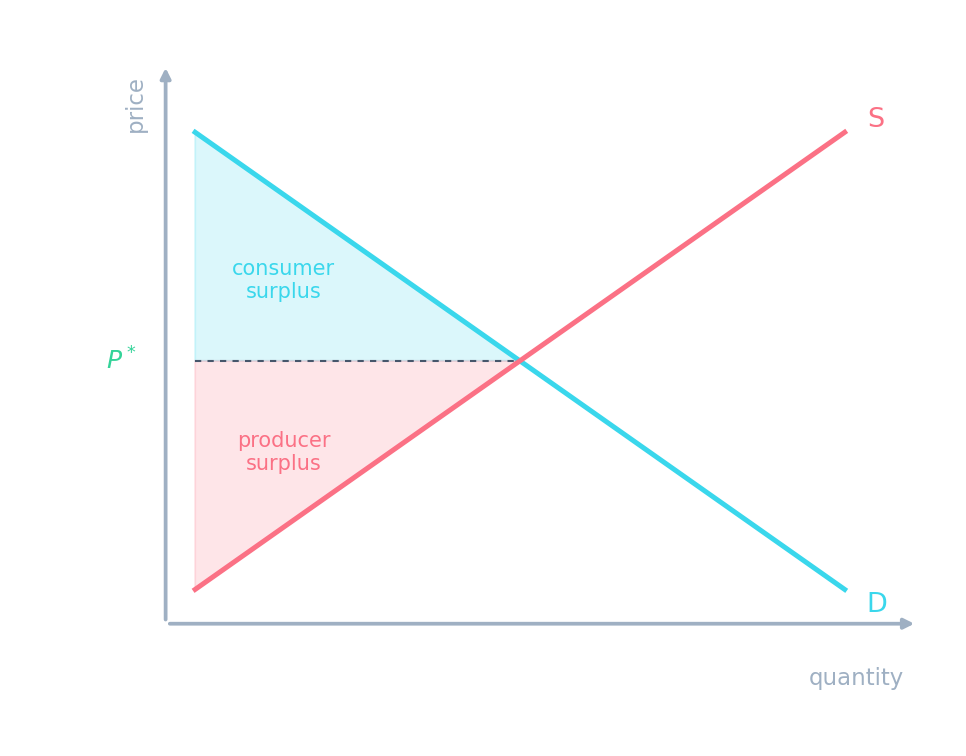
The efficient market
A market is efficient where marginal social benefit equals marginal social cost — the same point that maximises total surplus.
A market is socially efficient at the quantity where:
Difficulté 1/5 · 100 pièces + un petit bonus lors de la première réussite aujourd'hui
At MSB = MSC total surplus is maximised — the efficient quantity.
At the socially efficient quantity, total surplus is as large as possible.
Difficulté 1/5 · 100 pièces + un petit bonus lors de la première réussite aujourd'hui
Making more or less than MSB = MSC would shrink total surplus.
Market failure and deadweight loss
- Produce at any other quantity and the outcome is inefficient — a deadweight loss 无谓损失.
- A common cause is market power 市场势力: a monopoly makes too little, so valued units go unmade.
- Whenever a market can't reach the efficient quantity on its own, we call it a market failure 市场失灵.
When a market cannot reach the efficient quantity on its own, we call it a market ______.
Difficulté 1/5 · 100 pièces + un petit bonus lors de la première réussite aujourd'hui
A market failure leaves a deadweight loss and may justify government action.
A monopoly causes a market failure mainly because it:
Difficulté 1/5 · 100 pièces + un petit bonus lors de la première réussite aujourd'hui
It restricts output so valued units (worth more than MC) go unmade — a deadweight loss.
Match each term to its meaning.
Difficulté 2/5 · 140 pièces + un petit bonus lors de la première réussite aujourd'hui
Efficiency is MSB = MSC; missing it is a market failure with a deadweight loss.
A worked case
- The last cinema ticket is worth 9 to society (MSB) but costs only 5 to provide (MSC).
- Since $MSB > MSC$, society gains 4 from making it — so not selling it is inefficient.
- Efficiency comes only when output expands until the 9 falls and the 5 rises to meet.
- That meeting point is $MSB = MSC$.
The last ticket is worth 9 to society (MSB) but costs 5 (MSC). Making it:
Difficulté 1/5 · 100 pièces + un petit bonus lors de la première réussite aujourd'hui
Since 9 > 5, society gains 4 from the ticket — not making it is inefficient.
A market is socially efficient at $MSB = MSC$, where total surplus is largest. Any other quantity leaves a deadweight loss. When a market can't reach that quantity alone — often from market power — it is a market failure, and a reason for the government to act.
Write from the data: find the social gain
- The last unit is worth 14 to society and costs 6 to provide.
- Find the gain from making it.
The last unit is worth 14 to society and costs 6 to provide. What does society gain from making it, and is leaving it unmade efficient?
14 minus 6 is 8, which is a gain.
What does society gain from the unit?
Difficulté 1/5 · 100 pièces + un petit bonus lors de la première réussite aujourd'hui
14 minus 6 is 8. Other options — 4 (the lesson cinema gain); 14 (the benefit with no cost subtracted).