The Production Function · La fonction de production
| English | Français |
|---|---|
| output/ˈaʊtpʊt/ | production |
| production function/prəˈdʌkʃn ˈfʌŋkʃn/ | fonction de production |
| short run/ʃɔːt rʌn/ | court terme |
| long run/lɒŋ rʌn/ | long terme |
| inputs/ˈɪnpʊts/ | entrées |
| fixed/fɪkst/ | fixe |
| variable/ˈveərɪəbl/ | variable |
| average product/ˈævrɪdʒ ˈprɒdʌkt/ | produit moyen |
| total product/ˈtəʊtl ˈprɒdʌkt/ | produit total |
| marginal product/ˈmɑːdʒɪnl ˈprɒdʌkt/ | produit marginal |
| law of diminishing marginal returns/lɔː ɒv dɪˈmɪnɪʃɪŋ ˈmɑːdʒɪnl rɪˈtɜːnz/ | loi des rendements marginaux décroissants |
One oven, more and more bakers
- Put one baker in a kitchen with a single oven — plenty of output.
- Add a second, a third, a fourth... the kitchen gets crowded.
- Each new baker still helps, but adds less than the one before.
- This simple story is the heart of the production function 生产函数.
Un four, toujours plus de boulangers
- Placez un boulanger dans une cuisine avec un seul four — il y a beaucoup de production.
- Ajoutez un deuxième, un troisième, un quatrième... la cuisine s'encombre.
- Chaque nouveau boulanger aide encore, mais apporte moins que le précédent.
- Cette histoire simple est au cœur de la fonction de production 生产函数.
Short run vs long run
- The production function links inputs 投入 to output 产出 — the most a firm can make.
- In the short run 短期, at least one input is fixed 固定 (usually the factory); only variable 可变 inputs like workers can change.
- In the long run 长期, every input is variable — the firm can resize completely.
Court terme vs long terme
- La fonction de production lie les inputs 投入 à l'output 产出 — ce qu'une entreprise peut produire de maximum.
- Dans le court terme 短期, au moins un input est fixé 固定 (généralement l'usine) ; seuls les inputs variables 可变 comme les travailleurs peuvent changer.
- Dans le long terme 长期, tout input est variable — l'entreprise peut redimensionner entièrement.
Short run or long run? · Court terme ou long terme ?
In the short run at least one input is fixed; only variable inputs can change. In the long run every input is variable. · Au court terme, au moins un facteur est fixe ; seuls les facteurs variables peuvent changer. Au long terme, tous les facteurs sont variables.
In the short run, a firm has: · Au court terme, une entreprise a :
The short run has at least one fixed input; the long run has none. · Le court terme possède au moins un facteur fixe ; le long terme n'en possède aucun.
Select all · tout that are usually variable inputs in the short run. · Sélectionnez tous les facteurs qui sont généralement variables au court terme.
Labour, materials and utilities flex in the short run; the factory is the fixed input. · La main-d'œuvre, les matières premières et les utilities s'adaptent au court terme ; l'usine est le facteur fixe.
Total, marginal, average product
- Total product 总产量 (TP) is all the output from all the workers together.
- Marginal product 边际产量 (MP) is the extra output from one more worker: $MP = \dfrac{\Delta TP}{\Delta L}$.
- Average product 平均产量 (AP) is output per worker: $AP = \dfrac{TP}{L}$.
Produit total, marginal, moyen
- Le produit total 总产量 (TP) est toute la sortie de tous les travailleurs réunis.
- Le produit marginal 边际产量 (MP) est la sortie supplémentaire apportée par un travailleur de plus : $MP = \dfrac{\Delta TP}{\Delta L}$.
- Le produit moyen 平均产量 (AP) est la sortie par travailleur : $AP = \dfrac{TP}{L}$.
Marginal product is: · Le produit marginal est :
MP = ΔTP/ΔL — the change in total product from adding a worker. (Output per worker is average product.) · MP = ΔTP/ΔL — le changement dans le produit total dû à l'ajout d'un travailleur. (La production par travailleur est le produit moyen.)
A bakery makes 24 loaves with 2 workers and 33 loaves with 3 workers. What is the marginal product of the 3rd worker? · Une boulangerie fait 24 pains avec 2 travailleurs et 33 pains avec 3 travailleurs. Quel est le produit marginal du 3e travailleur ?
MP of the 3rd worker = 33 − 24 = 9 loaves. · PM du 3e travailleur = 33 − 24 = 9 pains.
The law of diminishing marginal returns
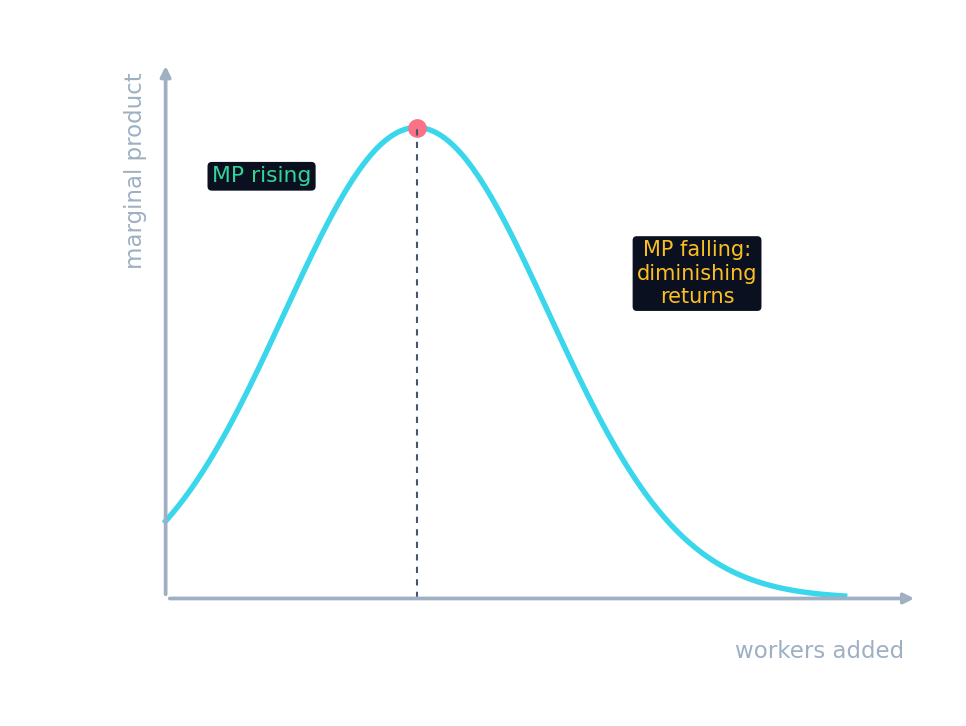
- Keep adding workers to a fixed factory and, past some point, each adds less than the last.
- This is the law of diminishing marginal returns 边际收益递减规律.
- Workers crowd the same machines, so marginal product falls.
- When MP is still positive, TP keeps rising — just more slowly. When MP hits zero, TP is at its peak.
La loi des rendements marginaux décroissants
- Continuez à ajouter des travailleurs à une usine fixe et, après un certain point, chacun ajoute moins que le dernier.
- C'est la loi des rendements marginaux décroissants 边际收益递减规律.
- Les travailleurs s'enchevêtrent sur les mêmes machines, donc le produit marginal chute.
- Tant que MP reste positif, TP continue d'augmenter — juste plus lentement. Quand MP atteint zéro, TP est à son sommet.
Diminishing marginal returns means each extra worker (added to a fixed factory) eventually adds less output than the one before. · Les rendements marginaux décroissants signifient qu'à partir d'un certain point, chaque travailleur supplémentaire (ajouté à une usine fixe) apporte moins de production que le précédent.
Past some point, crowding the fixed input makes marginal product fall. · Après un certain seuil, la surcharge du facteur fixe fait baisser le produit marginal.
Total product is at its maximum when marginal product equals ______. · Le produit total est à son maximum lorsque le produit marginal est égal à ______.
While MP is positive TP rises; at MP = 0 it peaks; when MP is negative TP falls. · Tant que PM est positif, PT augmente ; quand PM = 0, il atteint son sommet ; quand PM est négatif, PT diminue.
The production function turns inputs into output. In the short run some input is fixed; in the long run all are variable. As you add a variable input to a fixed one, marginal product eventually falls — the law of diminishing marginal returns.
La fonction de production transforme les inputs en output. Dans le court terme, un input est fixé ; dans le long terme, tous sont variables. En ajoutant un input variable à un fixe, le produit marginal finit par chuter — la loi des rendements marginaux décroissants.