Contemporary Causes of Diffusion
Introduit| English | Sens |
|---|---|
| globalisation/ˌɡləʊbəlaɪˈzeɪʃn/ | mondialisation |
| time-space compression/taɪm speɪs kəmˈpreʃn/ | compression temps-espace |
| social media/ˈsəʊʃl ˈmiːdiːə/ | médias sociaux |
From a twelve-day crossing to a billion views, 1865–2012
- President Abraham Lincoln was shot on 14 April 1865. The news crossed the Atlantic by steamship and reached London on 26 April — twelve days later. In July 2012 the South Korean singer Psy released the video "Gangnam Style"; by 21 December it was the first YouTube video watched one billion times, in almost every country.
- Ideas now spread across the world in hours. Geographers explain this through globalisation 全球化 and time-space compression 时空压缩.
News of Lincoln's shooting (14 April 1865) reached London on 26 April. How many days did it take?
Difficulté 2/5 · 140 pièces + un petit bonus lors de la première réussite aujourd'hui
By steamship.
Types of diffusion
- Relocation diffusion: people carry an idea when they move. Expansion diffusion: an idea spreads outward while staying in its hearth.
- Expansion can be contagious (person to person, like a virus), hierarchical (from powerful or connected places down), or stimulus (the idea changes as it spreads).
Historical or contemporary cause?
Sort each cause of diffusion as historical or contemporary.
Match each type of diffusion to its description.
Difficulté 2/5 · 140 pièces + un petit bonus lors de la première réussite aujourd'hui
Four types.
Time-space compression
- Time-space compression is the reduced importance of distance because of faster transport and communication. Distance decay — weaker influence with distance — becomes weaker itself.
- In 1865 a message needed a ship; today a video reaches Lagos and Lima in the same second.
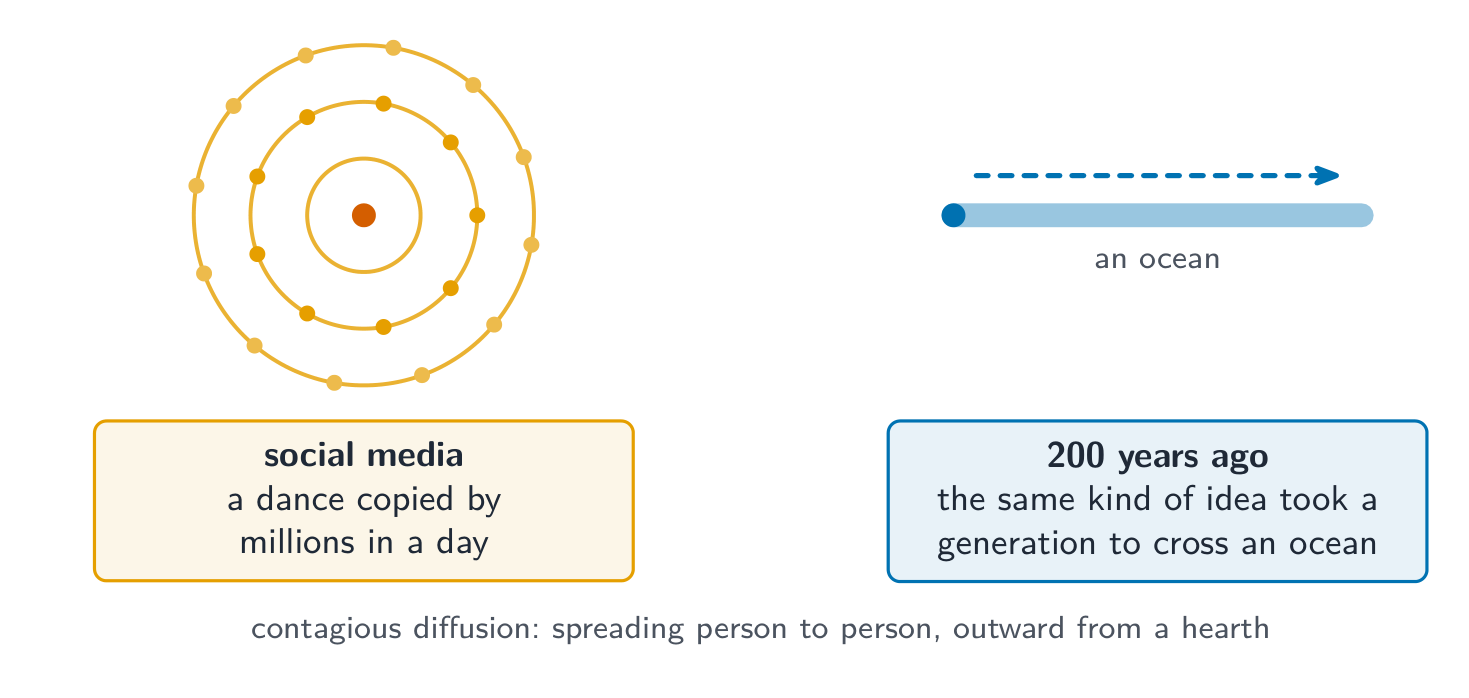
What is time-space compression?
Difficulté 1/5 · 100 pièces + un petit bonus lors de la première réussite aujourd'hui
Distance matters less.
Social media as a channel
- Social media 社交媒体 platforms let users share content with followers, who share it again; spread can be contagious (friend to friend) and hierarchical (celebrities and global cities first).
- Algorithms decide what each user sees, so platforms shape which ideas spread.
Platform algorithms influence which ideas spread on social media.
Difficulté 1/5 · 100 pièces + un petit bonus lors de la première réussite aujourd'hui
They decide what users see.
Worked example: classify the diffusion of a dance
A dance appears in one Seoul music video, is copied by K-pop fans worldwide, then a sportswear brand's celebrity ambassadors post it.
- Contagious: fans copy it from fans, regardless of status or place.
- Hierarchical: celebrities and brands with millions of followers spread it further, often to major cities first.
- Stimulus: local versions add new moves while keeping the core idea.
Celebrities posting a dance to millions of followers is an example of…
Difficulté 1/5 · 100 pièces + un petit bonus lors de la première réussite aujourd'hui
From influential nodes.
Effects of fast diffusion
- Cultural convergence: popular music, brands and fashion become more alike worldwide. Cultural divergence: some groups resist, protect local languages or create hybrid forms.
- Access is uneven: places with weak internet or censorship take part less, so time-space compression is not equal everywhere.
A community creating new local songs to protect its language shows…
Difficulté 1/5 · 100 pièces + un petit bonus lors de la première réussite aujourd'hui
Resisting a global trend.
Fast diffusion does not mean distance no longer matters at all. Connection speed, language, cost and government controls still shape who receives an idea and when.
Time-space compression affects all places equally.
Difficulté 1/5 · 100 pièces + un petit bonus lors de la première réussite aujourd'hui
Access and controls differ.
Diffusion is relocation or expansion (contagious, hierarchical, stimulus). Globalisation and time-space compression, through social media and fast communication, spread ideas in hours — producing both convergence and divergence, and unequally between places.
Explain how social media changes the diffusion of a new slang word compared with the 1960s.
Then and now.