Decolonisation
Introduit| English | Sens |
|---|---|
| decolonization/dɪˌkɒlənaɪˈzeɪʃn/ | The process by which colonies won independence from European empires, mostly between 1945 and the 1970s. |
| neocolonialism/ˈniːəʊkɒləʊnɪəlɪzəm/ | The continuation or creation of external economic or political influence over a formally independent country without direct colonial rule. |
Midnight in Delhi, 1947
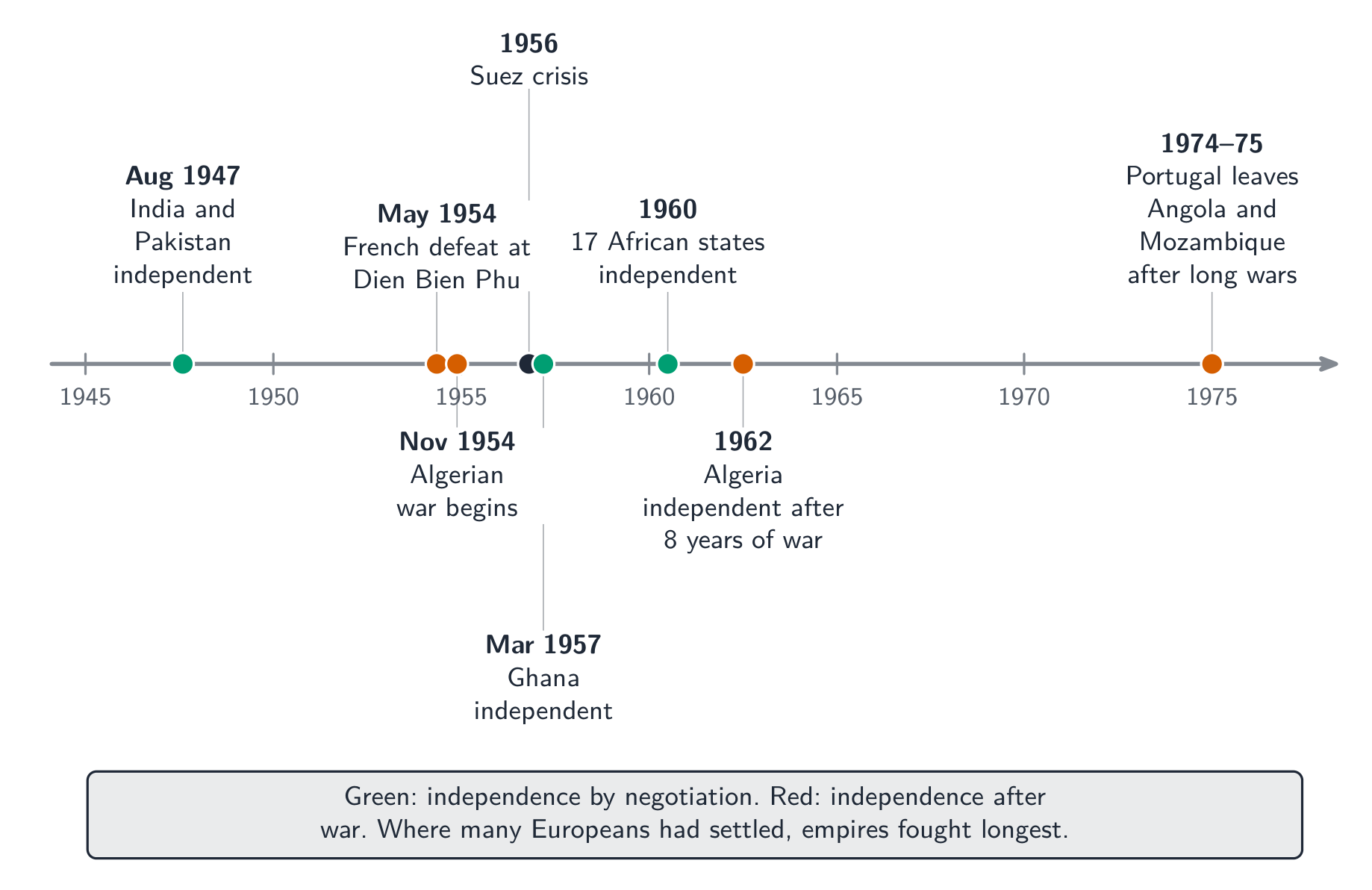
- At midnight on 14–15 August 1947, Jawaharlal Nehru told India's assembly: "At the stroke of the midnight hour, when the world sleeps, India will awake to life and freedom." British rule ended — but the partition of India and Pakistan that night led to violence in which perhaps a million people died.
- Between 1945 and the 1970s, Europe's empires came to an end, some by negotiation and some through war.
Why empires ended
- Two world wars had weakened Britain, France and the Netherlands. Colonial peoples who had fought for Europe now demanded their own freedom.
- Nationalist movements, led by figures such as Gandhi in India and Kwame Nkrumah in the Gold Coast, organized mass protest. This process is called decolonization 非殖民化.
Which helped end European empires after 1945?
Difficulté 2/5 · 140 pièces + un petit bonus lors de la première réussite aujourd'hui
Weakness and nationalism.
Negotiated independence
- Britain granted independence to India and Pakistan in 1947 and to Ghana (the Gold Coast) in 1957 after negotiation.
- In 1960 alone, 17 African countries became independent, most of them former French colonies.
European cooperation, interference, or resistance?
Sort each European posture toward independence.
How many African countries became independent in 1960?
Difficulté 2/5 · 140 pièces + un petit bonus lors de la première réussite aujourd'hui
The "Year of Africa".
Worked example: Algeria and Ghana
- Ghana: Nkrumah's party won elections, and Britain agreed a timetable. Ghana became independent in 1957 without war.
- Algeria: France saw Algeria as part of France, home to about a million European settlers. The war of independence (1954–62) killed hundreds of thousands and brought down the French Fourth Republic in 1958.
- The difference: where there were many European settlers, as in Algeria and Kenya, European governments resisted longer and more violently.
Match each colony to how it became independent.
Difficulté 2/5 · 140 pièces + un petit bonus lors de la première réussite aujourd'hui
Different paths.
Why did France fight longer to keep Algeria?
Difficulté 1/5 · 100 pièces + un petit bonus lors de la première réussite aujourd'hui
Settler colonies were resisted hardest.
Other wars
- The Netherlands fought to keep Indonesia until 1949. France was defeated at Dien Bien Phu in Vietnam in 1954.
- Portugal fought colonial wars in Angola and Mozambique until 1974.
Influence after independence
- France kept close ties with its former African colonies through money (the CFA franc), aid and troops.
- Critics call such continued influence neocolonialism 新殖民主义.
France kept influence in former African colonies after independence.
Difficulté 1/5 · 100 pièces + un petit bonus lors de la première réussite aujourd'hui
Through the CFA franc, aid and troops.
Decolonization was not simply a gift from Europe. Colonial peoples organized movements, protests and wars to win independence. Treat them as the main actors.
Decolonization was simply a decision made by European governments.
Difficulté 1/5 · 100 pièces + un petit bonus lors de la première réussite aujourd'hui
Colonial peoples were the main actors.
After 1945, weakened European empires faced nationalist movements across Asia and Africa. Some colonies, such as India and Ghana, won independence by negotiation; others, such as Algeria and Indonesia, fought long wars. European influence often continued after independence.
Compare the decolonization of Ghana and Algeria.
Comparison.